
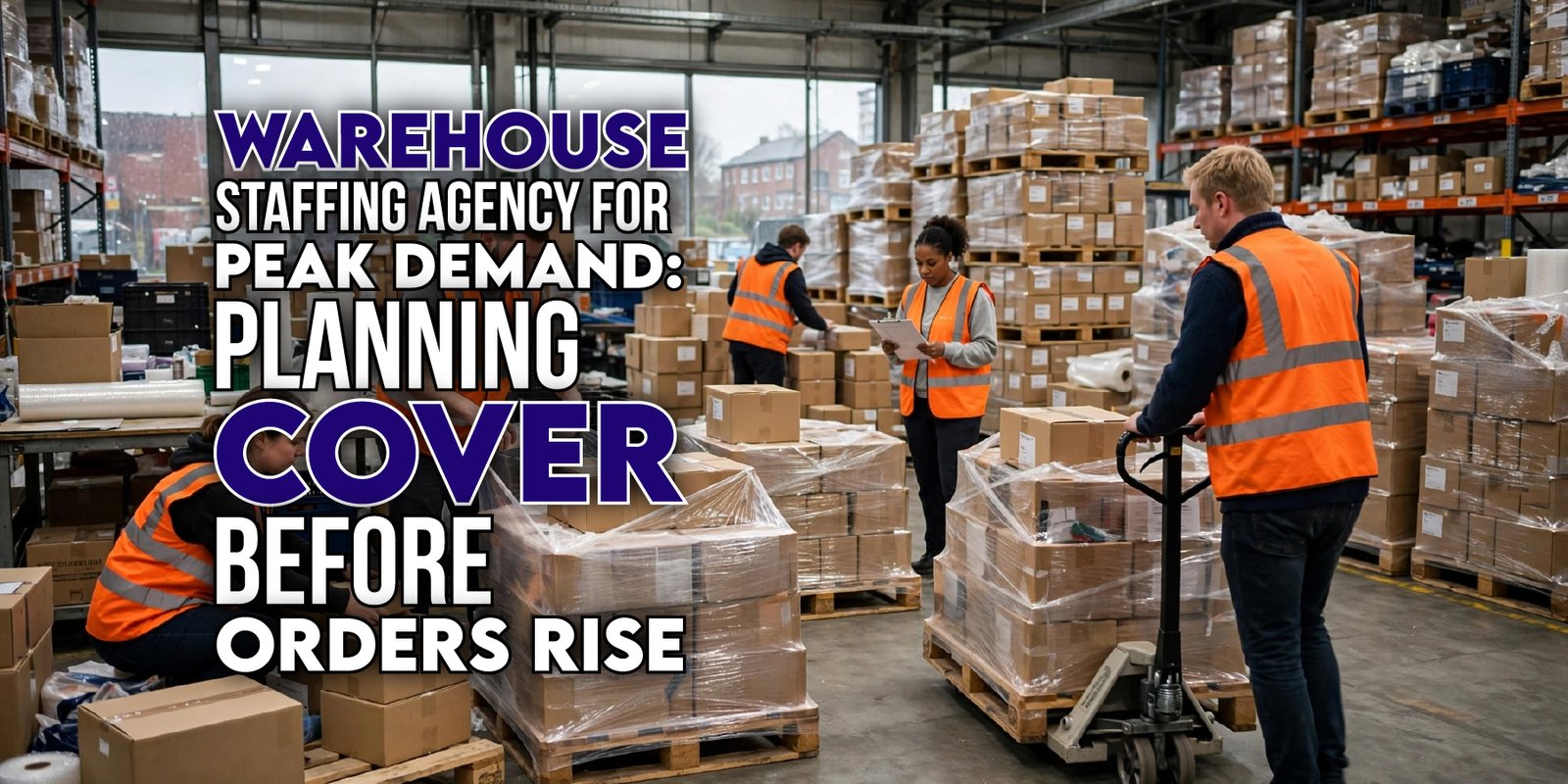
Warehouse Staffing Agency for Peak Demand: Planning Cover Before Orders Rise
Warehouse demand can change quickly. Seasonal trading, promotions, e-commerce activity, increased customer orders, stock movements and new contracts can all create additional pressure on warehouse operations.
For that reason, businesses should review staffing requirements before order volumes rise rather than waiting until shifts become difficult to cover. A warehouse staffing agency can form part of that planning process by helping businesses address temporary, seasonal or changing personnel requirements.
However, staffing decisions should start with the operation itself. Managers need to understand expected demand, existing capacity, shift patterns and role requirements before deciding what additional support they need.
What Does a Warehouse Staffing Agency Do?
A warehouse staffing agency can support businesses with recruitment and staffing requirements by helping source suitable personnel for temporary, seasonal or changing operational needs. Depending on the provider, support may include candidate sourcing, warehouse recruitment, shift coverage and staffing for periods of increased demand.
The exact service offered can vary between providers.
For a warehouse manager, the first step is therefore to define the operational requirement clearly. This may involve identifying the number of roles, shift times, expected duration, duties and any relevant experience or equipment requirements.
A business might need additional warehouse staff because of:
- Seasonal demand
- Increased order volumes
- Staff absence
- New contracts
- Temporary projects
- Additional shifts
- Promotional campaigns
- Stock movements
- Business expansion
A warehouse staffing agency can then work from that defined requirement rather than a vague request for “more staff”.
When Should a Warehouse Start Planning for Peak Demand?
A warehouse should start planning when it has enough information to identify a potential staffing gap, rather than waiting until peak demand has already arrived. Historical order patterns, expected promotions, seasonal activity, current headcount, absence and shift requirements can all help determine when planning should begin.
There is no universal lead time that suits every operation.
For example, an established distribution centre with predictable seasonal demand may have more information available than a business experiencing a sudden increase in orders.
Therefore, managers should review:
- Previous peak-period demand
- Expected order volumes
- Planned promotions
- Current staffing levels
- Existing vacancies
- Expected employee absence
- Shift patterns
- Overtime capacity
- Picking and packing requirements
- Dispatch deadlines
The earlier a potential staffing gap becomes visible, the more time the business has to define the requirement and consider its available staffing options.
Peak Warehouse Staffing: What Should Businesses Assess?
Peak warehouse staffing starts with understanding the gap between expected operational demand and available capacity. Businesses should assess order volumes, current staffing, absence, shift patterns, picking, packing, goods-in, dispatch, equipment requirements and the expected duration of the peak.
A practical assessment should include:
- Expected order volume
Review the anticipated increase rather than relying solely on previous years. - Existing staffing levels
Establish how many personnel are already available for each shift. - Current vacancies
Include roles that remain unfilled before the peak begins. - Absence
Consider planned holidays and any operational absence patterns that the business can reasonably anticipate. - Shift patterns
Review day, night, weekend and extended shifts. - Picking requirements
Consider how increased orders could affect picking activity. - Packing requirements
Assess whether packing capacity can handle the expected workload. - Goods-in activity
Increased stock movement may create additional receiving requirements. - Dispatch requirements
Review deadlines and loading activity. - Equipment requirements
Consider forklift or other equipment-related roles where applicable. - Peak duration
A short demand spike may require a different staffing approach from a longer seasonal period.
This assessment gives managers a more realistic basis for deciding whether they need temporary, seasonal or longer-term recruitment support.
Seasonal Warehouse Staff: Preparing Before Demand Rises
Seasonal warehouse staff can help businesses address periods when operational requirements temporarily increase. Christmas trading, promotional campaigns, retail activity, e-commerce growth and inventory movements can all create seasonal staffing requirements, although the effect varies between businesses.
Instead of assuming that every peak requires the same number of additional personnel, assess the actual operation.
Ask:
- When does demand normally increase?
- What order volumes are expected?
- Which shifts experience the greatest pressure?
- Which roles become bottlenecks?
- How long is the additional demand expected to continue?
- Which existing employees will remain available?
- What temporary roles will the operation require?
For example, an operation may experience increased picking activity without the same increase in goods-in requirements. Another business may experience pressure across picking, packing and dispatch at the same time.
Therefore, seasonal recruitment should reflect the specific operational pattern.
A warehouse staffing agency can work more effectively when the business provides clear information about the expected peak, roles and shift requirements.
Temporary Warehouse Cover for Absence and Demand Spikes
Temporary warehouse cover can help businesses address short-term staffing gaps caused by absence, seasonal demand, temporary projects, new contracts or unexpected changes in operational requirements.
Temporary staffing may be relevant when:
- Employees take planned holidays
- Short-term absence affects a shift
- Orders increase unexpectedly
- A new project creates additional work
- A temporary contract increases workload
- The business introduces additional shifts
- Seasonal demand lasts for a defined period
However, temporary staffing should complement workforce planning rather than replace it.
Managers should first understand the gap they need to address. Then they can define the role, shift, location, expected duration and responsibilities.
This gives a warehouse staffing agency clearer information when discussing potential recruitment requirements.
Warehouse Shift Support: Planning the Right Coverage
Warehouse shift support depends on more than the number of people required. Shift times, duties, handovers, operating hours and dispatch deadlines can all affect the staffing requirement.
Businesses should clearly define:
- Day-shift times
- Night-shift times
- Weekend requirements
- Early starts
- Late finishes
- Overtime arrangements
- Handover requirements
- Expected contract duration
- Role responsibilities
- Site location
For example, a warehouse that operates extended hours may need different coverage across several shifts rather than simply adding personnel to the busiest period.
Similarly, a late dispatch deadline could create a specific requirement for packing or loading staff.
Clear shift information helps a warehouse staffing agency understand the actual requirement rather than simply the requested headcount.
Common Peak-Season Warehouse Staffing Mistakes
Peak periods can create pressure quickly. However, many staffing problems begin with planning decisions made before the peak.
1. Waiting Until Demand Has Already Increased
Waiting until orders have already risen can leave less time to define requirements and consider recruitment options.
2. Underestimating Order Volume
Forecasts can change. Therefore, managers should review expected volumes and operational capacity rather than relying entirely on assumptions.
3. Ignoring Employee Absence
Planned holidays and expected absence can reduce available capacity during an already busy period.
4. Relying Entirely on Overtime
Overtime can form part of an operational strategy, but businesses should consider availability and the sustainability of extended working arrangements.
5. Failing to Define Shift Requirements
A request for warehouse staff without clear shift information can make it harder to understand the actual requirement.
6. Not Allowing Enough Time for Recruitment
Recruitment involves identifying the role, sourcing candidates and establishing suitability. Therefore, businesses should consider these activities before the peak starts.
7. Providing Unclear Role Information
Candidates need accurate information about duties, location, shifts and expectations.
8. Ignoring Candidate Suitability
Availability alone does not establish suitability. Role-specific experience, skills and other requirements can also matter.
9. Changing Requirements at the Last Minute
Frequent changes to shifts, duties or staffing requirements can make planning more difficult.
10. Failing to Review Staffing During the Peak
Demand can change after the peak begins. Managers should continue reviewing operational requirements instead of treating the original plan as fixed.
How to Calculate Your Additional Warehouse Staffing Requirement
There is no universal staffing formula that accurately applies to every warehouse. Instead, managers should use their own operational data to understand the relationship between workload and available capacity.
Consider:
- Current headcount
- Expected order volume
- Historical productivity
- Operating hours
- Shift duration
- Number of shifts
- Absence
- Overtime capacity
- Picking requirements
- Packing requirements
- Dispatch deadlines
- Peak duration
For example, an operation may have enough personnel overall but still experience a staffing gap on particular shifts.
Similarly, additional people may not solve a bottleneck if the constraint sits elsewhere in the process.
Therefore, review the complete workflow before defining the staffing requirement.
The objective is to identify where additional capacity is actually needed.
What Information Should You Give a Warehouse Staffing Agency?
When approaching a warehouse staffing agency, provide enough information for the recruitment requirement to be understood accurately.
A useful brief should include:
- Warehouse location
- Job roles
- Number of personnel required
- Expected start date
- Shift times
- Contract duration
- Expected peak period
- Main duties
- Experience requirements
- Equipment requirements
- Site rules
- Pay information where appropriate
- Attendance expectations
- Required qualifications
- Any specific operational requirements
For instance, “we need warehouse staff” gives limited information.
By comparison, a brief that explains the role, shift, location, expected duration, duties and relevant requirements gives a much clearer starting point.
Businesses should also explain whether the requirement relates to picking, packing, goods-in, dispatch, forklift duties or another warehouse function.
What Employers Look For When Hiring Warehouse Staff
Warehouse employers may consider several factors when assessing candidates. The precise requirements depend on the role, but relevant considerations can include reliability, punctuality, communication, teamwork, shift availability and role-specific experience.
For equipment-related positions, relevant training or experience may also matter.
Businesses should define which characteristics are genuinely necessary for the role rather than creating unnecessarily broad requirements.
It can also help to distinguish between essential and desirable criteria.
For example:
Essential
- Availability for the required shift
- Ability to perform the role’s duties
- Relevant qualification where required
- Ability to follow site procedures
Desirable
- Previous experience in a similar environment
- Familiarity with a particular warehouse process
- Experience with relevant systems or equipment
Businesses can also review what employers look for when considering broader hiring requirements.
What Warehouse Candidates Should Know Before Accepting Peak-Season Work
Peak-season recruitment works more effectively when candidates understand the role before accepting it.
Businesses should communicate:
- Shift times
- Warehouse location
- Main duties
- Contract duration
- Working hours
- Attendance expectations
- Workplace requirements
- Required experience
- Role responsibilities
Clear communication matters because candidate expectations should match the actual position.
For example, a warehouse role involving early starts should clearly communicate the required shift pattern. Similarly, a temporary role should make its expected duration clear.
Businesses can also use what warehouse candidates should know as a useful reference when preparing information for prospective personnel.
Planning Your Peak Warehouse Staffing Requirements
A structured staffing brief can make it easier to discuss a requirement with a recruitment provider.
Start by defining:
- Expected order increase
- Current staffing capacity
- Identified staffing gap
- Required roles
- Shift patterns
- Proposed start date
- Expected duration
- Site requirements
- Relevant experience
- Equipment requirements
Next, review whether the requirement is temporary, seasonal or potentially ongoing.
The right approach depends on the operation and the reason behind the staffing gap. A short promotional period may require temporary cover, while a sustained increase in activity may require a different recruitment strategy.
If your business has identified a potential staffing gap, you can discuss your warehouse staffing requirements with 1st Workforce.
How to Choose the Right Warehouse Staffing Agency
Choosing a warehouse staffing agency involves assessing how well the provider understands the business requirement.
Consider:
Sector understanding
The provider should understand the terminology and operating environment relevant to warehouse and logistics recruitment.
Recruitment process
Ask how roles are sourced and how candidate suitability is considered.
Role matching
The provider should understand the difference between requirements for picking, packing, dispatch, goods-in and equipment-related roles.
Communication
Clear communication matters when shifts, requirements or expected durations change.
Flexibility
Warehouse demand can change, so businesses should explain how their requirements may fluctuate.
Candidate suitability
Availability matters, but businesses should also define the experience, skills and other requirements relevant to the role.
There is no single criterion that determines whether a warehouse staffing agency is suitable for a particular business. Instead, compare the provider’s understanding of your requirements with the support you actually need.
Why Early Warehouse Staffing Planning Matters
The relationship between demand and staffing can be viewed as a straightforward planning sequence:
Forecast → staffing gap → role requirements → recruitment planning → candidate sourcing → shift planning → peak readiness
This sequence helps managers identify what needs attention before order volumes rise.
Late planning can create additional operational pressure. Depending on the circumstances, businesses may face:
- Rushed recruitment
- Limited staffing options
- Greater management pressure
- Increased reliance on overtime
- Shift coverage challenges
- Operational disruption
Early planning does not guarantee that these issues will disappear. However, it gives businesses more opportunity to understand the requirement and assess available options.
Peak Demand Staffing Checklist for Warehouse Managers
Use this checklist when preparing for a busy period:
☐ Review historical demand
☐ Forecast expected order volumes
☐ Review current staffing levels
☐ Identify expected absence
☐ Identify overtime capacity
☐ Identify staffing gaps
☐ Define required roles
☐ Define shift patterns
☐ Confirm start dates
☐ Confirm expected duration
☐ Define site requirements
☐ Prepare accurate job information
☐ Review candidate requirements
☐ Plan temporary staffing
☐ Review staffing levels during the peak
Staffing Approaches Compared
| Staffing Approach | Useful For | Main Consideration |
|---|---|---|
| Existing permanent team | Normal operating demand | Capacity may be limited during peaks |
| Overtime | Short-term increases | Availability and fatigue need consideration |
| Temporary staff | Short-term or seasonal demand | Requires clear role and shift planning |
| Seasonal warehouse staff | Predictable seasonal peaks | Planning needs to begin before demand rises |
| Permanent recruitment | Ongoing staffing gaps | Recruitment requires planning and time |
No option works in exactly the same way for every warehouse.
For example, overtime may address a short-term gap within an existing team, while temporary personnel may provide additional capacity for a defined period. Permanent recruitment may become relevant where increased demand continues beyond the original peak.
The appropriate approach depends on the business, workload, staffing structure and expected duration of the requirement.
What does a warehouse staffing agency do?
A warehouse staffing agency can help businesses address recruitment and staffing requirements by sourcing personnel for temporary, seasonal or changing operational needs. Depending on the provider, services may include candidate sourcing, warehouse recruitment and staffing support. Businesses should explain their roles, shifts, location, duration and requirements clearly so the staffing need can be understood accurately.
When should a warehouse start planning for peak staffing?
A warehouse should begin planning when it can identify a potential staffing gap based on expected demand and operational capacity. Businesses can review historical order patterns, upcoming promotions, seasonal activity, current headcount and expected absence. There is no universal planning date because recruitment requirements and operating conditions differ between businesses.
What are peak warehouse staffing requirements?
Peak warehouse staffing requirements are the additional personnel a business may need when operational demand increases. The requirement can involve picking, packing, goods-in, dispatch, forklift duties or other warehouse roles. Managers should assess expected order volumes, existing capacity, shift patterns, absence and the expected duration of the busy period before defining the staffing gap.
How does temporary warehouse cover work?
Temporary warehouse cover addresses a staffing requirement for a defined or potentially short-term period. It can relate to employee absence, seasonal demand, temporary projects, new contracts or unexpected increases in workload. Businesses should define the role, shift, location, duties, expected duration and any relevant requirements before discussing temporary staffing options with a recruitment provider.
When should businesses use seasonal warehouse staff?
Businesses may consider seasonal warehouse staff when they expect demand to increase for a particular period. This can include Christmas trading, promotional activity, retail peaks or increased e-commerce orders. The decision should depend on the business’s actual forecast and staffing capacity rather than an assumption that every seasonal period creates the same requirement.
What information should I give a warehouse staffing agency?
Provide the warehouse location, roles, required personnel, start date, shift times, contract duration, expected peak period, duties, experience requirements and relevant site or equipment requirements. Clear information helps define the recruitment requirement. Businesses should also explain attendance expectations, qualifications and any role-specific conditions that candidates need to understand.
How can businesses plan warehouse shift support?
Businesses can plan warehouse shift support by reviewing operating hours, order volumes, staffing capacity, absence, dispatch deadlines and the duties required on each shift. Define the start and finish times, role requirements, location and expected duration. This gives managers a clearer view of where additional capacity may be required.
What should employers look for when hiring warehouse staff?
Employers should identify the skills and characteristics genuinely required for each role. Depending on the position, these may include reliability, punctuality, communication, teamwork, shift availability, relevant experience and role-specific qualifications. Equipment-related roles may also require appropriate training or experience. Requirements should reflect the actual duties rather than generic assumptions about warehouse work.
Discuss Your Warehouse Staffing Requirements
Peak demand planning starts with a clear understanding of the operational requirement.
Before approaching a warehouse staffing agency, review your:
- Expected order volumes
- Existing staffing levels
- Staffing gaps
- Warehouse roles
- Shift requirements
- Expected start date
- Contract duration
- Site requirements
- Candidate requirements
A clear brief gives your business a more structured basis for discussing temporary, seasonal or other staffing requirements.
If your operation is preparing for increased demand, you can discuss your warehouse staffing requirements with 1st Workforce and explain the type of support your operation is considering.
The right staffing approach depends on your demand, existing capacity, roles and operating model. Therefore, planning should begin with the warehouse’s actual requirements rather than a predetermined staffing solution.
Leave a Reply