Food Packer Jobs: Duties, Skills and What Employers Look For
A food factory worker candidate sees three vacancies: Food Packer, Production Operative and Pick and Pack Operative. The titles overlap, but duties and expectations can differ.
Before applying for a food-packing role, understand the actual packing tasks, hygiene expectations, shift pattern, physical demands and experience requested. That preparation helps you decide whether the job matches your background.
What Does a Food Packer Do?
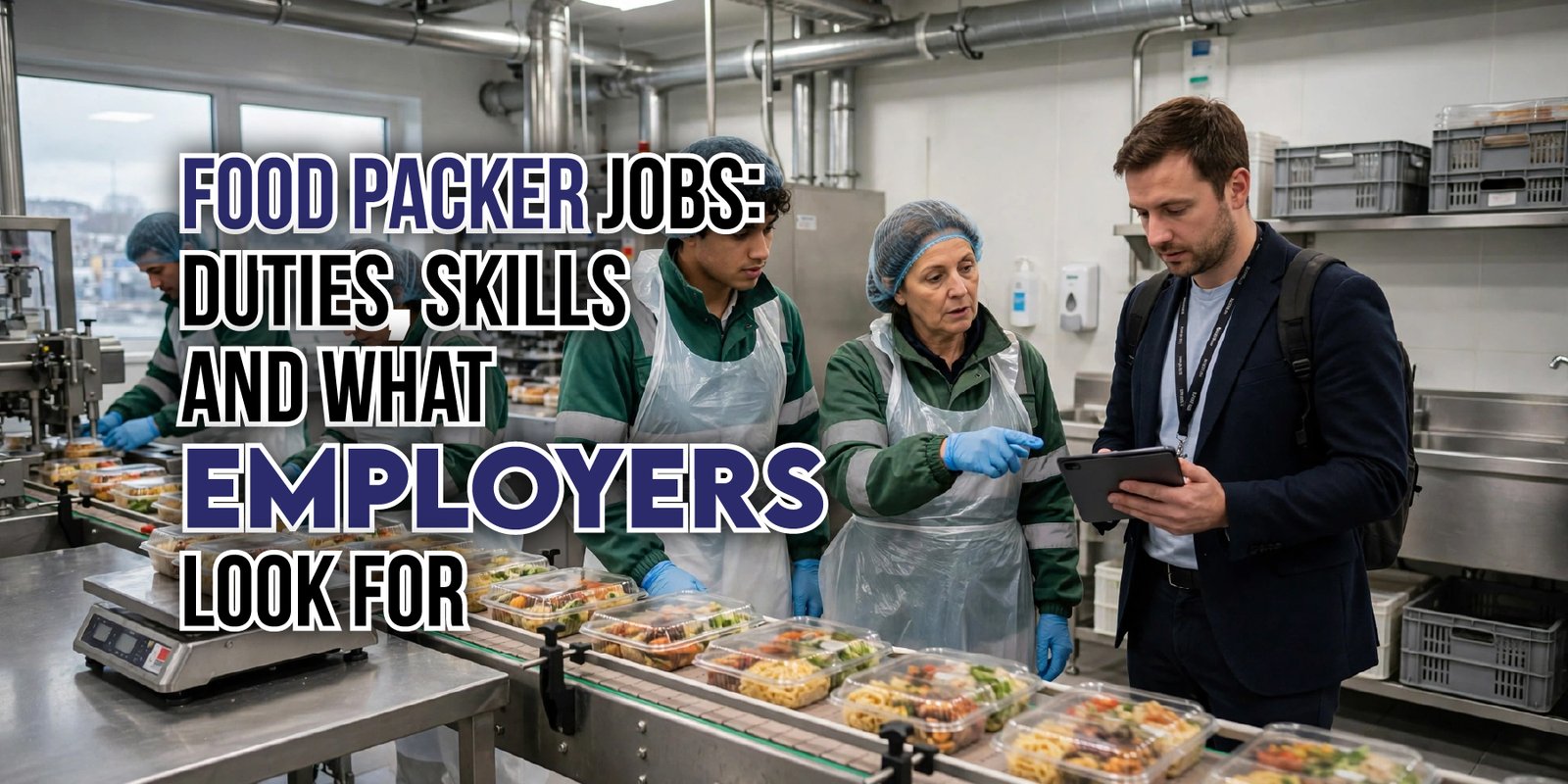
A packing operative may pack finished food products, prepare packaging, check presentation, apply or check labels, complete basic quality checks, organise packed items and follow site hygiene procedures. Exact responsibilities depend on the employer, product, production line and training provided. 1st Workforce’s current direct role page similarly describes packing, labelling, quality checking and hygiene-aware food-production work.
Typical Duties in a Food Packing Role
A food packer job description usually explains the products being handled, packing process, shift pattern and any experience or hygiene requirements. Candidates should read the whole advert because employers may use the same job title for different production environments.
Possible responsibilities can include:
- Packing finished food products
- Preparing trays, boxes or other packaging
- Checking visible product presentation
- Applying or checking labels
- Sorting products
- Packing finished items into outer containers
- Preparing packs for the next production stage
- Completing simple quality checks within training
- Keeping the work area organised
- Following site hygiene procedures
- Reporting damaged, incorrect or unsuitable packs
The exact food-packing duties depend on the food product, workplace and employer instructions. 1st Workforce currently describes its Food Packer role around packing finished goods accurately while maintaining cleanliness.
What Does a Typical Packing Shift Look Like?
A food-packing shift usually follows a structured production routine, although the sequence varies between sites. Therefore, candidates should treat the following as a planning illustration, not a universal factory procedure.
ILLUSTRATIVE ONLY
- Attend the shift briefing.
- Prepare according to site hygiene procedures.
- Go to the assigned packing or production area.
- Confirm the product and packing requirements.
- Pack products according to instructions.
- Check labels or presentation where required.
- Separate or report products that do not meet instructions.
- Keep the work area organised.
- Complete required shift records where applicable.
- Hand over relevant information at shift end.
Actual procedures vary. Most importantly, candidates should follow the employer’s induction, product-specific instructions and supervisor guidance.
Packing Skills Employers May Look For
Useful food packer skills can include attention to detail, reliability, timekeeping, teamwork, basic numeracy, hygiene awareness and the ability to follow instructions consistently. However, employers may prioritise different abilities depending on the product and production environment.
| Skill | Why It May Matter |
|---|---|
| Attention to detail | Supports label and pack checking |
| Reliability | Helps maintain organised shift coverage |
| Timekeeping | Matters for production starts and handovers |
| Teamwork | Packing often connects with other production stages |
| Following instructions | Supports consistent site procedures |
| Basic numeracy | May help with quantities and simple records |
| Communication | Helps issues reach the correct supervisor |
| Hygiene awareness | Relevant in food-production environments |
| Consistency | Supports expected work standards |
Do You Need Experience to Become a Food Packer?
Not always. Requirements for a food packer vary by employer, and some roles may accept candidates with transferable operational experience while others may request previous food-production or packing experience.
Entry-level food factory worker candidates may bring experience from cleaning, catering, warehouse packing or similar process-driven roles. Meanwhile, experienced candidates may already understand production lines, labelling or quality checking.
Always check whether experience is listed as essential or desirable.
Transferable Experience That Can Help
Previous packing work can help even when it came from another environment. Warehouse packing, manufacturing, production-line work, catering, kitchen work and cleaning may demonstrate useful habits such as reliability, following procedures and attention to detail.
Ultimately, the employer decides whether previous experience matches the vacancy.
Food Packing vs Production Operative
A food packer usually concentrates more directly on packing finished food products, while a production operative may work across broader production activities. However, employers use these titles differently, so candidates should compare actual responsibilities.
| Area | Food Packer | Production Operative |
|---|---|---|
| Main focus | Packing finished food products | Broader production activity |
| Packing | Usually central | May be included |
| Production line | Common | Common |
| Machinery involvement | Limited to authorised role duties | Can vary more widely |
| Quality checks | May be included | May be included |
| Materials | Packaging and finished products | Ingredients, components or products |
| Environment | Food production/packing | Wider production environments |
| Training | Site and task-specific | Site, process or equipment-specific |
1st Workforce currently lists both Food Packer and Food Production Operative as separate roles, which supports checking the individual vacancy rather than assuming the titles mean the same thing.
Food Packing vs Pick and Pack Operative
A food packer is often connected to a food-production or food-packaging process. In comparison, a pick-and-pack operative commonly selects products or orders and prepares them for dispatch within warehouse or fulfilment operations.
Candidates interested in that route can review 1st Workforce’s pick and pack roles.
| Factor | Food Packer | Pick and Pack Operative |
|---|---|---|
| Main environment | Food production or packing | Warehouse or fulfilment |
| Main task | Packing food products | Selecting and packing orders |
| Hygiene requirements | Often more prominent | Depends on site |
| Picking orders | Usually not central | Often central |
| Labelling | May be involved | Often involved |
| Dispatch preparation | May occur later | Common |
1st Workforce’s live jobs page separately describes Order Pick Pack Operator work as picking and packing orders for shipment.
Because titles overlap, compare actual duties before choosing between food production and warehouse pick and pack support.
Food Packing vs Warehouse Packing
A warehouse packer usually prepares stock or orders for dispatch, while a food packer generally works with food products within a production or packing process.
Warehouse roles may involve more picking, stock handling or dispatch preparation. Therefore, candidates moving between environments should identify which skills genuinely transfer.
What Is Packing Work?
Packing work is a broad category covering food packing, warehouse packing, manufacturing packing, order preparation, sorting, labelling and preparing goods for dispatch or another production stage.
For this reason, candidates searching for packing roles should look beyond the job title. Product type, workplace, shift and responsibilities determine what the job is actually like.
What Is It Like Working in a Food Factory?
A food factory worker may work on production lines, packing stations or other process-led areas where hygiene, teamwork and consistency matter. Depending on the site, work can involve standing, repetitive tasks, different temperature conditions, protective clothing and shift patterns.
1st Workforce’s current Food Packer page specifically references food factories, production lines, chilled sites and packing environments.
Hygiene Expectations in Food Packing
A food packer must follow the hygiene procedures set by the employer and site. Depending on the workplace, requirements may involve clean workwear, hand-hygiene procedures, hair covering, gloves, jewellery rules, product separation or allergen controls.
These are not universal rules for every employer. Candidates should follow site-specific induction, food-safety instructions and PPE requirements.
Why Labelling Matters in Food Packing
Labelling can form part of a food packer job description because finished packs need to match the production instructions. A worker may check that the correct visible label appears and report discrepancies.
1st Workforce’s current Food Packer role specifically includes checking labels and presentation among example duties.
Quality Checks Food Packers May Carry Out
A packing operative may complete simple checks within the responsibilities and training provided. For example, checks could cover packaging condition, visible presentation, quantity where applicable, label presence and expected pack format.
However, candidates should follow workplace instructions and escalate issues rather than making technical quality decisions outside their role.
Production Targets and Packing Speed
Many production environments require consistent output, so packing roles may involve working at an organised pace. However, speed should not replace hygiene requirements, quality procedures or employer instructions.
1st Workforce’s direct role page currently references production targets and packing speeds while also emphasising hygiene and quality.
Is Food Packing Physical Work?
Yes, some food packer jobs can involve physical activity. Depending on the vacancy, this may include standing, repetitive movements, handling products, moving packaging materials or working at a production line.
Candidates should therefore check the stated physical requirements before applying.
What Shift Patterns Can Food Packers Work?
A packing operative may work day, evening, night, rotating, weekend or seasonal shifts depending on the employer. These are possible examples rather than standard conditions.
Check the current advert for the exact shift and working hours.
What Should Candidates Check About Shift Work?
Before accepting packing work, confirm:
- Start and finish times
- Rotation
- Weekend requirements
- Travel time
- Public-transport availability
- Overtime where stated
- Break arrangements
- Availability expectations
Transport deserves particular attention when shifts begin early or finish late.
Temporary Food Packing Jobs
Temporary food-packing roles can give candidates experience within production environments or defined assignments. For example, temporary work may arise where employers need flexibility around changing workload.
However, temporary assignments do not guarantee continuous work, a particular duration or later permanent employment.
Permanent Food Packing Jobs
Permanent food-packing roles may suit candidates looking for ongoing employment with one employer. Over time, workers may develop deeper knowledge of a site or production process.
Any progression depends on the employer, available opportunities, training and individual suitability.
Temporary vs Permanent Food Packing Work
| Factor | Temporary | Permanent |
|---|---|---|
| Assignment length | Defined or variable | Ongoing |
| Flexibility | May suit short-term work | Greater continuity |
| Recruitment process | Assignment-specific | Employer-specific |
| Experience | Can build exposure | Can build deeper site experience |
| Longer-term opportunity | Possible, not guaranteed | Depends on employer |
Neither option is automatically better for every food packer candidate. Compare the actual opportunity.
Food Packing Jobs During Seasonal Production Peaks
Food producers may need different staffing levels during seasonal orders, promotional periods or larger production runs. Therefore, temporary opportunities can arise when workload changes, although that does not mean a particular vacancy is currently available.
1st Workforce currently presents temporary staffing as support for seasonal cover, busy periods and changing operational demand.
What Should You Check Before Applying for a Food Packer Job?
Before applying for a food packer job, check the duties, product environment, location, shift, hours, contract type, pay stated in the advert, experience, hygiene expectations, physical demands, training, workwear or PPE, start date and travel arrangements.
| Job Advert Check | What to Confirm |
|---|---|
| Duties | What you will actually do |
| Product/environment | Production setting |
| Location | Whether travel is practical |
| Shift | Exact working hours |
| Contract | Temporary or permanent |
| Pay | Only the rate stated in that advert |
| Experience | Essential versus desirable |
| Hygiene | Site-specific expectations |
| Physical work | Standing or handling where stated |
| Training | Induction or task-specific instruction |
| Workwear/PPE | Site requirements |
| Start date | Vacancy-specific requirement |
| Documents | Application requirements |
How to Read a Food Packer Job Advert
Use this sequence:
JOB TITLE → DUTIES → PRODUCT → LOCATION → SHIFT → PAY → CONTRACT → EXPERIENCE → REQUIREMENTS → APPLICATION
Start with what you will actually do. Then check whether the shift, location, experience requirements and contract match your circumstances.
What Should You Put on a Food Packer CV?
A food packer CV should highlight genuine experience relevant to the vacancy. This might include food production, packing, labelling, quality checking, warehouse packing, pick and pack, manufacturing, shift work, hygiene procedures and teamwork.
Keep every claim accurate.
Food Packing CV Skills Examples
Candidates may use the following phrases only when they accurately describe their experience:
- Food packing and labelling experience
- Production-line experience
- Quality-checking experience
- Following hygiene procedures
- Working to production instructions
- Warehouse packing experience
- Reliable shift attendance
- Team-based production experience
These can demonstrate food packer skills, but never claim experience or training you do not have.
Interview Questions a Food Packer May Be Asked
Possible questions include:
- Have you worked in food production before?
- Have you worked on a packing line?
- Are you comfortable with repetitive work?
- Can you work the stated shift?
- How do you maintain accuracy during repetitive tasks?
- Have you worked to quality standards?
- Can you follow hygiene procedures?
Not every employer will ask the same questions.
Questions Candidates Should Ask Before Accepting
Before accepting a food packer role, consider asking:
- What are the main duties?
- What product environment will I work in?
- What shift applies?
- Is training provided?
- What workwear is required?
- Is the role temporary or permanent?
- Where is the site?
- What physical requirements apply?
- When does the role start?
- Who supervises the role?
Career Progression From Food Packing
Depending on the employer and experience, a food packer may later explore production operative, machine operative, line operative, experienced packer, team leader, line leader or suitable quality-related operational work.
These are possible career routes rather than guaranteed progression.
How 1st Workforce Supports Food-Production Candidates
At 1st Workforce, food-packing recruitment sits alongside wider food-production, packing, manufacturing and operational opportunities. Its current jobs architecture includes Food Packer, Food Production Operative, Machine Operative, Food Production Line Operator, Packer and Order Pick Pack Operator.
Candidates should still review current vacancy information because individual assignments, shifts and availability can change.
Other Operational Staffing Areas at 1st Workforce
1st Workforce’s recruitment support extends beyond food production and warehousing. For example, businesses with hospitality or accommodation staffing requirements can separately explore its housekeeping staffing support.
That is a separate staffing category and does not change the candidate focus of this food-production guide.
What Employers Should Tell a Staffing Agency
Employers requesting packing staff should give the agency enough information to understand the actual requirement.
| Requirement | Information to Provide |
|---|---|
| Role | Food packing or related role |
| Site/location | Work location |
| Product environment | Relevant production setting |
| Number of staff | Required headcount |
| Start date | Required date |
| Shift | Exact working hours |
| Contract duration | Expected requirement |
| Experience | Essential background |
| Hygiene/site needs | Relevant requirements |
| Workwear/PPE | Site requirements |
| Supervisor | Reporting contact |
| Induction | Site-specific information |
Need Additional Food Packing Staff for a Busy Period?
Employers may require extra packing capacity during seasonal demand, absence, larger production runs, temporary vacancies or recruitment gaps. 1st Workforce currently supports factory staffing across production lines, packing, manufacturing and food-production environments.
Businesses can share the role, site, start date, shift, headcount and required experience when they discuss food-production staffing requirements.
Common Food Packer Application Mistakes
Avoid these common mistakes:
- Applying without reading the duties.
- Assuming every food factory works identically.
- Ignoring shift times.
- Ignoring the site location.
- Claiming food-production experience you do not have.
- Failing to mention genuine packing experience.
- Ignoring physical requirements.
- Not checking hygiene expectations.
- Ignoring the contract type.
- Not asking about training.
- Confusing food packing with warehouse picking.
- Using an outdated CV.
- Missing the stated start date.
- Ignoring travel arrangements.
- Applying only because the job title sounds familiar.
Food Packer Application Checklist
Use this food packer application checklist:
| Check | Action |
|---|---|
| Full job description | Read every section |
| Duties | Confirm what you will do |
| Product environment | Understand the workplace |
| Location | Confirm exact site |
| Travel | Check practical journey |
| Shift | Confirm pattern |
| Hours | Confirm start and finish |
| Contract | Temporary or permanent |
| Advertised pay | Review stated amount |
| Experience | Check essential/desirable |
| Hygiene | Review site expectations |
| Physical requirements | Check suitability |
| Workwear/PPE | Confirm requirements |
| Start date | Check availability |
| CV | Update before applying |
| Packing experience | Add genuine examples |
| Food-production experience | Include where applicable |
| Warehouse experience | Include if relevant |
| Quality checking | Add genuine experience |
| Shift work | Add where relevant |
| Documents | Prepare requirements |
| Availability | Check honestly |
| Induction | Ask what is involved |
| Training | Confirm role-specific support |
| Application process | Follow correctly |
| Vacancy details | Save a copy |
| Interview examples | Prepare genuine examples |
| Conditions | Review before accepting |
Frequently Asked Questions
What does a food packer do?
A packing operative may pack finished food products, prepare packaging, check labels and presentation, complete basic quality checks, organise packed goods and follow hygiene procedures. Exact duties depend on the employer, product and production process. Candidates should read the current job description because packing roles can differ significantly between factories and production lines.
What does a food packer job description normally include?
A food packer job description usually covers packing duties, the product or work environment, shift pattern, location, hygiene requirements, experience and physical expectations. It may also mention labelling, quality checking or preparing products for another production stage. Candidates should treat the current vacancy as the authoritative description because responsibilities vary between employers.
What food packer skills do employers look for?
Useful food packer skills may include attention to detail, reliability, timekeeping, teamwork, communication, basic numeracy, hygiene awareness and the ability to follow instructions consistently. Employers can prioritise different abilities depending on the product and packing process. Candidates should support their application with genuine examples rather than claim skills they cannot demonstrate.
Do you need experience to become a food packer?
Not always. A food packer vacancy may accept transferable experience from production, manufacturing, warehouse packing, catering, cleaning or other process-driven roles, while another employer may require previous food-production experience. Some sites may provide task-specific training. Check whether experience is essential or desirable before applying.
Is a food packer the same as a production operative?
Not always. A food packer usually focuses more directly on packing finished food products, while a production operative may work across wider production tasks. However, titles can overlap between employers. Compare the actual duties, machinery involvement, quality responsibilities and training requirements instead of relying on the title alone.
Is a food packer the same as a pick and pack operative?
Usually not. A food packer commonly works within food production or packaging, while a pick-and-pack operative often selects items or orders in a warehouse before preparing them for dispatch. Employers may still use titles differently, so candidates should compare the workplace, product and duties before applying.
What should I put on my CV for a food packer job?
Include genuine experience in food production, packing, labelling, quality checking, warehouse packing, manufacturing, shift work and hygiene procedures where relevant. A food packer CV should make your real operational experience easy to understand. Do not claim machine experience, food-production knowledge or certificates that you do not genuinely have.
Can warehouse packing experience help me become a food packer?
Yes. Warehouse packing can provide transferable experience such as accuracy, labelling, teamwork, timekeeping and working to structured processes. However, food-production sites may have additional hygiene and product-handling requirements. Present warehouse experience honestly and allow the employer to decide whether it meets the requirements of the food-packing vacancy.
Are food packer jobs temporary or permanent?
They can be either. Temporary food packer assignments may support seasonal demand, absence or changing production requirements, while permanent roles can support ongoing staffing needs. Candidates should check the contract type, shift, location, stated pay, assignment information and start date before accepting an opportunity.
What should I check before applying for packing work?
For packing work, check the actual duties, product environment, location, shift, contract, pay stated in the advert, physical expectations, hygiene requirements, experience, training, workwear, start date and travel arrangements. These details help you compare vacancies accurately and avoid assuming that every packing role involves the same work.
Does 1st Workforce recruit food packers?
Yes. 1st Workforce’s current role architecture includes Food Packer alongside Food Production Operative, Machine Operative, Food Production Line Operator, Packer and Order Pick Pack Operator. However, vacancy availability and assignment details can change, so candidates should review current opportunities rather than assume that a particular job is open.
Can employers request food packing staff from 1st Workforce?
1st Workforce currently supports employers across factory, manufacturing, packing, food production and wider operational staffing. Employers should provide the role, site, shift, start date, headcount, experience and relevant site requirements when discussing a staffing need. Staff availability should be assessed for the actual requirement rather than assumed in advance.
Conclusion
A food packer role can involve packing, labelling, simple quality checks, hygiene procedures and structured production work. Before applying, understand the product environment, shift, location, physical expectations, experience and contract.
Be accurate about your background and highlight transferable experience where it genuinely applies. Ultimately, the strongest application comes from reading the complete vacancy rather than relying on the job title.
Discuss Food Production Staffing With 1st Workforce
1st Workforce currently supports temporary and permanent recruitment across factory, manufacturing, food-production, packing, warehouse and other operational environments.
Employers planning a food packer requirement can request a food packing staffing quote.