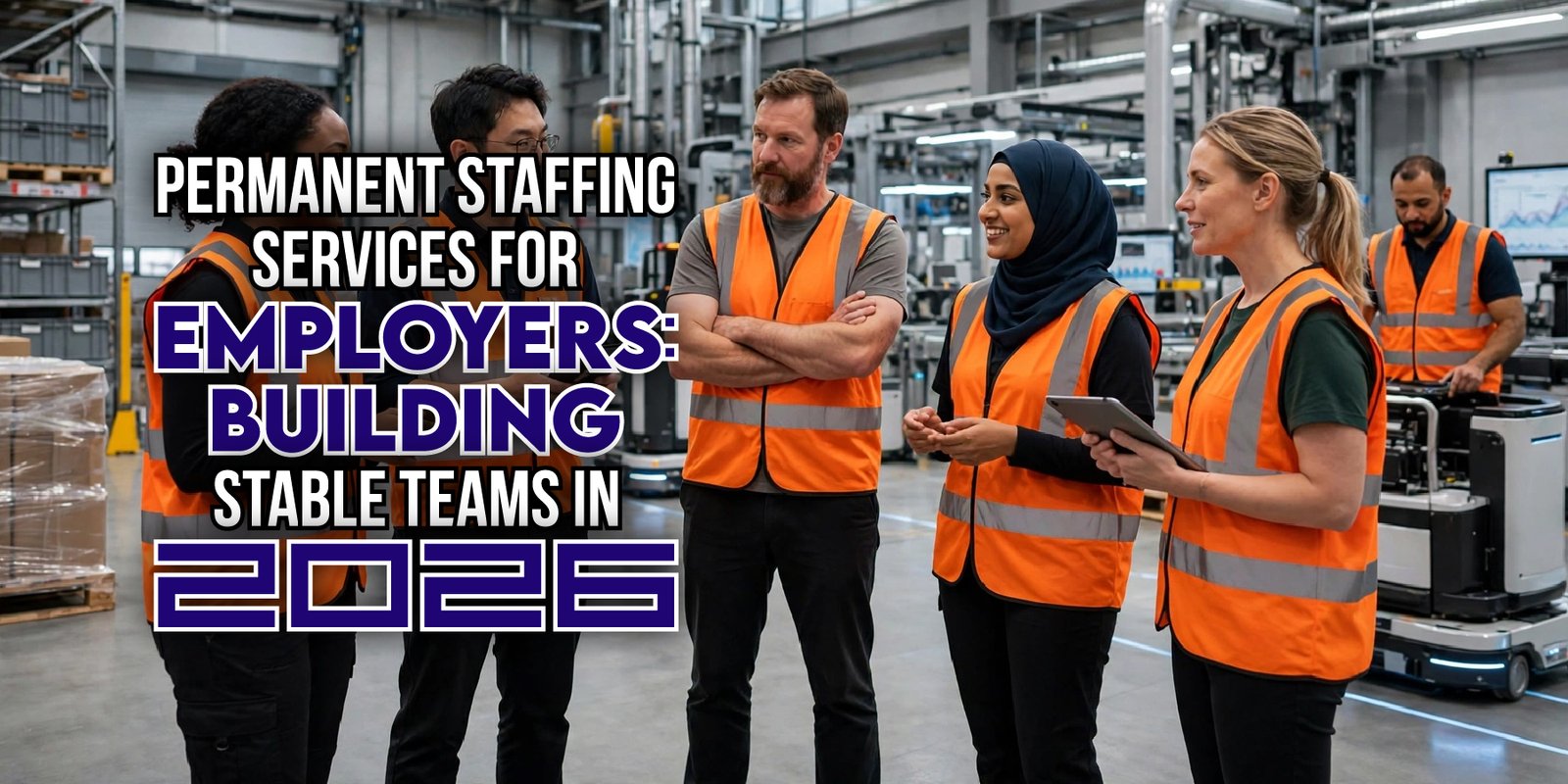
Permanent Staffing Services for Employers: Building Stable Teams in 2026
Permanent hiring affects far more than a single vacancy. It can influence team stability, operational continuity, skills availability, management time and future growth. Well-planned permanent staffing services help employers approach those decisions with a clearer structure instead of treating every vacancy as an isolated recruitment task.
For UK employers in warehouse, logistics, manufacturing, production and other operational environments, the goal is simple: match the role, candidate and long-term business requirement. Permanent staffing services work best when employers define what they need before sourcing begins and keep the recruitment process connected to real operational demand.
What Are Permanent Staffing Services?
Permanent staffing services help employers recruit candidates for ongoing roles by supporting role definition, candidate sourcing, screening, shortlisting and recruitment coordination. They are most useful when the business has a continuing need and wants a structured route from vacancy planning to permanent hiring, rather than short-term cover for temporary demand.
In practice, permanent staffing services can support an employer from the first job brief through to candidate discussions and interview coordination. However, the employer still needs to make clear decisions about responsibilities, working patterns, salary expectations, onboarding and long-term team needs.
Why Employers Use Permanent Staffing Services
Employers may use permanent staffing services when internal recruitment capacity is limited, a role is difficult to fill, a department is growing or a key team member needs replacing. External recruitment support can also reduce the amount of management time spent sourcing and initially screening applicants.
Additionally, permanent staffing services can help create a more consistent process when several hiring managers are involved. Instead of every vacancy being handled differently, the employer can use a clearer brief, defined screening criteria and an agreed decision process.
This does not remove every recruitment risk. Employers still need timely feedback, suitable interviews, effective onboarding and good management after the hire.
Permanent Hiring Starts With a Clear Role
Permanent hiring becomes more effective when the employer defines the role before candidate sourcing begins. A vague job title is not enough.
Employers should clarify:
- the main responsibilities
- essential skills
- desirable experience
- working pattern
- reporting line
- location
- role priorities
- realistic expectations
- interview process
- expected start date
Because permanent staffing services depend on the quality of the brief, unclear requirements can produce irrelevant applications or unnecessary screening. Therefore, hiring managers should distinguish between genuine essentials and preferences that can be learned after appointment.
Employer Recruitment Support for Growing Businesses
Employer recruitment support becomes particularly useful when business growth creates several vacancies at once. New contracts, new locations, expanded production, increased logistics activity or additional warehouse capacity can quickly turn one vacancy into a wider recruitment programme.
In these situations, permanent staffing services should connect headcount, role priority, sourcing, screening, interviews and onboarding. Growing employers can also review scalable recruitment solutions when hiring volumes are changing across more than one role or department.
1st Workforce currently supports UK employers with temporary and permanent recruitment across warehouse, factory, logistics, production and wider operational environments. Its published employer guidance asks businesses to provide practical details such as role, location, shift pattern, headcount and preferred start date before recruitment support is discussed.
Planning Permanent Recruitment for Your Business?
If you are preparing to add permanent team members, start by documenting the role, hiring volume, shift pattern, location, start date and essential candidate requirements. This gives permanent staffing services a clearer operational brief and helps avoid unnecessary back-and-forth once sourcing begins.
Employers can discuss their permanent hiring requirements with 1st Workforce when they are ready to review the requirement in more detail.
Skilled Staff Recruitment: What Should Employers Define?
Skilled staff recruitment needs more precision than simply asking for an experienced candidate. Employers should separate non-negotiable requirements from skills that can be developed internally.
A practical brief may include essential technical experience, relevant operational knowledge, qualifications where genuinely required, transferable skills and the level of responsibility expected. Permanent staffing services can then focus sourcing and screening around the role rather than an overly broad wish list.
However, unrealistic requirements can narrow the candidate pool. Therefore, employers should review whether every requested skill is essential on day one or whether some capability can be developed through onboarding and training.
Permanent Staffing vs Temporary Staffing
Permanent and temporary staffing solve different employer needs. Permanent staffing services generally suit ongoing positions, confirmed core-team requirements, specialist roles and stable capacity needs.
By comparison, temporary staffing may suit seasonal demand, temporary absences, short projects, peak periods or situations where the duration of demand remains uncertain. Employers comparing both options can review temporary staffing and cost control before choosing the hiring route.
The decision should follow the workload. If the role is genuinely continuing, permanent hiring may fit better. If demand is short term or still being tested, temporary support may provide more flexibility.
What Should Employers Look for in a Permanent Recruitment Partner?
A permanent recruitment partner should understand the employer’s role requirements, communicate clearly, explain its sourcing and screening process, set realistic expectations and support the recruitment process without promising guaranteed outcomes. Relevant sector understanding and the ability to adapt when hiring needs change can also make permanent staffing services more useful.
Employers should ask how the provider receives a brief, screens candidates, communicates shortlists and handles changes to the requirement. In addition, the recruitment partner should be clear about what the employer needs to provide for the process to move efficiently.
Candidate Screening for Permanent Roles
Candidate screening should focus on relevance to the role rather than volume alone. Permanent staffing services may support initial checks around experience, skills, availability, shift suitability, location and employment expectations before a candidate reaches the employer’s interview stage.
However, screening cannot guarantee future performance or staff retention. The employer should still use a structured interview, realistic job information and an appropriate onboarding process.
During hiring, fast internal feedback also matters. Suitable candidates can disengage if the decision process becomes unclear or repeatedly delayed.
Permanent Staffing Services for Warehouse and Logistics Employers
Warehouse and logistics employers often need a mixture of operational and supervisory roles. Permanent staffing services can support long-term recruitment where the requirement is stable rather than tied only to a short peak.
1st Workforce’s current published service information covers warehouse staff, logistics support and permanent placements, including long-term recruitment for supervisors, managers, skilled operators and core operational staff where requirements fit. It also lists support across warehousing, distribution, packing, fulfilment, quality control and wider operational environments.
For employers, the most useful brief includes the exact role, shift, site location, headcount, start date and essential skills. Permanent staffing services can then be discussed around the actual operation rather than a generic job title.
Permanent Staffing Services for Manufacturing and Production
Manufacturing and production employers may need permanent operational personnel when demand is stable, a production line is expanding or a critical vacancy needs a long-term replacement. Permanent staffing services can support sourcing for roles that align with the provider’s actual sector coverage and the employer’s requirements.
1st Workforce currently describes recruitment support across factory, manufacturing, production, food production, packing, quality control and operational settings. As a result, employers should explain the environment, shift pattern, role duties and skill level before recruitment begins.
Where a technical or supervisory role is involved, permanent staffing services should use a more specific brief than a high-volume general staffing requirement.
How Permanent Recruitment Supports Team Stability
Permanent recruitment can support longer-term team planning when the role itself is genuinely ongoing. Employers can build core capacity around positions that remain necessary throughout normal operations rather than repeatedly treating them as temporary gaps.
Still, permanent staffing services do not guarantee employee loyalty, productivity, cultural fit or staff retention. Those outcomes depend on multiple factors, including management, role accuracy, pay, communication, onboarding, working conditions and progression opportunities where available.
The recruitment process is therefore one part of team stability, not the whole answer.
Staff Retention Starts Before the Hire
Staff retention begins partly with accurate expectations. Candidates should understand the role, working pattern, responsibilities and environment before accepting an offer.
Permanent staffing services can support this by working from a clear employer brief and communicating the role consistently. However, retention also depends on what happens after the candidate joins.
Employers should therefore prepare onboarding, line-management support, feedback processes and realistic development opportunities where appropriate. A strong hire can still leave if the job differs significantly from what was presented.
Common Permanent Recruitment Mistakes
- Starting without a clear role. Permanent staffing services work better when duties, skills and expectations are defined first.
- Writing unrealistic requirements. Excessive criteria can unnecessarily shrink the candidate pool.
- Focusing only on speed. A fast hire is not automatically the right long-term hire.
- Using unclear salary or role expectations. Candidates need enough information to assess suitability.
- Delaying feedback. Slow internal decisions can weaken candidate engagement.
- Ignoring candidate experience. Communication matters throughout permanent hiring.
- Failing to prepare interviews. Different interviewers should assess the same core criteria.
- Treating temporary and permanent hiring as identical. They solve different operational needs.
- Forgetting onboarding. Recruitment should connect with the employee’s first weeks in the business.
- Failing to review future needs. Hiring plans should change as the business grows.
What Should Employers Prepare Before Using Permanent Staffing Services?
Before using permanent staffing services, employers should prepare a clear job title, role purpose, responsibilities, essential skills, preferred experience, location, working pattern, reporting structure, hiring deadline, number of positions, interview process, decision-makers, availability requirements and onboarding plan. The brief should also explain why the role is needed long term.
A practical checklist includes:
- Job title
- Role purpose
- Main responsibilities
- Essential skills
- Desirable experience
- Working pattern
- Site location
- Reporting line
- Number of positions
- Preferred start date
- Interview stages
- Hiring decision-maker
- Candidate availability requirements
- Salary or package information for candidate discussions
- Onboarding plan
- Long-term business need
- Any role-specific compliance or qualification requirements
- Internal feedback timescale
This preparation makes permanent staffing services easier to manage because the recruitment partner receives a more complete brief from the start.
Permanent Recruitment Comparison Table
| Hiring Factor | Permanent Staffing | Temporary Staffing |
|---|---|---|
| Typical need | Ongoing role | Short-term or changing requirement |
| Team planning | Long-term capacity | Flexible capacity |
| Recruitment focus | Long-term role match | Immediate operational requirement |
| Suitable for | Core roles and continuing needs | Peaks, projects and temporary gaps |
| Employer consideration | Retention, onboarding and progression | Duration, flexibility and assignment needs |
Neither model is universally better. Permanent staffing services are most relevant when the role has a continuing purpose, while temporary recruitment may suit variable or time-limited demand.
How Can Employers Improve Permanent Hiring Results?
Employers can improve permanent hiring by writing clearer job descriptions, setting realistic requirements, preparing interviews, giving faster internal feedback and maintaining consistent candidate communication.
In addition, permanent staffing services work more effectively when hiring managers agree on decision criteria before interviews begin. This reduces the risk of changing expectations after candidate sourcing is already underway.
Finally, structured onboarding matters. Recruitment does not end when an offer is accepted.
How Should Permanent Hiring Change as a Business Grows?
As businesses add contracts, locations, production capacity, warehouse space, supervisory layers or specialist functions, recruitment needs can become more complex. Permanent staffing services should therefore evolve from one-off vacancy filling into a repeatable hiring process.
When growth creates several permanent roles, employers should prioritise positions according to operational need and management capacity. In practice, hiring too many people at once can create onboarding pressure even when the headcount itself is justified.
Scalable recruitment planning can help employers separate confirmed long-term roles from temporary demand. That allows permanent staffing services to focus on genuinely ongoing positions while temporary support covers variable requirements.
7. FAQs
What are permanent staffing services?
Permanent staffing services help employers recruit candidates for ongoing positions by supporting role definition, candidate sourcing, screening, shortlisting and recruitment coordination. They are most suitable where the business has a continuing requirement and wants a structured permanent hiring process rather than short-term staffing cover.
How can permanent staffing services help employers?
Permanent staffing services can help employers organise long-term recruitment around clear role requirements, sourcing, screening and candidate coordination. They can be useful when internal recruitment capacity is limited, several vacancies need attention or the business wants employer recruitment support for confirmed ongoing roles.
What is the difference between permanent and temporary staffing?
Permanent recruitment is designed for continuing employment needs, while temporary staffing is generally better suited to peaks, absences, projects or uncertain demand. Permanent staffing services focus on ongoing roles and long-term team needs, whereas temporary recruitment provides more flexibility when the workload may change.
What should employers prepare before recruiting permanent staff?
Employers should prepare the job title, responsibilities, essential skills, preferred experience, location, shift pattern, reporting line, salary or package information, interview process, start-date expectations and onboarding plan. Permanent staffing services work more efficiently when these details are clear before candidate sourcing begins.
How can employers improve skilled staff recruitment?
Employers can improve skilled staff recruitment by separating essential skills from desirable experience, writing realistic job requirements and deciding which capabilities can be developed after hiring. Permanent staffing services can then focus screening on genuine role needs rather than an unnecessarily restrictive list.
Can permanent recruitment support staff retention?
Permanent recruitment can support staff retention indirectly when candidates receive accurate information about duties, working patterns and expectations before joining. However, retention also depends on management, onboarding, pay, working conditions, communication and development opportunities. Permanent staffing services cannot guarantee that an employee will stay.
When should a growing business use recruitment support?
A growing business may use recruitment support when several vacancies appear together, internal hiring capacity becomes stretched or new contracts and locations create confirmed headcount needs. Permanent staffing services can support ongoing roles, while temporary recruitment may remain more suitable for demand that is still uncertain.
What should employers look for in a permanent recruitment partner?
Employers should look for clear communication, a structured recruitment process, relevant sector understanding, realistic expectations and a transparent approach to candidate sourcing and screening. Permanent staffing services should also adapt when role requirements or hiring volumes change without making unsupported placement or retention guarantees.
8. Discuss Your Permanent Hiring Requirements
Employers planning long-term recruitment should start with their current vacancies, role priorities, headcount, working patterns, site locations and preferred start dates. Permanent staffing services are most useful when these requirements are connected to confirmed business needs and a realistic interview and onboarding process.
1st Workforce supports temporary and permanent recruitment across warehouse, factory, logistics, production and operational environments, including permanent placements for suitable long-term roles. Employers can request tailored recruitment support to discuss their recruitment requirements.
Leave a Reply