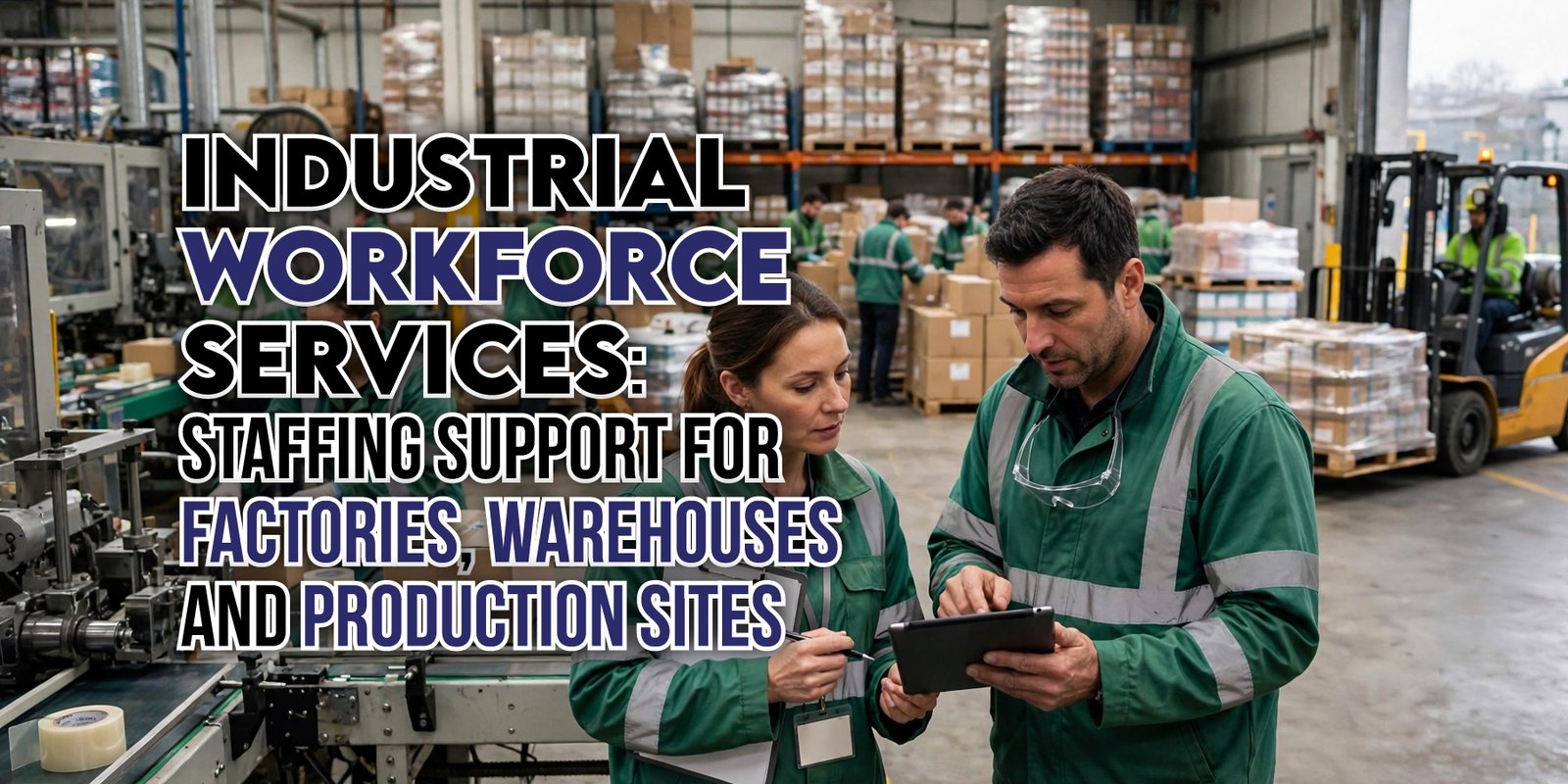
Industrial Workforce Services: Staffing Support for Factories, Warehouses and Production Sites
A new production order can arrive before a factory has enough personnel to cover the line. Meanwhile, a warehouse may face sickness, annual leave, weekend shifts and dispatch pressure in the same week. In those moments, industrial workforce services help employers review staffing options without making every short-term requirement permanent.
At 1st Workforce, we support employers across warehouse, factory, manufacturing, production and logistics environments. Industrial workforce services can support temporary staffing, contract personnel and permanent recruitment, depending on the role, shift structure and operating environment.
What Are Industrial Workforce Services?
Industrial workforce services help employers recruit temporary, contract or permanent personnel for operational environments such as factories, warehouses, manufacturing facilities, food production sites and logistics operations. Support can include role matching, shift cover, seasonal staffing and recruitment for production, warehouse and supervisory duties.
In practice, industrial workforce services connect staffing discussions to the real site requirement. That means looking at the role, duties, shift pattern, location, headcount, start date, required experience and expected duration.
These services may support warehousing, factories, manufacturing, production, food production, distribution and fulfilment. However, the right arrangement depends on the job and the employer’s operating environment.
Which Businesses Use Industrial Workforce Services?
Industrial workforce services are used by businesses that need additional personnel across practical, shift-based environments. These can include manufacturers, food producers, packing operations, logistics hubs, distribution centres, fulfilment sites and factories running production or assembly processes. This makes industrial workforce services useful wherever staffing levels need to match operational demand.
For example, a warehouse may need pickers and packers during seasonal demand. Meanwhile, a production facility may need production operatives, machine operatives or quality-control personnel when order volume increases.
| Industrial Environment | Typical Staffing Need | Example Roles | What Employers Should Specify |
|---|---|---|---|
| Warehouse | Picking, packing, dispatch and goods-in support | Warehouse operatives, pickers and packers, loaders | Shift pattern, goods handled, pace and site access |
| Factory | Line support, packing and practical production duties | Production operatives, packers, machine operatives | Duties, machinery, PPE and supervision |
| Manufacturing site | Process-led production support | Machine operatives, production personnel, quality-control personnel | Competence, SOPs, quality checks and reporting lines |
| Food production | Product handling, packing and labelling | Food production operatives, food packers, line personnel | Hygiene rules, PPE, temperature and labelling duties |
| Logistics or fulfilment | Order flow, stock movement and dispatch | Order pickers, dispatch personnel, supervisors | Start time, transport access, targets and shift structure |
Industrial Workforce Solutions for Changing Demand
Industrial workforce solutions help employers respond when workload changes faster than standard recruitment planning. However, they should still be matched to role detail, shift pattern, assignment duration and site readiness.
When demand changes, industrial workforce services can help managers plan practical cover. Seasonal peaks, new contracts, sickness cover, holiday cover, short-term projects, additional shifts and recruitment gaps can all create staffing pressure. Therefore, industrial workforce services can add operational capacity while managers decide whether the need is temporary or long term.
For example, a fulfilment centre may need extra packing personnel before a retail peak. Likewise, a factory may need short-term factory labour support while a permanent recruitment process continues.
Factory Labour Support: Define the Role Properly
Factory labour support should never start with a vague request such as “we need factory staff.” A useful brief explains what the person will actually do, where they will work and what experience they need.
In factory settings, industrial workforce services should start with precise role detail. Before requesting industrial workforce services, employers should define duties, product environment, shift, machinery, manual-handling requirements, PPE, hygiene rules, quality expectations, supervisor and assignment duration.
Clearer briefs improve staffing discussions because a packing role, machine-support role and quality-control role are not interchangeable. As a result, industrial workforce solutions work best when the staffing partner understands the job before recommending options.
Manufacturing Staffing
Manufacturing staffing covers personnel requirements inside manufacturing and production environments. It may include machine operatives, production personnel, food production operatives, packing roles, quality-control support, supervisors and line managers where the role fits the provider’s coverage.
For manufacturing staffing, industrial workforce services usually need more detail than a simple headcount request. Employers should explain machinery, processes, competence, PPE, production line expectations, quality checks and site procedures.
At 1st Workforce, we support employers across manufacturing, factories, production, food production, packing, warehousing, logistics and quality-control environments. Current role coverage includes machine operative, food production operative, food production line operator, food packer, packer and line manager roles.
Production Operatives: What Do They Do?
Production operatives usually support production lines by handling products, packing goods, assembling where relevant, checking quality, following work instructions and keeping work areas organised. However, duties vary by employer, product, machinery and site process.
Within production environments, industrial workforce services should clarify how the role supports output. In industrial workforce services, production operatives may support line flow during seasonal peaks, new orders, absence cover or additional shifts.
Therefore, employers should explain whether the role involves packing, assembly, product handling, labelling, cleaning, recording information or reporting faults.
Machine Operatives
For machine-led sites, industrial workforce services need clear competence checks. A candidate with general production experience should not automatically be treated as suitable for every machine or process.
Employers should clarify the equipment involved, operating procedures, monitoring duties, quality checks, production records, fault reporting and supervision. In addition, the site should define whether the role involves operating, feeding, monitoring or simply working near machinery.
Warehouse Staffing Within Industrial Operations
For warehouse operations, industrial workforce services often sit beside factory and manufacturing staffing because many industrial sites include goods-in, storage, packing, dispatch and fulfilment. Therefore, industrial workforce services may need to cover both production and warehouse activity on the same site.
Typical warehouse duties can include picking, packing, goods handling, stock movement, loading support, dispatch and order preparation. In comparison, factory staffing may focus more heavily on line flow, product handling, assembly, machinery and quality checks.
Food Production Staffing
For food production, industrial workforce services can include production-line support, packing, product handling, labelling and quality checks. However, employers should provide clear information about hygiene requirements, PPE, temperature conditions, product-handling duties and shift pattern.
For example, a chilled food site may need a different brief from an ambient packing operation. Because of this, industrial workforce services for food environments should always include site-specific hygiene and reporting requirements.
Temporary vs Contract vs Permanent Industrial Staffing
Industrial workforce services may involve temporary staffing, contract staffing or permanent recruitment. Within industrial workforce services, the right model depends on the purpose, expected duration, duties and whether the requirement is short-term, defined or stable.
| Factor | Temporary Staffing | Contract Staffing | Permanent Recruitment |
|---|---|---|---|
| Typical use | Seasonal peaks, sickness, holidays and short workload increases | Defined assignments, projects or medium-term needs | Stable vacancies and long-term headcount |
| Duration | Short term or variable | Defined period or assignment-based | Ongoing employment need |
| Best suited to | Shift cover, temporary vacancies and flexible capacity | Time-limited production or operational requirements | Core roles, supervisors and continuing duties |
| Employer focus | Speed of brief, role clarity and shift detail | Assignment scope, term and required skills | Job fit, long-term suitability and retention planning |
Temporary staffing may suit short workload peaks, while contract staffing may suit a defined assignment. For more detail on the contract staffing meaning for employers, employers should review the actual arrangement rather than relying on labels.
When Contract Staffing Makes Sense
As part of industrial workforce services, contract staffing can make sense when an industrial site has a defined requirement, such as a project, new contract, medium-term shift need or time-limited production increase. However, the assignment should have a clear purpose, duration, shift pattern and role brief.
Employers considering industrial workforce services should confirm headcount, required skills, expected length, supervision and commercial terms. To understand the distinction, review how contract staffing works for employers before deciding whether temporary, contract or permanent support fits the situation.
Industrial Staffing and Site Readiness
Industrial workforce services do not replace the employer’s need to prepare the site. Before using industrial workforce services, employers should prepare the operating environment. Additional personnel still need induction, reporting lines, PPE information, shift times, break arrangements, workstation allocation, emergency procedures and task limits.
GOV.UK explains that employers using recruitment agencies have responsibilities for agency personnel’s health and safety, shared-facility access and relevant internal vacancies. HSE guidance also says the end-user business usually directs day-to-day work and controls the premises, so it remains central to managing workplace risks.
For manufacturing environments, the guide on temporary manufacturing staff and site procedures can support planning without replacing the employer’s own workplace arrangements.
Manufacturing Personnel and Site Procedures
Good industrial workforce services also depend on clear site procedures. Manufacturing personnel should understand the site procedures that affect their assignment. This can include PPE, site induction, machinery restrictions, supervision, quality checks, hygiene expectations, emergency routes and escalation processes.
HSE says suppliers and end-user businesses should exchange information about duties, competence, workplace risks and control measures before work starts. Therefore, employers using industrial workforce services should prepare practical site information before personnel arrive.
The linked guidance on preparing manufacturing personnel for site requirements covers induction, PPE and role-readiness in more detail.
A strong industrial staffing brief is not just a list of vacancies. It is a practical operating document that tells the staffing partner what the role involves, where the person reports and what the site expects from the first shift.
What Information Should Employers Give an Industrial Staffing Agency?
The briefing stage is where industrial workforce services become practical. Employers should give an industrial staffing agency enough detail to match the role to suitable personnel.
In practice, industrial workforce services work better when the staffing partner understands the site, shift, duties and required experience.
| Briefing Detail | Why It Matters | Employer Example |
|---|---|---|
| Role title and duties | Clarifies the actual task | Production operative on packing line |
| Site location and access | Affects attendance practicality | Industrial estate, bus route, parking rules |
| Headcount and start date | Defines scale and timing | Four people from Monday |
| Shift pattern | Affects suitability | Nights, weekends or rotating shifts |
| Required experience | Improves role matching | Food packing, machine monitoring or goods-in |
| PPE and induction | Supports site readiness | Safety shoes, hairnet, local induction |
| Supervisor | Creates a reporting line | Shift manager or line leader |
Also share assignment duration, manual-handling duties, machinery involved, quality responsibilities, hygiene requirements, transport practicality and timesheet process.
How 1st Workforce Supports Industrial Employers
At 1st Workforce, we support industrial employers that need additional staffing across warehouse, factory, manufacturing, production and logistics environments. Our current service coverage includes warehousing, factories, manufacturing, food production, distribution, packing, fulfilment, quality control and wider operational settings.
Our team reviews the role, location, shift pattern, required headcount and start date before discussing suitable staffing options. Depending on the requirement, industrial workforce services may support temporary staffing, permanent recruitment or contract-style arrangements.
Businesses can use our staffing support for seasonal requirements, sickness cover, holiday cover, increased workload, short-term projects and longer-term recruitment where appropriate. Candidate availability depends on the role, location, shift pattern, required experience and notice provided.
Discuss Your Industrial Staffing Requirement
Manufacturing, warehouse and production employers can share the role, site, shift pattern, headcount, start date, expected duration and required experience with 1st Workforce.
To start a focused discussion, use the request an industrial staffing quote route and include as much operational detail as possible.
How to Compare Industrial Staffing Providers
Employers should compare staffing providers by role coverage, sector experience, screening process, communication, shift understanding, site-readiness questions and commercial terms. When comparing industrial workforce services, price matters, but it should not be the only factor.
GOV.UK guidance says employer Right to Work responsibilities remain important even where checks are delegated, and the employer can remain liable if prescribed checks have not been correctly completed. Therefore, businesses should ask how screening and Right to Work processes are handled.
| Comparison Area | What to Review | Why It Matters |
|---|---|---|
| Sector experience | Warehouse, factory, manufacturing and logistics familiarity | Helps the provider understand practical duties |
| Role coverage | Operatives, packers, machine roles and supervisors | Matches service to requirement |
| Screening | Experience, suitability and Right to Work process | Supports better role discussions |
| Shift handling | Nights, weekends, rotating shifts and changes | Reduces confusion |
| Site briefing | PPE, induction, duties and supervision | Improves first-shift readiness |
| Commercial terms | Rates, timesheets, notice and cancellation | Avoids unclear expectations |
Industrial workforce services should be compared on the complete arrangement, not one headline rate.
Questions to Ask an Industrial Staffing Agency
Before choosing a provider, ask practical questions:
- Which industrial sectors do you support?
- Which roles do you regularly recruit?
- Can you support temporary requirements?
- Can you support permanent recruitment?
- How do you handle contract staffing requirements?
- What role information do you need?
- How do you assess candidate experience?
- How do you verify Right to Work?
- How should we communicate shift requirements?
- What PPE or induction information should we provide?
- How are staffing rates structured?
- How are timesheets handled?
- What happens when requirements change?
- What notice terms apply?
- Which areas do you cover?
Common Industrial Staffing Mistakes
Industrial workforce services can only work from the information provided. Common mistakes include giving vague role descriptions, asking only for generic factory staff, failing to mention machinery and ignoring shift patterns.
In addition, employers sometimes forget PPE requirements, site induction, assignment duration or transport practicality.
Another mistake is assuming all production roles are interchangeable. For this reason, industrial workforce services should start with defined duties, required experience, supervision and site information.
Avoid comparing agencies only on headline price. Instead, review screening, communication, role understanding, terms and how the provider handles changing requirements.
Industrial Workforce Services Checklist
Use this industrial workforce services checklist before confirming a staffing requirement:
- Define the role.
- Confirm the duties.
- Confirm headcount.
- Set the start date.
- Define assignment duration.
- Confirm shift pattern.
- Identify required experience.
- State machinery involved.
- Define PPE requirements.
- Prepare induction.
- Assign supervision.
- Explain quality requirements.
- Define hygiene requirements.
- Confirm site access.
- Clarify transport practicality.
- Choose temporary, contract or permanent staffing.
- Compare staffing providers.
- Review commercial terms.
- Monitor the requirement.
- Update staffing levels.
- Review recurring temporary roles.
- Move stable long-term requirements into permanent recruitment where appropriate.
Frequently Asked Questions
What are industrial workforce services?
Industrial workforce services help employers recruit temporary, contract or permanent personnel for operational sites such as factories, warehouses, manufacturing facilities, food production environments and logistics operations. They can support shift cover, seasonal staffing, production duties, warehouse roles and supervisory requirements, depending on the site brief.
What are industrial workforce solutions?
Industrial workforce solutions are staffing approaches designed around changing operational demand. They may include temporary staffing, contract personnel, permanent recruitment, seasonal support, shift cover and role-specific recruitment for production, warehouse, factory or manufacturing settings. The right option depends on duration, duties, headcount and site requirements.
Which businesses use industrial staffing services?
Manufacturers, factories, warehouses, food producers, fulfilment sites, distribution centres, logistics operations and packing businesses commonly use industrial staffing services. However, each requirement should reflect the workload, shift pattern, experience needed, supervision, location and operating environment rather than a generic headcount request.
What does factory labour support mean?
Factory labour support means staffing assistance for practical factory duties such as production-line support, packing, goods handling, product movement, machine-adjacent support or quality checks. Employers should still define the exact duties, machinery, shift pattern, PPE, hygiene requirements and supervision before asking an agency to discuss suitable personnel.
What do production operatives do?
Production operatives may support production lines, handle products, pack goods, complete basic assembly where relevant, perform quality checks, follow work instructions, record information, report faults and keep work areas organised. However, duties vary by employer, product, site process, machinery and supervision.
What does manufacturing staffing include?
Manufacturing staffing can include production personnel, machine operatives, food production operatives, packers, production-line personnel, quality-control support, supervisors and line managers where relevant. Industrial workforce services for manufacturing should include details about machinery, competence, PPE, shift pattern, induction and site procedures.
Can industrial workforce services provide temporary staff?
Yes, industrial workforce services can support temporary staffing for seasonal peaks, sickness cover, holiday cover, short-term projects, temporary vacancies and increased workload. However, candidate availability depends on role detail, location, shift pattern, required experience, notice and the current labour market.
When should manufacturers use contract staffing?
Manufacturers may consider contract staffing when the requirement has a defined assignment, expected duration, project need or medium-term production demand. Employers should confirm the purpose, role, competence, shift pattern, headcount and site requirements before deciding whether contract staffing, temporary staffing or permanent recruitment fits best.
Can industrial staffing support warehouse operations?
Yes, industrial staffing can support warehouse operations such as picking, packing, goods-in, dispatch, fulfilment, stock movement and loading support. However, the staffing brief should explain product type, shift pattern, pace, equipment, site access, manual handling and supervisor details.
What should employers tell an industrial staffing agency?
Employers should share the role title, duties, site location, headcount, start date, assignment duration, shift pattern, required experience, machinery, PPE, induction, hygiene rules, quality responsibilities, manual handling, site access, transport practicality and reporting line. Clear information helps industrial workforce services reflect the real assignment.
Why do induction and PPE requirements matter?
Induction and PPE requirements matter because additional personnel must work inside the employer’s site procedures. Employers should provide information about duties, task limits, reporting lines, emergency arrangements, equipment, hygiene requirements and PPE before the first shift so staffing support fits the workplace safely and practically.
How should businesses compare industrial staffing providers?
Businesses should compare industrial staffing providers by sector experience, role coverage, screening, Right to Work processes, communication, shift understanding, site-brief quality, timesheets and commercial terms. Industrial workforce services should be judged by fit for the actual operation, not only headline price.
Can 1st Workforce support factories and production sites?
Yes. At 1st Workforce, we support employers across warehouse, factory, manufacturing, production, logistics, food production, packing, fulfilment and quality-control environments. Our team reviews the role, site, shift pattern, headcount and start date before discussing suitable staffing options.
How do I request an industrial staffing quote?
To request a quote, prepare the role requirements, site location, shift pattern, headcount, start date, expected duration and required experience. Include PPE, induction, machinery, hygiene, quality and access details where relevant so industrial workforce services can reflect the actual assignment before 1st Workforce discusses suitable options.
Conclusion
For industrial employers, industrial workforce services work best when roles are clearly defined, staffing type matches demand and short-term needs are separated from stable long-term vacancies. Therefore, role duties, shift pattern, headcount, PPE, induction and site procedures should be clear before staffing begins.
In that review, industrial workforce services should be matched to the real demand. Temporary staffing may support seasonal peaks, sickness cover or extra shifts. Meanwhile, permanent recruitment may suit continuing roles, and contract arrangements may fit defined assignments where the purpose and duration are clear.
Ultimately, industrial workforce services should help employers compare options, communicate site requirements and choose a practical staffing approach for factories, warehouses and production environments.
The best staffing conversations start before the site is under pressure. When employers share the role, shift, headcount and site requirements early, the discussion becomes more useful for everyone involved.
Plan Staffing for Your Industrial Site
Factories, warehouses, manufacturing sites and production facilities can share role requirements, site location, shift pattern, required headcount, start date and expected duration with 1st Workforce.
To discuss suitable options for temporary, contract or permanent staffing, request industrial staffing support from 1st Workforce.
Leave a Reply