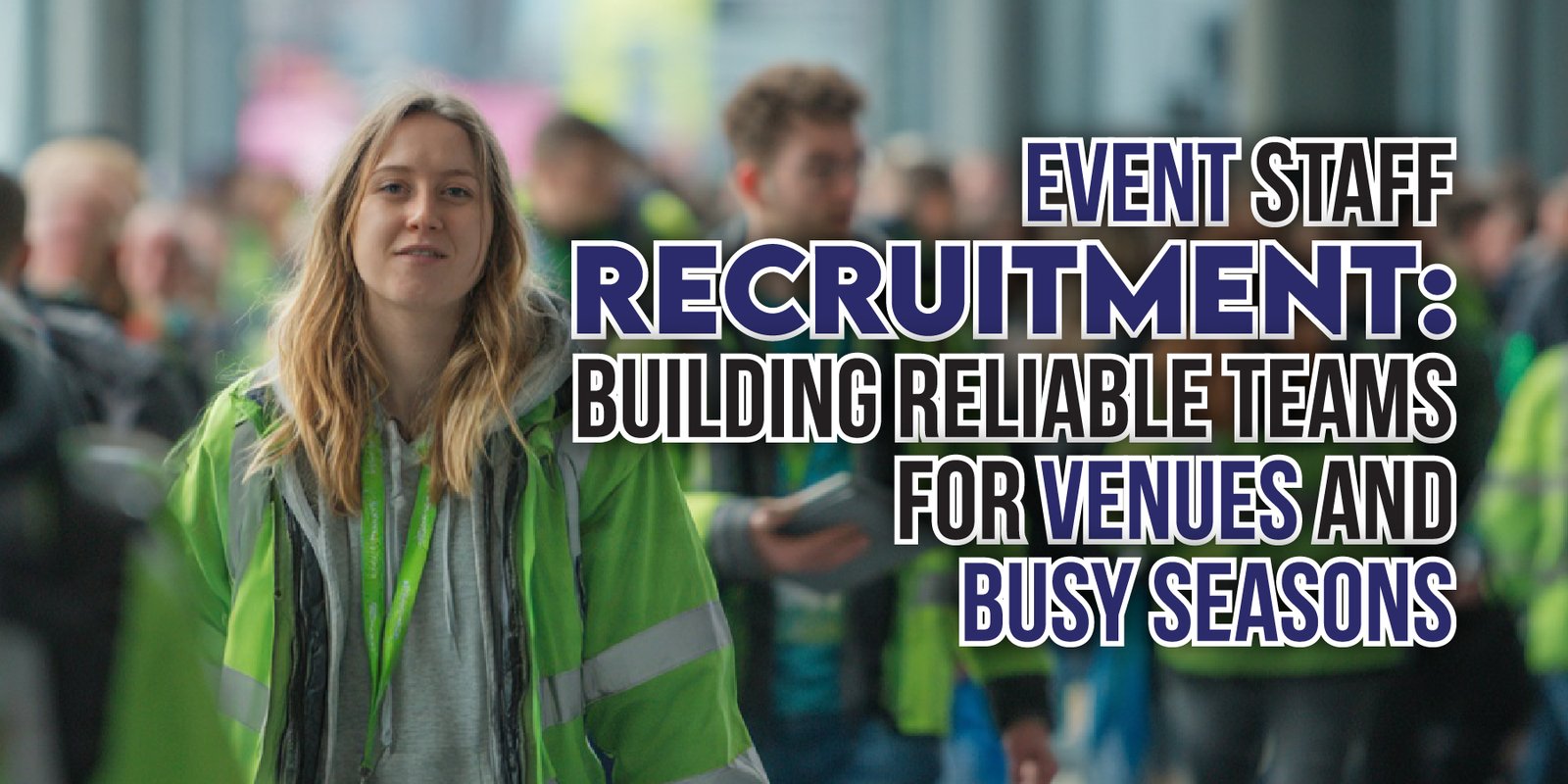
Event Staff Recruitment: Building Reliable Teams for Venues and Busy Seasons
Event staff recruitment helps employers cover stewarding, hospitality service, guest flow, setup, breakdown, rota gaps and seasonal demand. It gives venues a practical way to respond when their internal team cannot cover every event, shift or operational requirement.
In addition, 1st Workforce supports UK employers across events, hospitality, manufacturing, warehouse, factory, production and operational roles. The agency can assess temporary, permanent and temp-to-permanent needs where suitable candidates are available. Therefore, effective staffing starts with accurate information about the role, shift, site and assignment.
What Event Staff Recruitment Means
Event staff recruitment means sourcing temporary, seasonal, temp-to-permanent or permanent workers for event stewarding, hospitality service, venue support, cleaning, setup, breakdown and back-of-house duties.
For employers, this approach can support one-off functions, recurring venue calendars, seasonal peaks and ongoing staffing gaps. However, an agency still needs clear details before checking candidate availability. These details normally include duties, headcount, shift times, venue location, start date and assignment length.
A broad request for “event workers” rarely gives enough information. Instead, employers should separate guest-facing, service, setup and operational duties so the agency can assess the right type of worker.
Why Venues Need Flexible Staffing Support
Venue demand can change quickly because guest numbers, event types and operating hours vary. For example, a conference may need front-of-house support during the day, while an evening banquet requires waiting staff, bar workers and kitchen porters.
At the same time, annual leave, sickness and last-minute rota gaps can reduce available headcount. Event staff recruitment allows organisers to assess additional support without treating every short requirement as a permanent vacancy.
A structured staffing plan may help with:
- Weekend events
- Evening functions
- Public holidays
- Conferences and banquets
- Christmas parties
- Wedding season
- Summer events
- Setup and breakdown periods
- Staff absence
- Recurring venue demand
Nevertheless, worker availability depends on the role, site, notice, shift pattern and assignment requirements.
Event Stewards Recruitment for Guest Flow and Venue Support
Event stewards recruitment focuses on workers who may support guest directions, entrance areas, seating guidance, queue flow and general venue organisation where appropriate.
Stewards need clear instructions because every venue has different entry points, restricted areas and reporting lines. Therefore, employers should explain the event layout, expected guest numbers, shift times and supervisor structure before the assignment begins.
Event staff recruitment for stewarding should also distinguish general guest support from regulated or specialist responsibilities. Employers must define the actual role and avoid assuming one worker can cover every function.
Hospitality Event Staff for Service-Led Events
Hospitality event staff may support waiting service, bars, banquets, conferences, kitchens and front-of-house operations. Their duties vary, so employers should provide more than a generic hospitality title.
For example, banquet staff may need to set tables, serve courses and clear rooms to a schedule. Meanwhile, bar support may require product knowledge, age-check procedures and till experience, depending on the venue.
Event staff recruitment works better when the agency receives the service style, uniform rules, guest numbers, shift hours and reporting structure. More importantly, the employer should identify which skills are essential and which can be taught during induction.
Temporary Event Workers for Peaks, Absence and Busy Seasons
Temporary event workers may help with one-off events, repeated weekend demand, seasonal peaks, public holidays and short-term rota gaps. They can also support venues that need additional headcount during large functions.
However, event staff recruitment should not depend on vague last-minute requests. Short notice, difficult travel times and unusual hours can reduce candidate availability. Because of this, employers should share expected demand as early as possible.
In addition, event staff recruitment may use temporary staffing for a single event or a defined busy period. In contrast, recurring requirements may point towards temp-to-permanent or permanent recruitment.
Venue Staffing Support for Operational Teams
Venue staffing support can cover guest-facing, service, cleaning, setup, breakdown, kitchen and wider operational duties. Different departments often need help at different stages of the same event.
For instance, setup teams may move furniture and prepare service areas before guests arrive. Later, hospitality workers support service, while breakdown teams clear equipment and restore the venue.
A well-planned event staff recruitment request maps each task to a shift and supervisor. As a result, employers can avoid asking one group of workers to perform duties that were never explained.
Event Staff Recruitment for Busy Venue Calendars
Event staff recruitment helps venues prepare for changing calendars by matching workers to defined roles, shifts and operational needs. Reliability improves when employers provide clear instructions, realistic timings and a named reporting contact.
Busy calendars often create overlapping requirements. A venue may host a daytime conference, an evening dinner and another event the next morning. Therefore, planners should consider turnaround time, breaks, late finishes and early starts.
Strong event staff recruitment also accounts for induction capacity. Bringing in more workers than the venue can brief or supervise may create confusion rather than useful support.
Covering Events, Hospitality and Back-of-House Demand
Events rely on several teams working together. Stewards help with guest flow, waiting teams support service and kitchen porters keep back-of-house areas moving. Meanwhile, cleaners, setup crews and cloakroom staff support the wider venue operation.
At the same time, stock movement, deliveries and room resets affect timing. A joined-up event staff recruitment plan should account for each stage. The staffing plan should reflect these connected tasks instead of focusing only on what guests see.
Operational planning matters before, during and after the event. Therefore, event staff recruitment should reflect the full operating timeline. Clear shift boundaries help the agency understand when each staffing need begins and ends.
Temporary Versus Permanent Event Staff
Temporary workers can suit one-off events, absence and changing headcount. Seasonal workers may support predictable busy periods, while temp-to-permanent recruitment can fit recurring needs where an employer wants to assess longer-term suitability.
Permanent recruitment, however, may suit core venue roles that require continuity and deeper site knowledge. A considered event staff recruitment model depends on frequency, training needs, shift stability and the expected duration of the role.
Therefore, employers should confirm conversion terms before using temp-to-permanent arrangements. This avoids confusion if the venue later wants to offer a permanent position.
Weekend, Evening and Public Holiday Event Staffing
Many venues operate when standard offices are closed. Weekend, evening and public holiday shifts can therefore form a large part of event staffing demand.
Yet these shifts may be harder to fill because transport, family commitments and availability vary. For that reason, event staff recruitment requests should state exact start and finish times, expected breaks, late-night travel considerations and overtime arrangements.
For venue managers, the staffing brief should include accurate information about unsocial hours. Accurate details help candidates decide whether the assignment suits them. In turn, this can reduce avoidable cancellations caused by unclear shift information.
Event Staffing During Seasonal Peaks
Wedding season, summer events, conferences, Christmas parties and bank holidays can place several departments under pressure at once. Guest flow, service, kitchen support and cleaning demand may all increase.
Therefore, event staff recruitment should begin before the busiest dates. Early planning gives employers time to estimate headcount, organise induction and assign supervisors.
A practical event staff recruitment plan should cover the event itself and the surrounding workload. For example, setup may begin hours earlier, while cleaning and breakdown continue after guests leave.
Operational and Production-Linked Staffing Support
Event operations can connect with stock handling, packing, setup, cleaning, kitchen support, deliveries and back-of-house movement. Larger organisations may also rely on warehouse, factory or production teams before materials reach the venue.
Employers can review 1st Workforce’s manufacturing and operational staffing support when their requirement extends into production, packing or operational roles.
Even so, event staff recruitment should define the venue-specific duties clearly. A worker with factory or warehouse experience may still need training on guest areas, venue rules and event timing.
Productivity Without Sacrificing Guest Experience
Fast setup, efficient service and prompt breakdown matter. However, speed should not replace accuracy, attitude or guest care.
Employers should use event staff recruitment alongside checks for task completion, service errors, supervisor feedback and guest-flow issues. In practice, staffing works best when the venue explains both productivity expectations and service standards.
New workers may need time to understand the venue layout, stock locations and reporting process. Realistic event staff recruitment should allow for that learning period. Therefore, supervisors should set sensible first-shift expectations.
Induction, Uniform, PPE and Supervision
In practice, a structured induction helps workers understand the venue before the event starts. Employers should cover emergency procedures, reporting lines, restricted areas, manual handling, guest-facing expectations and task priorities.
In addition, uniform rules should be clear before the shift. The venue should also confirm whether workers need gloves, non-slip footwear, high-visibility clothing or other PPE for specific duties.
Event staff recruitment does not replace site supervision. A named manager, clear brief and practical checklist help workers understand what the employer expects.
Information Employers Should Provide Before Requesting Event Staff
A complete event staff recruitment request should include:
- Role title and event type
- Required headcount
- Main duties
- Shift dates and exact hours
- Venue location
- Start date
- Assignment length
- Required experience
- Guest-facing expectations
- Uniform requirements
- PPE requirements
- Manual-handling duties
- Break arrangements
- Reporting manager
- Pay or approved budget
- Contact details
As a result, clear information helps 1st Workforce assess the requirement. Conversely, missing details can slow the process because the agency still needs to understand the role and shift.
Plan Event Staffing Before the Venue Gets Busy
Employers should share roles, headcount, shifts, duties, location and assignment length before the rota becomes critical. Early event staff recruitment planning also gives the venue time to organise induction, uniforms, equipment and supervision.
Venues can discuss their event staffing needs by providing the event type, required roles, numbers and preferred start time. Worker availability depends on the assignment and current candidate pool.
More importantly, accurate information helps 1st Workforce understand whether the requirement involves stewarding, hospitality service, setup, cleaning, back-of-house support or several teams.
Common Event Staffing Mistakes
Waiting until the rota is already short can limit available options. Other mistakes include hiring only for numbers, ignoring guest-facing experience and failing to explain uniform or service standards.
Venues also weaken event staff recruitment when they forget setup and breakdown work, provide unclear shift details or fail to assign supervisors. In addition, employers should not expect guaranteed availability at very short notice.
Another event staff recruitment mistake involves treating every event role as interchangeable. Stewarding, waiting, kitchen, cleaning and operational duties need different instructions and experience.
Practical Event Staffing Examples
One event staff recruitment example is a venue needing extra hospitality event staff for a large banquet. An organiser could require temporary event workers across several weekend shifts.
Similarly, a venue may use event stewards recruitment to support guest movement and directions. A Christmas party venue might need additional waiting, bar and kitchen-portering workers across several evenings.
These are hypothetical examples, not real 1st Workforce client case studies. In each case, event staff recruitment should follow the event type, department, duties and shift pattern.
Looking for Event or Hospitality Work?
Candidates interested in event staff recruitment can explore event and hospitality job opportunities through 1st Workforce. Available roles may also include warehouse, manufacturing, production, packing and operational work.
Therefore, applicants should provide accurate experience, availability, travel information and preferred shifts. Finally, current opportunities can change according to employer demand.
How 1st Workforce Supports Event Employers
1st Workforce supports UK employers across events, hospitality, warehouse, manufacturing, factory, production and operational roles. The agency can assess temporary staffing, permanent placements and longer-term requirements where suitable candidates are available.
For event staff recruitment, employers should provide accurate details about the venue, duties, shifts and service expectations. This allows the agency to understand the requirement before checking potential workers.
Availability will depend on the role, location, notice, hours and assignment length. Therefore, clear planning improves the quality of the staffing discussion.
Keep Your Venue Team Ready for Busy Seasons
Event staff recruitment can support employers during weekends, public holidays, seasonal peaks, banquets, conferences and recurring rota gaps. The strongest requests include clear duties, realistic expectations and enough time to assess candidate availability.
1st Workforce can discuss requirements for event stewards, hospitality event staff, temporary event workers, waiting staff, bar staff, kitchen porters, cleaners, setup teams and back-of-house support. Employers should share the site location, headcount, shifts, duties, start date and assignment length.
Venues can request venue staffing support and provide the information needed for 1st Workforce to assess the requirement.
Event Staffing Comparison Table
| Staffing Option | Best For | Main Benefit | Employer Consideration |
|---|---|---|---|
| Temporary event staff | One-off events, absence and rota gaps | Flexible short-term support | Availability and induction |
| Seasonal event staff | Predictable busy periods | Planned extra capacity | Arrange workers early |
| Temp-to-permanent staff | Recurring venue requirements | Assess longer-term suitability | Confirm conversion terms |
| Permanent recruitment | Core venue roles | Long-term workforce planning | Longer hiring process |
Employer Checklist
- Confirm the role title
- State the event type
- Identify the venue department
- Provide the required headcount
- List stewarding or guest-flow duties
- Explain hospitality and service duties
- Include setup and breakdown tasks
- Provide shift dates and exact hours
- Share the full venue location
- Confirm the start date and assignment length
- List required experience
- Explain uniform requirements
- Identify required PPE
- Describe manual-handling duties
- Prepare induction information
- Name the reporting manager
- Confirm break arrangements
- Identify evening, weekend or public holiday needs
- Share pay or approved budget
- Provide an employer contact
FAQ Section
What is event staff recruitment?
Event staff recruitment means sourcing temporary, seasonal, temp-to-permanent or permanent workers for stewarding, hospitality service, setup, cleaning, venue support and back-of-house duties. The agency reviews the role, location, shift, experience and assignment length before checking suitable candidate availability.
Why do venues use temporary event workers?
Venues use temporary event workers for one-off events, seasonal peaks, weekends, public holidays, absence and changing guest numbers. Temporary support can add short-term capacity, although employers still need to provide induction, supervision and accurate shift information.
What does event stewards recruitment involve?
Event stewards recruitment involves finding workers who may support queue flow, guest directions, entrance areas, seating guidance and general venue organisation. Employers should explain the exact duties, venue layout, shift times and supervisor arrangements before requesting workers.
Can an agency provide hospitality event staff?
Yes, an agency can assess requirements for hospitality event staff, including waiting, bar, banquet, kitchen and front-of-house support. Availability depends on the venue, shift, notice, experience and number of workers required.
What is venue staffing support?
Venue staffing support means providing workers for guest-facing, service, setup, breakdown, cleaning, kitchen and operational roles. The exact staffing model may be temporary, seasonal, temp-to-permanent or permanent, depending on the employer’s requirement.
Can agency staff cover weekends and public holidays?
Agency staff may cover weekends and public holidays when suitable candidates are available. Venue location, transport, shift length, notice and assignment duration can affect availability, so employers should provide exact hours as early as possible.
What information does a recruitment agency need before supplying event staff?
A recruitment agency needs the event type, roles, headcount, duties, venue address, shift hours, start date, assignment length, experience, uniform, PPE and reporting contact. Clear service and guest-facing expectations also help the agency assess the requirement.
What is the difference between temporary and permanent event staff?
Temporary workers support short-term events, absence and changing demand. Permanent recruitment focuses on ongoing core roles. Temp-to-permanent staffing may suit recurring needs when the employer wants to assess longer-term suitability before offering a permanent position.
Can candidates apply for event jobs through 1st Workforce?
Yes. Candidates can review available roles through the 1st Workforce jobs page. Opportunities may include event, hospitality, warehouse, manufacturing, packing, production and operational work, depending on current employer requirements.
How can venues plan staffing before busy seasons?
Venues should forecast their event calendar, guest numbers, department workloads and rota gaps. They should then confirm roles, headcount, dates, exact shifts, induction capacity and supervisors. Early event staff recruitment planning gives the agency more time to assess candidate availability.
Leave a Reply