
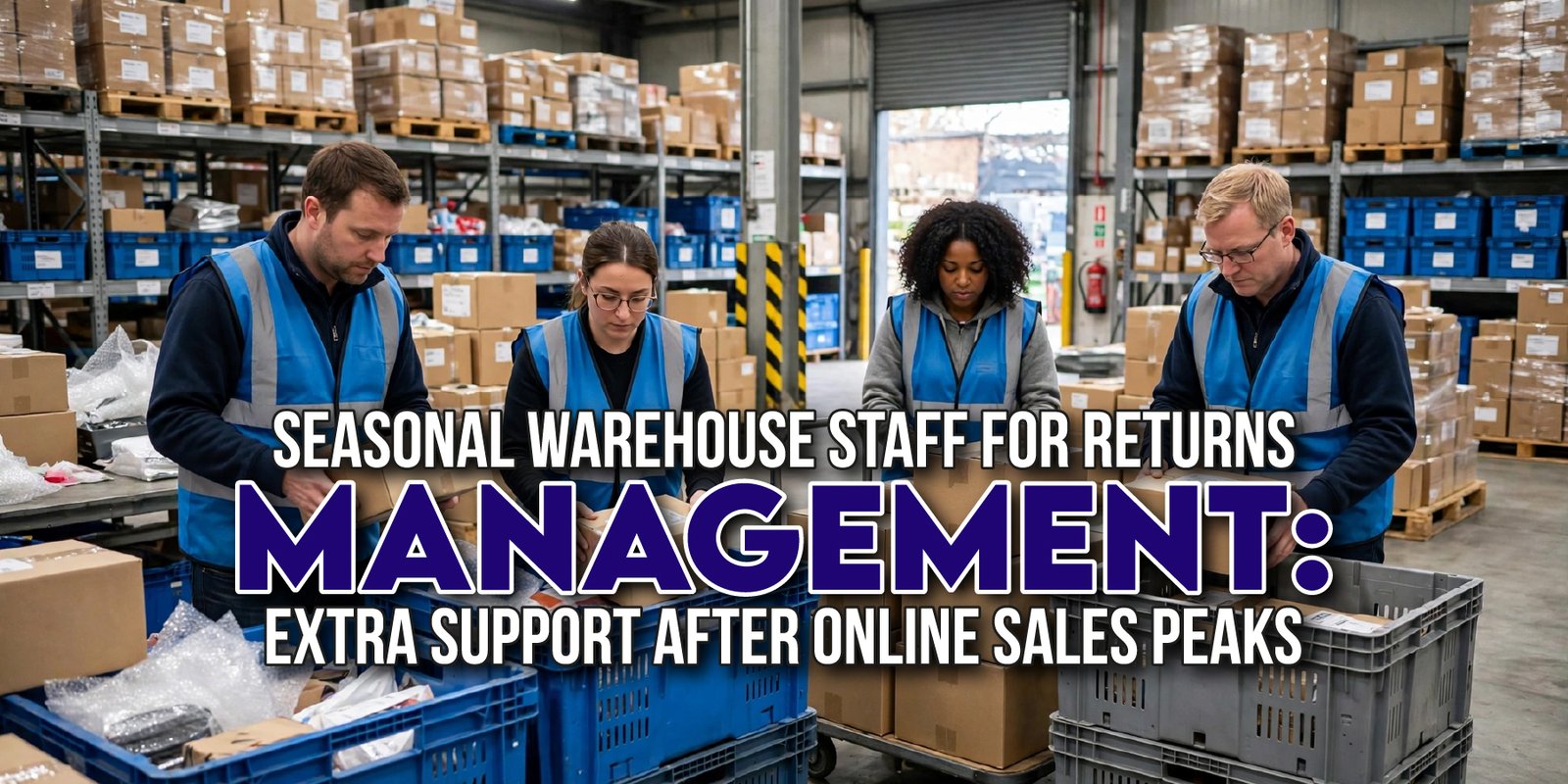
Seasonal Warehouse Staff for Returns Management: Extra Support After Online Sales Peaks
The orders may have left the building, but the work has not finished. After Christmas, Black Friday and major online promotions, returned parcels can arrive while warehouse teams are still packing new customer orders. Each return needs receiving, identification, sorting and an approved next step. Consequently, seasonal warehouse staff can help employers manage incoming workloads without shifting every permanent operative away from outbound fulfilment.
However, temporary headcount only helps when managers understand where returns accumulate. A receiving backlog needs different skills and equipment from a queue awaiting condition checks. Likewise, repacking needs clear instructions.
Quick Answer: How Can Seasonal Warehouse Staff Support Returns Management?
Seasonal warehouse staff can provide temporary labour for receiving parcels, scanning returns, sorting products, assisting with condition checks, repacking eligible goods and restocking approved items. Employers can arrange additional shifts around fluctuating returns while protecting their permanent teams’ outbound capacity. Effective support depends on workload forecasts, safe induction, clear product-handling rules and appropriate supervision.
Why Online Sales Peaks Create Additional Returns Work
A promotion generates outbound demand immediately, but returned goods may arrive over a longer period. Therefore, receiving docks can become busy even after the original dispatch surge ends. Seasonal warehouse staff may help separate this incoming workload from everyday replenishment and customer orders.
Furthermore, not every returned parcel follows the same process. Unopened goods, damaged products and items missing identifiers may require different checks.
What Do Seasonal Warehouse Staff Do in Returns Operations?
Seasonal warehouse staff can work on clearly defined stages of an employer’s reverse-logistics process. Typical duties include unloading permitted parcels, scanning barcodes, locating return references, sorting packages and moving approved stock to the correct location.
For example, returns processing staff may record parcel details while trained colleagues decide whether products need further inspection. Similarly, temporary workers can support labelling and repacking where site procedures identify the goods as suitable.
Returns Processing Staff, Warehouse Sorters and Repacking Staff: What Is the Difference?
| Role | Main responsibilities | Skills or instructions required | When extra cover helps |
|---|---|---|---|
| Returns processing staff | Receive, identify and record returned parcels | Return references, scanning and exceptions | Unopened returns build up at goods-in |
| Warehouse sorters | Route products by category, location or condition flag | Sorting codes, manual handling and segregation | Items wait for their next process |
| Repacking staff | Repack suitable products to site specifications | Approved packaging, labelling and quality rules | Cleared items wait for stock movement |
| Stock-handling operatives | Move approved inventory and reconcile locations | Stock-system procedures and handling restrictions | Restocking queues grow |
| Fulfilment centre staff | Support wider packing, picking or despatch duties | Task-specific system and safety induction | Returns compete with outbound orders |
Seasonal warehouse staff should not independently certify electrical safety, judge hazardous materials or release unsuitable products for resale without appropriate competence and authorised procedures.
How Does the Returns Processing Workflow Operate?
A defined workflow helps deploy seasonal warehouse staff safely. The exact steps depend on the products and the warehouse’s management system.
- Receive parcels into an identified returns area and record arrival.
- Scan labels, order identifiers or return authorisations.
- Identify the product and match it with the expected return record.
- Sort items by category and the next processing route.
- Check condition against written criteria, escalating unclear findings.
- Segregate damaged, potentially unsafe or unidentified goods.
- Repack only items that authorised procedures have cleared.
- Label and restock goods approved for storage or future fulfilment.
- Transfer exceptions for specialist assessment, recovery or other authorised disposition.
Consequently, seasonal warehouse staff can follow repeatable instructions without being asked to determine product safety or resale eligibility themselves.
What Is the Difference Between Outbound Fulfilment and Reverse Logistics?
Outbound fulfilment moves sellable inventory towards customers through picking, packing and despatch. Reverse logistics manages goods returning through identification, assessment, recovery, restocking or approved disposal.
For seasonal warehouse staff, the distinction affects scanning screens, workstations, documentation and quality checks. A parcel received back from a customer must not automatically re-enter available stock. Instead, follow the employer’s documented release process and product-specific requirements.
When Should Businesses Hire Seasonal Warehouse Staff for Returns?
Plan seasonal warehouse staff around expected return-arrival periods after Christmas, Black Friday, Cyber Monday, clearance campaigns or product launches. Review your own historical returns data and any changes to sales, product mix and returns arrangements.
How Can Employers Forecast Returns Processing Labour?
Then subtract the productive hours already available from experienced staff after breaks, meetings and other duties.
Additional labour hours = forecast returns-processing hours − existing available productive labour hours.
For example, if an internal forecast identifies 240 hours of work and your existing team has 160 productive hours available, the illustrative gap is 80 worker-hours. These are hypothetical figures, not industry benchmarks. Convert the gap into shifts only after considering training, workstations and peak arrival windows.
Recheck capacity at receiving, sorting, quality assessment and restocking separately.
Temporary Warehouse Teams vs Permanent Staff for Returns Management
Permanent workers often provide systems knowledge, escalation decisions and consistent quality supervision. Meanwhile, seasonal warehouse staff may cover clearly defined, time-limited increases in scanning, sorting, handling and repacking tasks.
For consistently high returns, review permanent recruitment. Explore warehouse staffing services for employers for temporary or longer-term warehouse recruitment discussions.
How Can Additional Staff Support Sorting and Repacking?
Seasonal warehouse staff working as warehouse sorters can direct returned goods into the correct processing lanes once managers establish clear categories and exception rules. Repacking staff can then prepare products already authorised for restocking or onward movement. However, product suitability decisions must follow the site’s quality procedures.
Otherwise, a growing queue may simply move from sorting to repacking rather than disappear.
What Should an Employer Include in a Returns Staffing Request?
A practical staffing brief should explain the operational requirement rather than only a desired headcount. Give recruitment suppliers:
- Company and warehouse location, including access instructions.
- Forecast returns workload and the tasks causing pressure.
- Number of seasonal warehouse staff required for each role.
- Sorting, scanning, product checking or repacking responsibilities.
- Working days, shifts, breaks, start date and assignment duration.
- Required experience, product handling restrictions and system familiarity.
- PPE, induction, manual handling and equipment-training expectations.
- Named supervisors, exception-handling procedures and site contacts.
Request Seasonal Returns Warehouse Staffing Support
When the brief is ready, request seasonal warehouse staffing quotes through 1st Workforce. The agency supports UK employers with temporary warehouse and logistics recruitment, including operational packing and stock-handling needs.
Describe the roles, headcount, location and timing so the team can discuss suitable recruitment options.
How to Onboard Temporary Returns Processing Workers
Seasonal warehouse staff need a site-specific introduction before handling returned products. Start with emergency procedures, pedestrian routes, manual handling, safe parcel lifting, PPE and hazard reporting. Then demonstrate the returns system and explain which product categories require escalation.
Only authorised employees should carry out specialist inspections or release decisions.
How Should Employers Manage Returns Staff Shifts?
Match seasonal warehouse staff shifts to the arrival of returned parcels and to the capacity of later processing stages. For instance, morning unloading may need more receiving support, while a later shift focuses on restocking already cleared goods.
Returns Processing Staffing Around Heathrow and West London
Heathrow and West London warehouse employers should consider transport, shifts and site access. This does not mean every returns warehouse works at the airport or that workers automatically hold restricted-area permissions.
Employers in the area can explore staffing agency support near Heathrow.
How Should Businesses Compare Warehouse Staffing Agencies?
Ask each supplier how it assesses seasonal warehouse staff suitability, confirms assignment details and coordinates essential safety information. Seasonal warehouse staff requirements should be described consistently across providers so rates and responsibilities can be compared fairly.
What Should a Temporary Warehouse Staffing Quote Include?
| Staffing detail | What employers should check | Why it matters |
|---|---|---|
| Roles and headcount | Task descriptions and workers per shift | Clarifies required coverage |
| Assignment dates | Start, finish and flexible periods | Supports planning |
| Charges | Rate basis, minimums, VAT and extras | Allows total-cost comparison |
| Candidate suitability | Experience, checks and specialist restrictions | Avoids mismatched duties |
| Induction responsibilities | Risk information, training and PPE | Supports safe deployment |
| Changes and cancellation | Notice, substitutions and terms | Defines operational expectations |
| Communication | Supervisors, agency contact and timesheets | Helps resolve issues |
If your requirements are defined, you can discuss temporary warehouse staffing requirements and request a written proposal to compare with alternatives.
What UK Safety Responsibilities Apply to Temporary Returns Workers?
HSE guidance explains that the end-user business directing daily work has significant responsibility for agency and temporary workers’ safety. Consequently, employers using seasonal warehouse staff need suitable risk controls, induction, equipment instruction, traffic segregation and supervision.
Similarly, qualifying agency workers have relevant rights from the first day of an assignment. After a qualifying 12 weeks in the same role with the same hirer, additional equal-treatment rights apply to basic working conditions.
Common Returns Staffing Mistakes Employers Should Avoid
- Forecasting parcel arrivals but ignoring inspection and repacking capacity.
- Assuming seasonal warehouse staff can make specialist product-safety decisions.
- Mixing returned stock with saleable inventory before authorisation.
- Using unclear sorting categories or missing barcode procedures.
- Forgetting manual handling, repetitive work and warehouse traffic risks.
- Requesting staff without providing shift, experience or induction details.
- Comparing agency charges without checking cancellations and exclusions.
- Assuming worker numbers or processing outcomes are guaranteed.
Seasonal Returns Staffing Checklist for Warehouse Managers
- Forecast returns by product type and processing stage.
- Measure current productive capacity and identify the real bottleneck.
- Separate approved restock items from damaged or uncertain goods.
- Define duties for sorters, receiving workers and repacking operatives.
- Check workstation space, scanners, packaging and system permissions.
- Calculate additional worker-hours and set realistic shift requirements.
- Prepare site induction, PPE, safety and supervisor arrangements.
- Compare agency role specifications, charges and contract terms.
- Confirm escalation, quality checking and stock-reconciliation procedures.
Frequently Asked Questions
What do seasonal warehouse staff do in returns management?
Seasonal warehouse staff can receive, scan, sort and move returned parcels according to an employer’s procedures. Some may help repack products that authorised processes have cleared for reuse or restocking. Employers must define role boundaries, train workers for site systems and keep specialist product decisions with competent personnel.
Why do warehouses need extra workers after Christmas?
Post-Christmas deliveries back to the warehouse can overlap with ongoing fulfilment, stock counts and replenishment. Therefore, receiving and processing returns may create a temporary workload gap. Seasonal warehouse staff can be considered when forecast hours exceed existing capacity, provided workstations and supervisors can accommodate extra people.
What roles are involved in processing customer returns?
Common functions include returns receiving, reference scanning, warehouse sorting, condition-check support, authorised repacking and stock movement. The actual division depends on product types and the employer’s system. Seasonal warehouse staff should follow written workflows and refer uncertain or potentially hazardous products to designated colleagues.
Can temporary staff handle sorting and repacking?
Yes, subject to the site’s procedures, suitable induction and worker competence. Warehouse sorters can categorise goods, while repacking staff can prepare items approved for the next stage. Neither role automatically authorises technical safety assessments or resale decisions. Confirm duties and escalation rules before assignments begin.
When should employers hire returns processing staff?
Begin reviewing requirements ahead of anticipated returns after Black Friday, Christmas and other campaigns. Use your own sales and historical return patterns to identify likely workload periods. Then confirm shift plans, training capacity and role specifications with recruitment providers rather than relying on assumed placement lead times.
How can businesses estimate the number of returns workers required?
Forecast handling hours across receiving, scanning, sorting, repacking and restocking, then subtract available productive worker-hours. Convert the remaining gap into shifts, accounting for training and supervision. For seasonal warehouse staff, site-specific processing times are more useful than unverified general industry averages.
What training should returns processing staff receive?
Give seasonal warehouse staff site induction and manual handling guidance, warehouse traffic rules, emergency instructions and task-specific training. Staff need to understand barcode systems, sorting categories, damage reporting and when to escalate an item. Additionally, employers must verify competence before allowing workers to operate machinery or undertake specialist inspections.
How do employers compare temporary warehouse staffing agencies?
Use one written role brief for every supplier. Compare shifts, worker requirements, recruitment terms, charge structure, induction responsibilities and communication arrangements. However, the lowest headline rate may not cover the same assignment conditions. Ask for clarification and avoid assuming immediate worker availability.
How can I request seasonal warehouse staff from 1st Workforce?
Provide the warehouse location, expected returns workload, seasonal warehouse staff roles, headcount, shifts and preferred dates. Include PPE, product-handling restrictions, essential experience and induction requirements. 1st Workforce can discuss suitable recruitment support for your operation; candidate availability and commercial arrangements require confirmation.
Preparing Your Warehouse Team for Post-Sale Returns Demand
Consequently, seasonal warehouse staff can provide targeted support when tasks, safety requirements and quality responsibilities are clear. Review the forecast regularly and keep inventory decisions under appropriate supervision.
Request Seasonal Warehouse Staff for Your Returns Operation
If your business expects increased customer returns, share your warehouse location, forecast workload, required roles, shifts and preferred assignment dates with 1st Workforce. Explain any product checks, training or handling restrictions so the agency can assess the request.
Get a quote for seasonal warehouse staff to discuss temporary staffing options for your receiving, sorting and repacking operations.
Leave a Reply