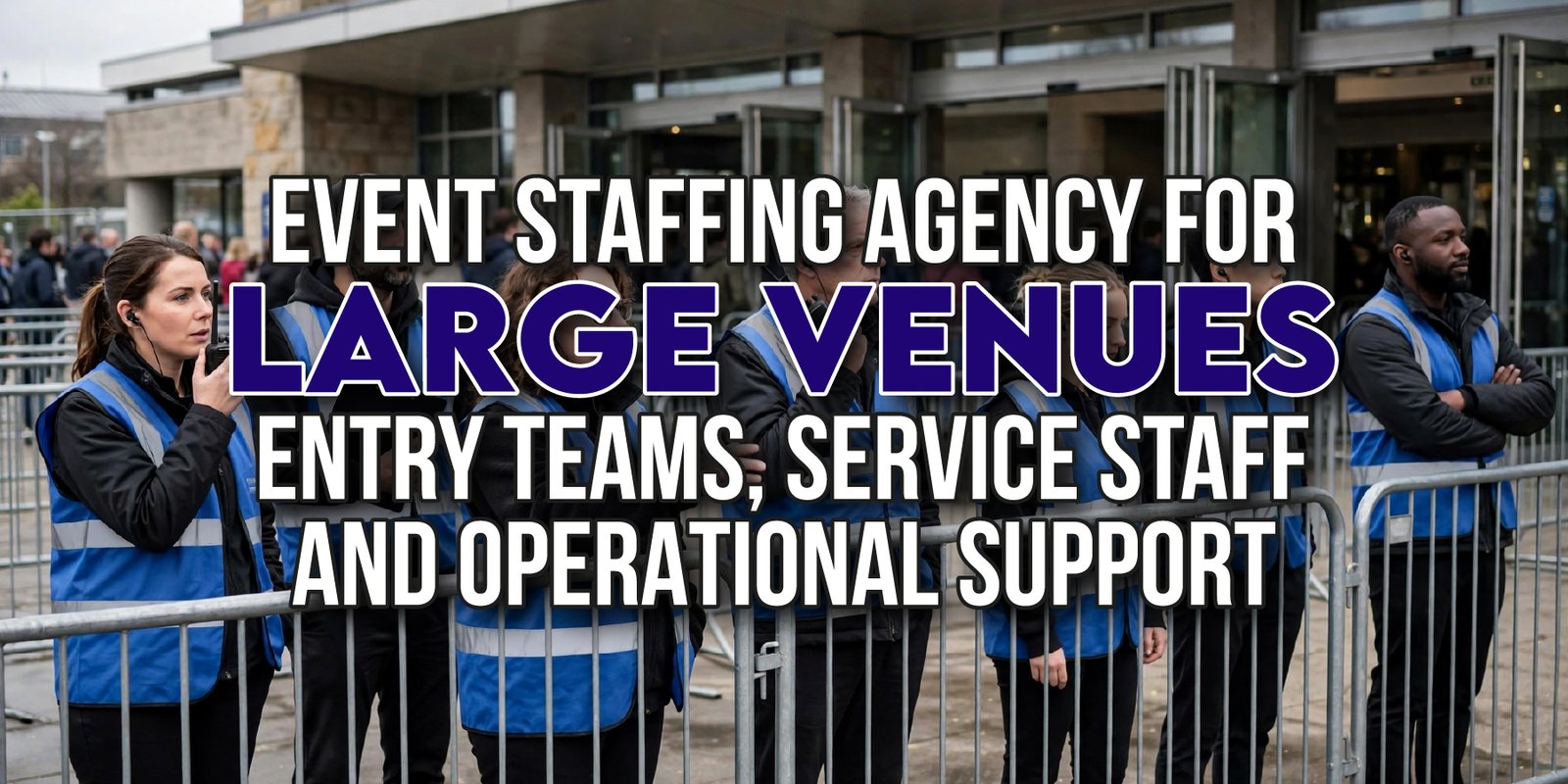
Event Staffing Agency for Large Venues: Entry Teams, Service Staff and Operational Support
A conference venue can face a quiet morning followed by a concentrated wave of registrations, catering requests and room changes. Similarly, exhibitions need different people during exhibitor set-up, visitor opening hours and breakdown. For organisers, an event staffing agency may help address temporary workforce gaps, but the right roles and clear instructions matter more than simply increasing headcount.
Quick Answer: How Can an Event Staffing Agency Support Large Venues?
An event staffing agency can help venues discuss temporary workers for entry assistance, guest service and operational support across changing event shifts. Organisers should forecast attendance and workloads, define each role, confirm specialist licences where required and prepare venue-specific briefings. Recruitment support supplements, rather than replaces, the organiser’s safety planning, supervision and responsibility for the event.
Why Large Venues Need Detailed Event Staffing Plans
When choosing an event staffing agency, remember that venue staffing demand changes across the event lifecycle. Registration may need more support shortly before opening, while hospitality peaks around breaks and operational crews face concentrated work during changeovers.
Which Roles Might Large Venues Need?
An event staffing agency discussion starts with a precise description of duties.
| Event role | Typical duties | Staffing considerations | Specialist checks |
|---|---|---|---|
| Entry assistants | Welcome visitors, explain routes | Arrival waves and accessible entrances | Duties must not cross into licensable security |
| Registration staff | Check delegate details, issue badges | Desk capacity, systems and privacy | Training on registration tools |
| Ticket-checking assistants | Verify admission documentation | Ticket formats and escalation routes | Security enforcement requires separate assessment |
| Ushers and information staff | Guide guests to rooms and seats | Room changes and accessibility | Venue orientation and instructions |
| Hospitality service support | Prepare and reset service spaces | Breaks, food service peaks | Relevant hygiene training and supervision |
| Back-of-house workers | Move supplies and support operations | Loading access and manual handling | Task-specific competence and safety controls |
| Set-up and breakdown support | Arrange furnishings and remove materials | Working hours and contractor coordination | Equipment authorisation where required |
Entry Teams: How Can Venues Manage Guest Arrivals?
An event staffing agency may discuss entry assistance focused on welcome and information. Staff might direct delegates to registration, check invitations or show guests where to find accessible routes.
Set a clear boundary between checking admission details and physically guarding access or dealing with disorder.
What Is the Difference Between Event Staff and SIA-Licensed Security?
Ordinary guest-service workers may check tickets, give directions and show visitors to seats. However, certain security activities, including guarding against unauthorised access or disorder, can require a Security Industry Authority (SIA) licence depending on the duties and circumstances.
SIA guidance distinguishes routine ticket checking from licensable door supervision and guarding; the position also depends on whether premises are licensed and how services are provided. Do not assign licensable duties to ordinary assistants or presume every steward needs an SIA licence.
Hospitality Event Staff: What Support Might Be Needed?
An event staffing agency may be asked about hospitality event staff for dining-room preparation, guest assistance, service replenishment or clearing and resetting tables. These needs often rise around scheduled refreshments and delegate breaks.
However, food preparation, handling and alcohol-related duties need appropriate arrangements. Before approaching an event staffing agency, specify food-contact tasks, hygiene requirements, applicable training, supervision and the exact service responsibilities.
Event Staffing Agency Support for Conferences and Exhibitions
Temporary event teams may assist with badge desks, exhibitor directions, visitor information, room resets and suitable back-of-house tasks. Each duty needs its own instructions and site access arrangements.
How Should Large Venues Estimate Staffing Requirements?
When briefing an event staffing agency, do not use an arbitrary worker-to-attendee ratio. Instead, combine anticipated attendance, arrival patterns, work per visitor, number of service points and actual available working hours.
For an event staffing agency brief, divide work by phase and location:
| Event area | Expected workload | Required role | Planned shift | Employer notes |
|---|---|---|---|---|
| Main foyer | High arrival concentration | Welcome and registration | Before and during opening | Badge equipment and queue routes |
| Conference rooms | Session changeovers | Ushers and information | Session blocks | Accessible seating directions |
| Refreshment area | Scheduled service peaks | Service support | Before, during and after breaks | Hygiene and catering supervision |
| Loading area | Set-up and breakdown activity | Operational support | Agreed access windows | Contractor coordination and handling rules |
What Should an Event Staffing Brief Include?
Include:
- Venue address, entrances, loading arrangements and reporting points.
- Event type, dates, expected attendance and operating phases.
- Number of workers required by role and shift.
- Specific duties, relevant experience and communication expectations.
- Any licences, qualifications or training that the actual tasks require.
- Dress code, accessibility considerations and approved equipment.
- Induction schedule, emergency information and responsible supervisors.
- Break arrangements, start and finish times, and any night work.
- Worker check-in process, escalation contacts and assignment duration.
How to Brief and Prepare Temporary Event Workers
For an event staffing agency placement, send instructions before each assignment, then run a venue-specific induction before work begins.
The linked resource on what candidates should know before an assignment may support general expectations; the venue must still provide its own role-specific instructions.
Request Temporary Staffing Support for Your Venue
Once roles and shifts are defined, request event staffing support and describe the workforce gaps.
Therefore, an event staffing agency enquiry should accurately distinguish general operational workers from regulated specialists.
What Should Venues Look for in Temporary Workers?
Match workers to duties rather than treating every role as interchangeable. For wider hiring considerations, see what employers look for in temporary workers. Good communication and a clear understanding of instructions matter for guest-facing support, whereas back-of-house roles may demand different manual-handling or equipment experience.
Planning Staffing Across Event Set-Up, Opening Hours and Breakdown
In an event staffing agency brief, set-up crews may need access to loading bays and clear handovers between contractors. During opening hours, guest services and registration take priority. Afterwards, breakdown work can involve heavy items, vehicle activity and late shifts.
Accordingly, event staffing agency requests should cover these phases separately.
How Should Venues Manage Staff Shifts and Supervision?
Assign a named supervisor to each work area. Furthermore, schedule breaks and handovers so service positions do not become unexpectedly unattended.
Event Staffing Agency and Venue Safety Responsibilities
An event staffing agency does not change the requirement for organisers to plan, coordinate and monitor event safety. HSE guidance covers the people attending, setting up and breaking down the event, while employers using temporary personnel retain relevant workplace responsibilities.
Provide event support staff with suitable induction, safe routes, task-specific information and emergency instructions. Moreover, coordinate venue management, catering providers, technical contractors and any licensed security team. Recruitment support cannot guarantee safe crowd movement or remove the organiser’s legal responsibilities.
Workers placed through an event staffing agency have relevant rights from the first day; qualifying workers generally gain equal treatment for basic working conditions after 12 weeks in the same role with the same hirer. These rights do not automatically make them permanent employees.
How Should Employers Compare an Event Staffing Agency?
Compare an event staffing agency by its response to the actual brief, not an unsupported promise about worker numbers. Ask how role requirements, experience, working hours and reporting arrangements will be discussed.
What Should an Event Staffing Quote Include?
Require written coverage of duties, shifts, costs and exclusions before comparing suppliers.
| Quote detail | What employers should check | Why it matters |
|---|---|---|
| Duties and headcount | Roles, numbers and qualifications | Prevents assumptions about coverage |
| Shifts and breaks | Dates, hours and overtime basis | Clarifies scheduled labour |
| Location and access | Venue, reporting point and transport constraints | Supports practical arrivals |
| Induction and supervision | Which party provides each element | Identifies operational responsibilities |
| Charges and VAT | Rates, minimums and tax treatment | Enables comparable total costs |
| Changes and cancellation | Notice, replacements and agreed terms | Clarifies commercial exposure |
| Specialist exclusions | Security, medical or technical tasks | Avoids unsupported service expectations |
For an event staffing agency, use identical written details when requesting a temporary staffing quotation.
Common Large Venue Staffing Mistakes
- Requesting an event staffing agency without separate entry, service and operational briefs.
- Treating ticket-checking assistants as licensed security personnel.
- Forecasting total attendance but ignoring concentrated arrival periods.
- Omitting staff induction, breaks or supervisor coverage.
- Forgetting set-up, changeovers, departures and breakdown shifts.
- Assuming temporary workers hold specialist qualifications without checks.
- Comparing quotations that cover different duties and cancellation conditions.
- Expecting a recruitment provider to manage event safety on the organiser’s behalf.
How 1st Workforce Can Help Businesses Discuss Temporary Staffing Requirements
1st Workforce supports UK employers with temporary cover, short assignments, shift assistance and longer-term recruitment. Through an event staffing agency enquiry, venue operators can explain their operational needs without assuming specialist services are available. Venue operators can explain their planned duties and ask whether suitable operational staffing support can be discussed.
Event Staffing Agency Checklist for Venue Managers
- Map event phases, entrances and service points.
- Calculate workloads and shifts by role, not just attendance.
- Identify any licensed or specialist tasks separately.
- Set supervision, breaks and emergency arrangements.
- Prepare site instructions and worker check-in information.
- Confirm relevant training, access and dress requirements.
- Share risk information with relevant recruitment and contractor contacts.
- Compare written agency scope, charges, VAT and exclusions.
- Reconfirm the final agreed roles and responsibilities before the event.
Frequently Asked Questions
What does an event staffing agency do?
An event staffing agency helps employers discuss recruitment for temporary event-related roles and changing operational needs. Depending on the provider’s verified capabilities, support may concern guest assistance, service activity or behind-the-scenes work. However, the organiser remains responsible for event safety, and specialist roles require appropriate checks rather than assumptions about universal availability.
Which staff roles do large venues need?
When approaching an event staffing agency, large venues may need registration assistants, ticket-checking support, ushers, visitor information, hospitality workers and operational teams. Requirements differ with the event type, attendance pattern and available in-house staff. An event staffing agency brief should specify tasks and shifts separately, with licensed security or specialist technical duties handled under appropriate arrangements.
Can temporary event teams assist with entry and registration?
Potentially, where suitable recruitment support is available. Typical duties include welcoming visitors, providing directions, checking invitations and assisting at registration desks. However, temporary event teams must receive suitable briefing and supervision. Physical guarding, enforcing access restrictions or responding to disorder can cross into SIA-licensable work depending on the circumstances.
What is the difference between event entry staff and licensed security?
Entry assistants generally provide information and routine admission help. Licensed security personnel may undertake specified guarding or door-supervision duties where SIA rules require a licence. Checking a ticket does not automatically create a security role, but refusing entry or guarding against disorder can change the legal position. Assess actual duties with specialist advice.
What do hospitality event staff do?
Hospitality event staff may help prepare service areas, assist guests, replenish supplies and reset dining spaces between sessions. Food handling and alcohol-related tasks require appropriate procedures, competence and supervision. Before booking, specify the precise tasks and ask the recruitment provider to confirm which roles it can consider rather than assuming every hospitality service is available.
How should organisers plan venue staffing?
Plan around event phases, expected attendance, arrival peaks, room changes, catering activity and breakdown. Allocate roles by task and shift, including supervisor cover, induction and rest breaks. An event staffing agency can discuss temporary recruitment needs, but event safety assessments and specialist staffing decisions remain the organiser’s responsibility.
How many event support workers should a venue request?
There is no universal headcount suitable for every event. Estimate work by service location, anticipated demand, shift length and existing staff capacity, allowing for training and breaks. Separately, follow the venue’s risk assessment and any applicable safety requirements. Do not treat a general operational workforce estimate as a statutory stewarding or security ratio.
What should an event staffing quote include?
Ask for role definitions, headcount, dates, shifts, relevant experience, charges, VAT treatment, overtime, cancellation terms and exclusions. The proposal should clarify who supplies induction, site supervision and required equipment. An event staffing agency quotation should distinguish ordinary support duties from services that need verified licences or specialist credentials.
How can employers request staffing support from 1st Workforce?
For an event staffing agency enquiry, provide the venue location, event type, dates, headcount by role, shift times and reporting arrangements. Include required experience, any licences or training, induction needs and access restrictions. 1st Workforce can review the request and discuss relevant recruitment options; do not assume every specialised event role or worker quantity is available.
Planning Suitable Staff Coverage for Large Events
A well-structured event staffing agency enquiry begins with clear duties, realistic shift forecasts and a boundary between ordinary assistance and regulated work. Above all, organisers should retain safety oversight and ensure every temporary worker understands the venue’s procedures before their assignment starts.
Discuss Your Venue Staffing Requirements With 1st Workforce
Share the event type, location, dates, required operational roles, worker numbers, shifts and induction arrangements. Explain any role-specific qualifications and identify separately managed licensed security or medical requirements.
Get a quote for temporary venue staffing support so 1st Workforce can review the request and discuss suitable recruitment options, subject to the particular assignment and availability.
Leave a Reply