
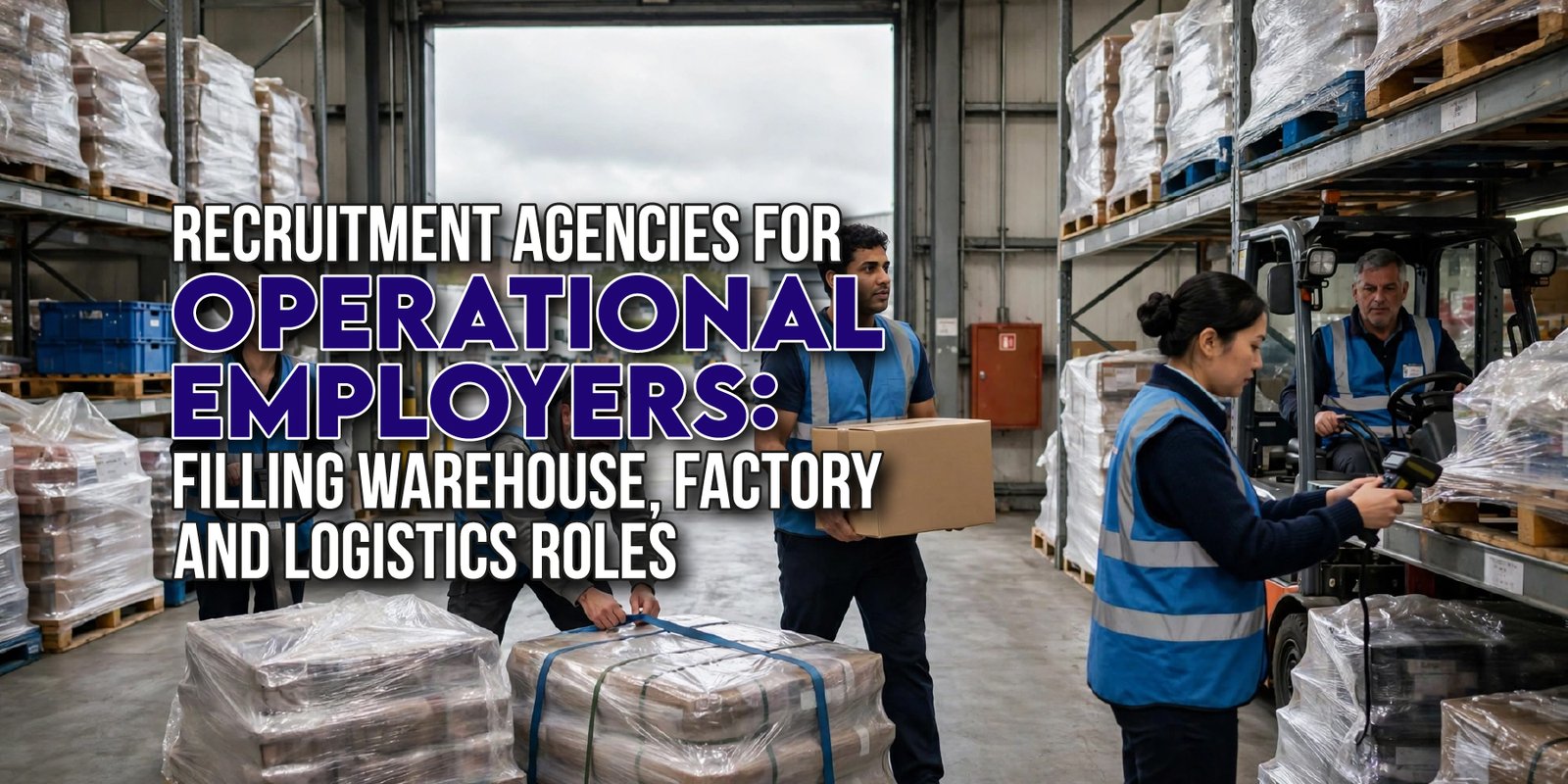
Recruitment Agencies for Operational Employers: Filling Warehouse, Factory and Logistics Roles
A warehouse may need weekend pickers while a factory requires operatives across rotating shifts. A distribution centre might have a permanent vacancy alongside sickness cover. Recruitment agencies can help employers respond to these different requirements, but the recruitment model must suit the work.
Choosing a supplier means more than asking for available people. Workers need suitable skills, reliable shift arrangements and proper instruction. Recruitment agencies also need accurate information about site risks, experience requirements and assignment duration. This guide explains how to plan warehouse, factory and logistics hiring, compare suppliers and prepare a useful staffing enquiry.
Quick Answer: How Can Recruitment Agencies Help Operational Employers?
Recruitment agencies help warehouse, factory and logistics employers source temporary workers for shift cover and permanent candidates for ongoing vacancies. Employers should define operational duties, headcount, shift patterns, experience, site conditions and start dates. A suitable provider can discuss candidate matching and workforce planning, while the hiring business retains important supervision and workplace safety responsibilities.
Why Operational Employers Use Recruitment Agencies
Recruitment agencies support companies whose labour requirements change by role, shift or season. For example, a warehouse may experience concentrated order-picking demand, while a manufacturer needs reliable cover for an established production line.
However, an agency cannot replace workforce planning. Employers should first distinguish predictable core requirements from temporary gaps, then describe the skills and hours required. This makes discussions about recruitment agencies more useful than a vague request for general labour.
What Is Operational Recruitment?
Operational recruitment means finding people for practical, often shift-based work that keeps warehousing, manufacturing, production and distribution running. Roles can involve order fulfilment, assembly, stock handling, packaging, goods-in and quality checks.
Unlike a generic office vacancy, the recruitment brief may need to specify manual tasks, production processes, protective equipment, physical conditions and relevant training. Therefore, recruitment agencies should understand what a worker will actually do on site.
Recruitment Agencies for Warehouse Employers: Which Roles Matter?
Warehouse recruitment covers several separate functions. Recruitment agencies may help employers discuss warehouse operatives, order pickers, packing workers, goods-in personnel and despatch support, depending on the supplier’s service and candidate availability.
| Warehouse role | Main activity | Employer information to prepare |
|---|---|---|
| Order picking operative | Locating and assembling orders | Picking method, scanners, accuracy checks |
| Packing operative | Checking and preparing consignments | Packaging standards, bench setup, labels |
| Goods-in worker | Receiving and recording deliveries | Handling processes, delivery schedules |
| Stock movement operative | Replenishment and internal movement | Equipment restrictions, routes and lifting |
| Despatch support | Sorting outgoing goods | Cut-off times, loading arrangements |
| Warehouse supervisor | Coordinating designated operations | Management experience and decision-making scope |
Do not assume a general operative has the authorisation to use a forklift or powered handling equipment. Specify required training and verification separately.
Factory Staff Agency: Which Workers Might Employers Need?
A factory staff agency brief should identify the product, production environment, duties and shift requirements. Possible roles include assembly workers, production operatives, packing-line workers, quality control assistants and food production personnel.
Recruitment agencies need to know whether work involves repetitive tasks, hygiene controls, temperature conditions or specialised machinery. However, no employer should treat previous factory experience as automatic permission to operate equipment. Task-specific competence checks, safe instruction and supervision remain essential.
For food processing and packaging, check whether the activity falls within Fair Work Agency gangmaster licensing rules. The rules apply to defined regulated activities, not automatically every factory role.
Logistics Staffing: Which Operational Roles Can Agencies Support?
Logistics staffing can cover warehouse-based distribution activity, stock movement, goods-in, goods-out and loading assistance. This is distinct from assuming a supplier offers regulated transport or licensed driving roles.
When comparing recruitment agencies, describe whether workers handle parcels, pallets, replenishment or despatch paperwork. Also highlight vehicle routes and equipment restrictions. A clear scope helps avoid assigning people to tasks beyond their verified competence.
Temporary vs Permanent Recruitment: What Should Employers Choose?
Temporary arrangements help address defined peaks or absences, while permanent recruitment suits enduring vacancies and core operational positions. Some recruitment agencies discuss both approaches, but contractual arrangements and charges can differ.
| Recruitment type | Suitable situations | Employer considerations | Planning question |
|---|---|---|---|
| Temporary staffing | Seasonal peaks, sickness, project work | Assignment dates, induction, hours | How long will the extra workload last? |
| Permanent recruitment | Core roles, sustained expansion | Experience, responsibilities, retention | Is the position needed year-round? |
| Mixed workforce | Stable base plus variable demand | Supervisors and training capacity | Which tasks need continuity? |
Consequently, recruitment agencies should understand whether the vacancy represents a temporary operational gap or a lasting staffing need.
How Should Businesses Prepare a Recruitment Brief?
Before asking recruitment agencies for staff, prepare one written brief:
- Business sector, worksite location and reporting contact.
- Job titles, duties, headcount and whether roles are temporary or permanent.
- Shift start and finish times, days, breaks and preferred start date.
- Assignment length or expected ongoing employment requirement.
- Essential experience, qualifications and equipment authorisations.
- PPE, access conditions, relevant hazards and manual handling demands.
- Induction process, supervisor details and any required site checks.
- Changes in anticipated demand and the process for requesting further cover.
A clear brief helps recruitment agencies discuss an actual assignment.
Request Operational Staffing Support From 1st Workforce
1st Workforce supports UK employers seeking temporary and permanent recruitment across warehousing, factories, manufacturing, fulfilment and logistics. Employers can request an operational staffing quote after preparing the site, role, headcount and shift information.
Unlike operators who manage the warehouse themselves, recruitment agencies focus on recruitment arrangements. Available candidates, commercial terms and suitable coverage must be discussed for each request.
How Does the Candidate Recruitment Process Affect Employers?
Candidate registration, availability checks and role matching affect the information an employer needs to provide. For example, unclear shift patterns can make it difficult to assess whether a person can take an assignment.
Understanding how recruitment agencies support jobseekers gives employers useful context about the candidate-facing process. Nevertheless, the hiring brief should remain focused on operational suitability rather than applicant career advice.
Warehouse and Logistics Staffing Around Heathrow
Employers around Heathrow and West London may have distribution, warehousing and logistics functions with particular access and shift considerations. However, proximity to the airport does not mean every job is an airside role or requires identical security checks.
Businesses can explore staffing agency support near Heathrow. Share the actual site location, access rules and duties so recruitment agencies can assess the enquiry without unsupported assumptions about airport permissions.
How Should Employers Compare Recruitment Agencies?
Evaluate recruitment agencies on more than a headline charge. Consider whether they understand your sector, can discuss the required roles, collect suitable candidate information and explain temporary or permanent arrangements clearly.
Additionally, ask about communication, replacement requests, induction coordination, charges and cancellation terms. No employer should assume the same staffing outcome or commercial conditions from every provider.
Recruitment Agency Comparison Checklist
| Agency selection factor | What employers should ask | Why it matters |
|---|---|---|
| Sector understanding | Which operational duties can you discuss? | Clarifies role fit |
| Candidate suitability | What experience and checks apply? | Supports realistic matching |
| Shift arrangements | How are shift details communicated? | Avoids ambiguity |
| Temporary or permanent model | Who contracts with and pays the worker? | Establishes responsibilities |
| Safety coordination | How will hazards and induction details be shared? | Protects workers |
| Commercial scope | What are the rates, terms and exclusions? | Enables fair comparison |
| Communication | Who handles changes or problems? | Supports operational planning |
If you are comparing recruitment agencies, discuss your logistics staffing requirements using the same brief supplied to other providers.
What Affects Operational Recruitment Costs?
Recruitment agencies may structure charges differently for temporary assignments and permanent placements. Role complexity, experience, headcount, location, shift timing and assignment duration can affect the proposal.
Therefore, ask for a written explanation of pay and charge arrangements, any applicable VAT, minimum booking terms, additional shift charges, cancellation provisions and agreed transfer conditions. Compare the complete cost of the arrangement rather than assuming a quoted rate covers every responsibility.
What UK Agency Worker and Workplace Safety Rules Should Employers Know?
UK guidance distinguishes an employment agency, which commonly introduces candidates employed by the hirer, from an employment business, which supplies temporary workers to work under the hirer’s direction. Both may commonly be called recruitment agencies, but the legal and payment arrangements differ.
Qualifying agency workers receive certain rights from day one, including access to shared facilities and vacancy information. After the relevant 12-week qualifying period in the same role, additional equal-treatment rights apply to specified working conditions; this does not create automatic permanent employment.
Furthermore, HSE explains that businesses directing day-to-day tasks retain significant responsibility for temporary workers’ safety. Employers must coordinate with suppliers, provide suitable risk information, site induction and supervision, and ensure necessary training before machinery use.
Common Recruitment Mistakes in Operational Businesses
- Asking recruitment agencies for ‘general workers’ without describing duties.
- Underestimating weekend, night or rotating shift requirements.
- Requesting cover too late to prepare suitable inductions.
- Assuming every factory worker can operate specialist equipment.
- Omitting PPE, access, hygiene or site-specific safety details.
- Choosing suppliers solely on an hourly or placement charge.
- Failing to clarify temporary versus permanent contractual responsibilities.
- Assuming candidate availability or placement outcomes are guaranteed.
Employer Checklist Before Requesting Staff
- Separate temporary shift gaps from permanent vacancies.
- Confirm roles, duties, headcount and worksite location.
- Specify shifts, start dates, duration and attendance requirements.
- Identify necessary qualifications and equipment authorisations.
- Prepare induction, PPE, safety and supervision information.
- Check whether sector-specific labour-provider licensing applies.
- Compare written commercial terms and recruitment responsibilities.
- Agree how staffing changes and queries will be communicated.
Frequently Asked Questions
What do recruitment agencies do for employers?
Recruitment agencies help employers identify candidates for specified roles, whether temporary assignments or longer-term vacancies. The precise service depends on the provider and arrangement. For operational employers, a useful recruitment enquiry includes site conditions, job duties, shift patterns and required competence. Employers should also confirm who pays, supervises and contracts with workers.
Can recruitment agencies supply temporary warehouse workers?
Yes, some recruitment agencies and employment businesses supply workers for temporary warehouse assignments, subject to suitability and availability. Employers should describe picking, packing, goods-in or dispatch tasks rather than requesting undifferentiated labour. Confirm working times, induction arrangements and site risks before relying on a proposed placement to cover operational demand.
How do employers recruit factory staff?
Start with a precise role brief covering manufacturing processes, shift patterns, expected duties and any safety-critical requirements. Then compare providers familiar with your sector. A factory staff agency should clarify relevant candidate checks, while the site manages appropriate task instruction and supervision. Specialist machinery and regulated food-processing work may need additional checks.
Which logistics roles can staffing agencies help fill?
Depending on their services, recruitment agencies may discuss goods-in, stock movement, packing, loading support and warehouse dispatch roles. Employers should specify actual duties, equipment restrictions, access arrangements and shifts. Do not assume a general logistics staffing service automatically includes licensed driving, specialist transport roles or workers with particular authorisations.
What is the difference between temporary and permanent recruitment?
Temporary recruitment typically covers defined shifts, seasonal demand or project work, while permanent recruitment serves ongoing roles. Recruitment agencies may facilitate both, but employment contracts and payment arrangements differ. Employers should ask who employs or pays each worker, how changes are managed and which commercial terms apply to the selected model.
What should employers include in a recruitment brief?
Specify location, headcount, work duties, temporary or permanent need, shifts, start date and assignment duration. Additionally, include essential experience, equipment permissions, PPE, induction and supervisor contacts. Complete information helps recruitment agencies understand the request and clarify uncertainties; it does not guarantee that suitable candidates will be available immediately.
How do businesses compare recruitment agencies?
Compare recruitment agencies by role suitability, sector understanding, recruitment process, communication and written commercial terms. Ask each provider how it addresses temporary versus permanent recruitment, shift requirements, worker competence and site safety information. Confirm contractual responsibilities and exclusions.
What should employers check about agency worker safety?
Before assignments begin, the hirer and staffing supplier should agree risk information, essential skills, PPE and site induction responsibilities. Managers directing work must provide effective supervision and task-specific training. Recruitment agencies do not remove the end-user business’s safety obligations, and untrained workers must not undertake specialist equipment tasks without suitable competence and authorisation.
How can I request operational staff from 1st Workforce?
Tell 1st Workforce your business location, the warehouse, factory or logistics positions required, headcount, working hours and preferred start date. Include assignment length, necessary experience, PPE and induction requirements. The agency can then discuss suitable recruitment options.
Choosing the Right Recruitment Approach for Your Operations
The most useful recruitment agencies understand the difference between an unexpected warehouse absence, a production surge and a lasting logistics vacancy. Start with the real work, choose an appropriate recruitment model and check suitability, supervision and contractual terms before committing.
Request Warehouse, Factory and Logistics Staff From 1st Workforce
If your business needs operational workers, share the job roles, site location, numbers required, shifts, start date and any site-specific training or PPE needs. 1st Workforce can review those details and discuss appropriate recruitment support.
Get a quotarehouse, factory and logistics staffing and compare the proposed service against your operational requirements.
Leave a Reply