
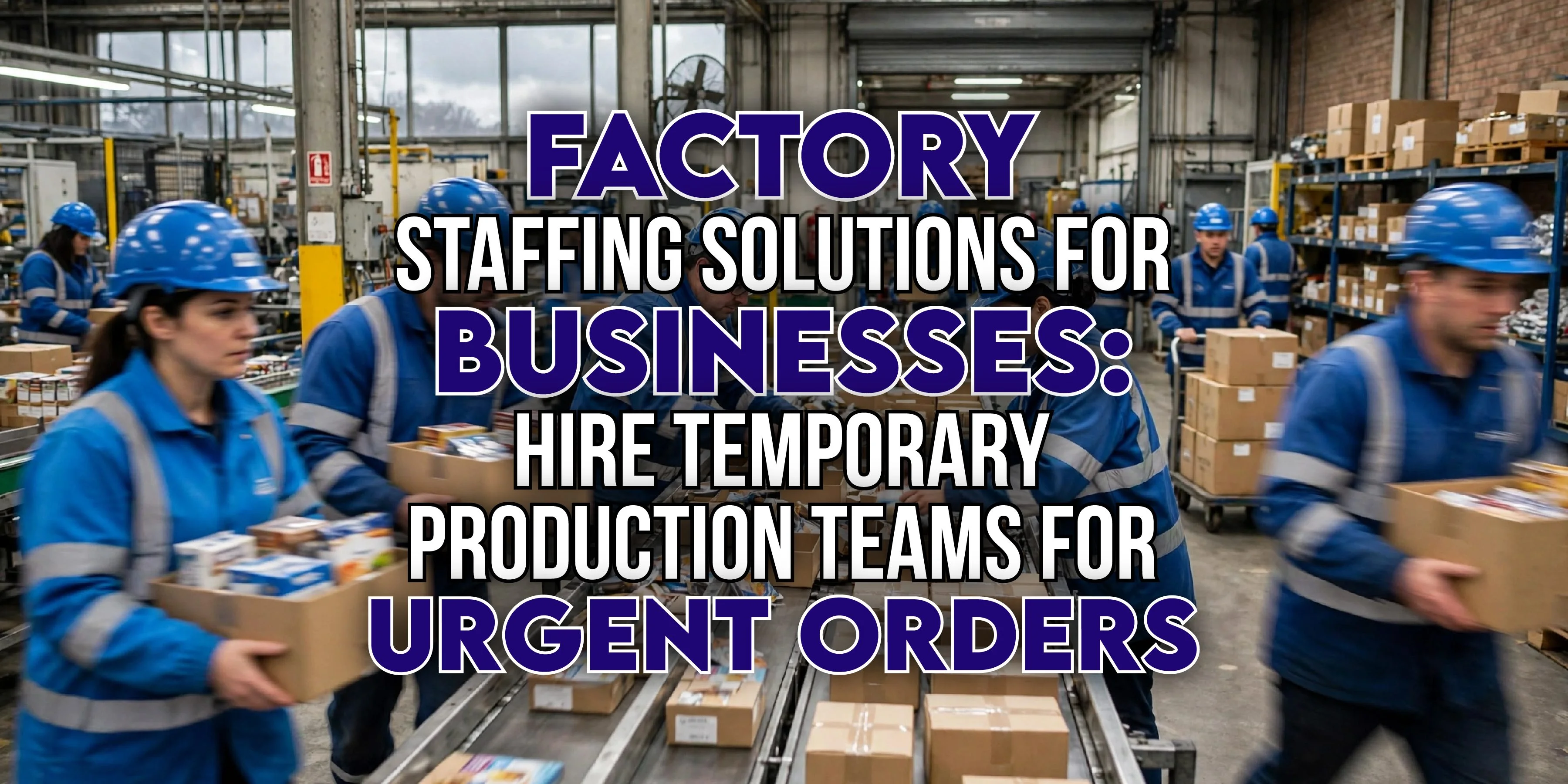
Factory staffing solutions can help businesses respond when an urgent order stretches the production plan. The first step is deciding which tasks actually need extra cover. Adding people across the factory without identifying the constraint can increase supervision demands while leaving the main delay untouched.
1st Workforce supports employers seeking temporary production workers and factory labour supply. Explain the order deadline, work involved and skills required so the enquiry can be assessed realistically.
Find the constraint before requesting a team
Walk through the production sequence from materials to finished goods. Is the delay in assembly, machine operation, packing, inspection or dispatch preparation? An extra packing team will not resolve a machine-capacity problem, and more assembly workers may not help if components are unavailable.
Separate tasks that suitable temporary workers could support after induction from duties requiring established technical knowledge. This gives urgent factory staffing a defined scope and helps avoid unsuitable assignments.
Create a minimum viable staffing brief
Speed matters, but a brief that leaves out key details can cause avoidable delays. Prepare the information a recruiter needs before making the enquiry.
Site postcode and first-shift reporting point.
Number of workers needed for each task and shift.
Essential experience and equipment responsibilities.
Start date, expected duration and production deadline.
Supervisor contact and induction arrangements.
Any working conditions that affect suitability.
Be explicit about which requirements are essential. If some tasks can be taught on site, describe the training available instead of presenting every preference as mandatory.
Stage arrivals around induction capacity
A large team arriving together needs enough supervision, workstations and instructions. Consider whether a smaller first group can be introduced effectively before a second group starts. The right sequence depends on your operation and the time available.
Prepare tools, materials and work instructions in advance. Temporary workers cannot contribute fully if they spend the opening part of a shift waiting for access, equipment or task allocation.
Keep one clear production priority
Urgent orders often compete with routine commitments. Tell supervisors which work takes priority and who can approve a change. Avoid giving new workers conflicting instructions from several departments.
Use a brief handover to record completed quantities, unfinished tasks and quality issues. If the order changes, update the role brief and staffing requirement rather than relying on informal extensions or unexpected duties.
Plan the end of the assignment
Agree how progress will be reviewed and how changes to duration will be communicated. Production team recruitment should support a defined workload, with enough notice to discuss extensions or a return to normal staffing levels.
Review accepted output and rework together. Increasing production speed only helps if completed work meets the required standard.
Can an agency promise same-day production teams?
Availability depends on location, skills, shift times and onboarding requirements. Discuss urgency openly, but base the operating plan on confirmed arrangements rather than an assumed start.
Establish what makes the order urgent
An urgent order can create several different pressures. The factory may need more output within an existing shift, additional operating hours or people for a particular stage such as packing. Identify the deadline and the work that must be completed before it. A broad request for a temporary production team does not explain whether the real gap is assembly, inspection, materials preparation or another task.
Ask the production manager to confirm the constraint using current information. If materials are unavailable or a required process is at capacity, extra operatives may not increase completed output. The staffing discussion should follow that assessment. Explain which duties can be supported by temporary workers after induction and which require experienced site personnel or specialist competence. A clear account of the urgent requirement helps the agency assess options without relying on an unrealistic assumption that adding people will automatically remove every delay.
Build a minimum workable team by role
List the positions needed for the proposed production period and describe how they interact. A team may require operatives for several stations and a supervisor who can coordinate the work. Do not assume that a group of individually suitable workers will function as a complete team without instruction and leadership. Identify which responsibilities remain with the manufacturer's existing staff.
Distinguish essential skills from duties that can be taught within the available time. If a role requires equipment competence, specialist checking or authorisation, state it explicitly. A generic factory labour supply request may otherwise attract candidates whose experience does not match the urgent task. The brief should make clear what each person is expected to do, who directs the work and how exceptions are handled. This gives the provider a practical basis for discussing availability and avoids discovering after arrival that a key responsibility was never included in the booking.
Use a realistic mobilisation timeline
Separate candidate identification, confirmation, arrival, induction and independent work. These stages take different amounts of time depending on the role and site. A worker being available to attend does not mean they can immediately operate unfamiliar equipment or complete a specialist task. Discuss the earliest realistic start for productive work rather than using a single urgent date that hides the preparation required.
Confirm what the site must provide before the team arrives. This may include access arrangements, instructions, workstations and a supervisor available for the briefing. Share any outstanding prerequisites with the agency. If the deadline cannot accommodate the required preparation, the production manager should reassess the plan rather than assume that induction can be omitted. Temporary staffing can support an urgent order, but it should be integrated into a workable process with clear responsibilities, suitable training and realistic expectations about the first shift's contribution.
Prepare the factory to receive additional people
Check that the proposed headcount can work effectively in the available space and that the required materials and equipment are ready. Several new operatives waiting for the same workstation do not create additional capacity. Review the practical flow of work and identify where supervision or supporting resources may become the next constraint. Resolve those issues before confirming a larger team wherever possible.
Provide clear arrival instructions, including the entrance, reporting point and named contact. Explain shift times and relevant clothing or equipment arrangements through the agreed process. Supervisors should know how many people are expected and which roles they are filling. A rushed first morning often reveals that different departments were working from different assumptions. A short readiness check helps connect the recruitment booking with the actual production plan, allowing the team to begin with a coherent briefing rather than several improvised task allocations.
Keep instructions stable during the first run
Urgent work can lead to frequent changes in priority, but new workers need a clear current instruction. Identify the person authorised to change the task sequence and explain how that change reaches the team. Avoid multiple managers giving competing directions to the same operative. Where a new product, material or packing format is introduced, confirm whether a fresh briefing or assessment is required.
Workers should know how to report uncertainty and when to refer an issue instead of improvising. Production pressure does not make an unclear requirement easier to follow. The supervisor should explain which checks and approvals remain necessary even when the deadline is close. Consistent instructions support both output and quality, while reducing rework caused by different interpretations of the same task. If the assignment changes materially, inform the agency so that suitability and the commercial arrangement can be reviewed against the current work rather than the original brief.
Plan supervision as part of production capacity
An experienced employee training new starters is contributing to mobilisation, even if their direct output falls during that period. Include that demand in the staffing plan. A supervisor cannot reasonably introduce a large team while also handling every production exception without support. Decide how many people can be inducted effectively and whether a phased start would suit the operation and available candidates.
Confirm who covers supervision during breaks or absence. Workers should have a clear contact throughout the shift, particularly where they are learning a process or completing tasks that require review. Record any limits on independent work and explain them to the people allocating duties. The agency needs feedback on how the placement is progressing, but day-to-day direction remains with the site's agreed reporting line. A realistic supervision plan makes the temporary team easier to integrate and helps prevent urgent cover from creating additional uncertainty for permanent staff.
Test the plan with a fictional order increase
Imagine a fictional manufacturer receiving an additional order that must be packed after an existing production run. The manager might initially request more production operatives, but a review could show that the main gap is packing and final checks. The appropriate staffing brief would then focus on those duties, with the required supervision and preparation, rather than adding people to a stage that already has enough capacity.
Use your own process records to estimate the work and allow for induction, breaks and exceptions. The example is not a staffing ratio or a claim about a real customer result. Its purpose is to demonstrate why urgency should sharpen the role definition rather than replace it. A clear workload review gives the agency useful information and helps the employer judge whether the proposed team can contribute to the deadline. It also identifies conditions, such as material availability, that remain outside the recruitment provider's control.
Monitor the order without rewarding shortcuts
Track completed work alongside quality, required records and the handling of exceptions. A high output figure can be misleading if the next stage must rework the product or investigate missing information. Explain the measures relevant to each role and make clear when supervisor approval takes priority over speed. Workers should be able to raise a genuine concern without being treated as an obstacle to the urgent order.
Review the first working period and give the agency specific feedback. Distinguish unsuitable experience from missing instructions, unavailable resources or a changed task. The response should address the cause rather than assume that replacing people is the answer to every delay. If the arrangement is successful and the order extends, discuss continuity early, subject to availability. Do not assume the same team can remain for an unspecified period or move to different shifts without confirmation through the agreed process.
Agree changes, overtime and the end of the assignment
Urgent production plans can change quickly, but the agency and workers still need clear information about hours and duration. Identify who can approve an extension and how it is communicated. Confirm the applicable terms before relying on additional time. A verbal request made to an operative should not be the only record of a material change to the assignment.
Plan the final handover as well as the start. Record unfinished work, outstanding checks and matters requiring an authorised decision. Explain who receives the records and how temporary access or equipment is returned. If the order is completed earlier than expected, use the agreed process for changing the remaining booking. Clear start, change and completion arrangements make urgent factory staffing more manageable for all parties and give the employer a useful record for reviewing whether the support met the actual production requirement.
Send a precise urgent staffing enquiry
Provide the location, deadline, tasks, headcount by role and shift times. State the essential experience, equipment requirements and induction available. Explain what has already been prepared and which details are still provisional. A clear enquiry allows 1st Workforce to assess candidate availability against the work rather than respond to a general request for people immediately.
Ask about the confirmation process, attendance communication and feedback arrangements. Identify the operational supervisor and the person authorised to approve commercial changes. Recruitment timelines depend on the role, location and availability, so avoid building the production plan around an unsupported guarantee. Temporary production team recruitment is most useful when it supports a defined, prepared operation. The employer's planning and supervision remain central to turning additional staffing into completed work that meets the order's requirements and can be handed over accurately to the next stage.
Request temporary factory support
Explore our factory staffing services and manufacturing staffing guidance. Send your urgent requirement to discuss a practical plan with 1st Workforce.