
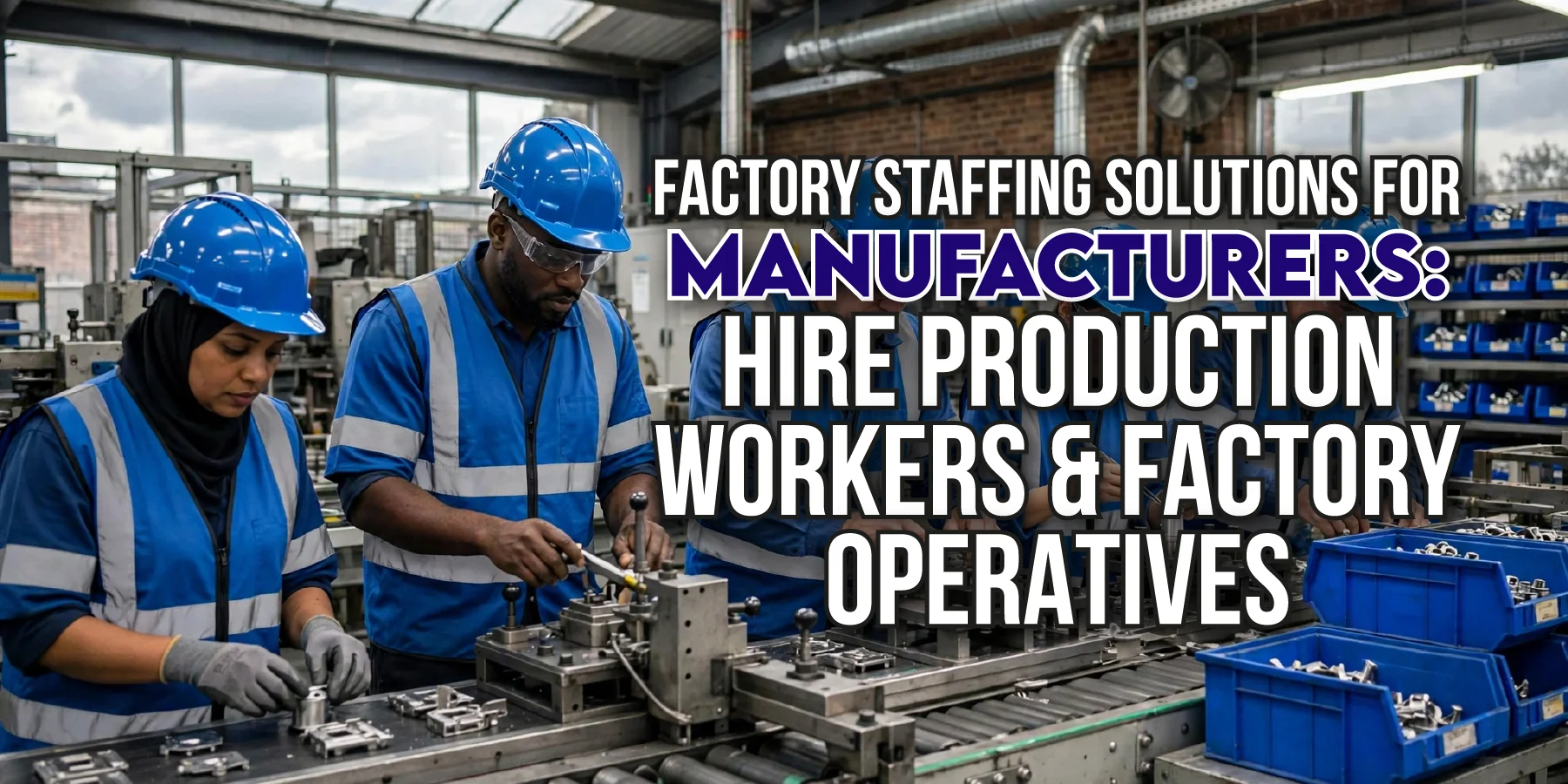
A food packaging factory receives a larger customer order while several production shifts have vacancies. The business needs additional packing and assembly personnel, but the production manager must also maintain quality standards and meet scheduled delivery requirements.
Factory staffing solutions can help manufacturers recruit suitable personnel for changing production demand. However, the right recruitment approach depends on the job roles, working hours, equipment and experience required.
For example, general factory operatives may support packing and product handling, while specialist machine operators need relevant competence and training.
Therefore, employers should define their production requirements before approaching a recruitment agency.
1st Workforce is a UK recruitment provider supporting manufacturing, food production, warehousing and related operational sectors.
This guide explains how manufacturers can use factory staffing solutions, plan headcount and choose suitable temporary or permanent recruitment arrangements.
What Are Factory Staffing Solutions for Manufacturers?
Factory staffing solutions are recruitment services that help manufacturers source suitable production operatives, packing personnel, assembly staff and other operational candidates. Depending on the requirements, an agency may discuss temporary assignments, seasonal cover or permanent recruitment. The appropriate arrangement depends on the factory's duties, shift patterns, location and candidate availability.
For example, a packaging manufacturer may need additional operatives for a defined production run.
Meanwhile, another business may require a permanent production supervisor.
Consequently, the recruitment process should reflect the actual vacancy rather than treat every factory position as interchangeable.
Which Production and Factory Roles Can Recruitment Agencies Supply?
A manufacturing recruitment provider may help employers source candidates for several factory functions.
However, each role requires a clear description of the actual responsibilities.
Factory and Manufacturing Recruitment Roles
Role | Main Responsibilities | Operational Requirements | Relevant Skills or Checks | Recruitment Considerations |
|---|---|---|---|---|
Factory operative | General manufacturing and product handling | Production schedules | Relevant induction | Physical duties and shifts |
Production operative | Supporting manufacturing processes | Line targets and procedures | Process experience where needed | Production environment |
Assembly operative | Assembling products or components | Assembly instructions | Manual skills and accuracy | Product complexity |
Packing operative | Packing and labelling goods | Packaging specifications | Packing experience | Quality and output requirements |
Machine operative | Operating designated equipment | Machinery procedures | Relevant training and competence | Equipment authorisation |
Food production operative | Processing or packing food products | Hygiene and handling procedures | Appropriate food hygiene instruction | Site-specific requirements |
Quality-control personnel | Product inspection and reporting | Quality specifications | Inspection knowledge | Reporting responsibilities |
Production supervisor | Coordinating production personnel | Staffing and line management | Leadership and operational experience | Shift oversight |
Therefore, factory staffing solutions should begin with role-specific requirements rather than a general request for production personnel.
Factory Staffing Solutions for Production Line Operations
Production lines often involve several connected activities, including preparation, assembly, inspection, packing and dispatch.
However, each stage may require different experience and staffing levels.
Factory staffing solutions can help manufacturers discuss candidates for particular operational responsibilities.
For example, assembly personnel may follow product instructions, while packing operatives prepare completed goods for distribution.
Meanwhile, quality-control staff may conduct specified inspections before products move to the next stage.
Before requesting personnel, production managers should clarify the relevant duties, expected shift schedules and supervision arrangements.
Furthermore, specialist equipment requirements should be identified separately from ordinary manual production tasks.
Hire Factory Workers for Temporary and Seasonal Production
Manufacturers searching online to hire factory workers may need additional personnel for short-term or recurring production requirements.
For example, a food manufacturer may increase packaging activity before a seasonal sales period.
Alternatively, a factory may need temporary cover because several employees are unavailable.
Factory staffing solutions can support discussions about temporary staffing for:
Seasonal production increases
Additional customer orders
Short-term projects
Holiday cover
Staff absence
Extended manufacturing schedules
Packaging and labelling requirements
However, availability depends on the location, role, shift pattern and required experience.
Consequently, employers should provide as much advance notice as practical.
Machine Operative Recruitment and Specialist Factory Roles
Machine operative recruitment requires careful consideration of training and competence.
For example, a production facility may use specialist packaging, cutting or processing equipment.
However, general factory experience does not automatically qualify a candidate to operate every machine.
Factory staffing solutions should therefore identify equipment-specific requirements before candidate selection.
Employers should confirm:
Relevant operating experience
Adequate machinery training
Understanding of applicable procedures
Required site induction
Competence for the assigned equipment
Appropriate supervision
Relevant authorisation
The Health and Safety Executive explains that employers must ensure people using work equipment receive adequate training.
Therefore, the manufacturer's obligations continue even when personnel arrive through a recruitment provider.
Quality Control and Inspection Staffing in Manufacturing
Quality-control personnel support manufacturing processes through relevant inspection and reporting duties.
However, their responsibilities differ from general assembly or packing work.
For example, a quality-control assistant may inspect packaging against specified requirements or report products that do not meet the agreed standard.
Factory staffing solutions can support recruitment discussions for suitable quality-checking roles.
Relevant duties may include visual inspection, recording results, checking packing accuracy and reporting defects.
Nevertheless, specialist quality auditing may require additional qualifications or experience.
Employers should clarify whether the vacancy involves routine production checks or a more technical quality assurance function.
Factory Staffing Solutions for Early, Late and Night Shifts
Manufacturing operations may use early, late, rotating or overnight shift patterns.
However, the timing of a shift can influence candidate availability and recruitment suitability.
Factory staffing solutions should reflect the exact working schedule.
For example, a factory in an industrial area may have different travel considerations for an early morning start compared with an afternoon shift.
Employers should confirm:
Shift start and finish times
Break arrangements
Workplace access procedures
Relevant travel considerations
Required induction
Shift handover responsibilities
Expected assignment duration
Additionally, manufacturers must consider applicable working-time and rest requirements.
A recruitment brief should explain the actual shift rather than describing the position simply as full-time or temporary.
How Manufacturers Can Reduce Recruitment Delays
Recruitment delays sometimes begin with unclear job descriptions or incomplete production forecasts.
However, employers can reduce avoidable uncertainty through better preparation.
A practical recruitment approach involves:
Forecast production demand. Review confirmed orders and expected manufacturing activity.
Identify operational bottlenecks. Determine which production stage requires support.
Define the required roles. Separate assembly, packing and machine-operation duties.
Estimate personnel by shift. Use internal production records.
Confirm essential skills. Identify experience and machinery requirements.
Prepare workplace information. Include the factory address and operating environment.
Specify PPE. Confirm protective clothing requirements.
Plan induction. Arrange relevant workplace instruction.
Share the preferred start date. Explain assignment duration.
Review staffing needs. Update the recruitment provider when requirements change.
Factory staffing solutions work best when the employer provides accurate information.
However, these steps do not guarantee immediate recruitment or a fixed placement timeline.
How Many Production Operatives Does a Factory Need?
There is no universal production staffing ratio suitable for every manufacturing facility.
Headcount depends on the required output, production methods, equipment, shift duration and existing personnel.
Hypothetical Factory Staffing Calculation
Imagine a packing department needs to prepare 2,400 units during one shift.
The manufacturer's own records suggest that one suitable operative completes 300 units during the relevant working period.
Using these hypothetical assumptions:
2,400 ÷ 300 = 8 packing operatives
If five suitable operatives are already available:
8 − 5 = 3 additional packing operatives
Therefore, the employer may initially request three additional personnel.
However, this example does not represent an industry productivity standard.
Actual factory staffing solutions should consider product complexity, machine capacity, quality checks, breaks and supervision.
Factory Staffing Costs: What Should Manufacturers Compare?
The cost of factory staffing solutions depends on the roles, number of personnel and agreed recruitment arrangements.
However, no universal hourly agency charge applies to every manufacturing assignment.
Manufacturers should compare:
Required job role
Number of personnel
Shift duration
Assignment length
Relevant experience
Specialist equipment requirements
Agreed agency charge
Overtime conditions
Minimum booking requirements
Cancellation terms
VAT where applicable
Furthermore, employers should compare quotations that cover the same responsibilities and working arrangements.
A machine operative requirement may differ commercially from general packing recruitment.
Therefore, manufacturers should request a role-specific quotation instead of relying on assumed staffing prices.
What Should Manufacturers Check Before Choosing a Production Staff Agency?
Selecting a recruitment provider involves more than comparing the first commercial quotation.
A suitable provider should understand the required production duties, relevant experience and working arrangements.
When evaluating factory staffing solutions, manufacturers should review:
Relevant manufacturing recruitment experience
Candidate suitability procedures
Temporary staffing options
Permanent recruitment arrangements
Specialist machinery requirements
Recruitment communication
Contractual terms
Induction responsibilities
Relevant employment obligations
Shift cover requirements
Furthermore, employers may benefit from comparing local recruitment support when assessing site-specific recruitment considerations.
No recruitment provider should be chosen solely because it makes unsupported promises about placement speed.
Common Factory Recruitment Mistakes
Avoidable recruitment mistakes can create unnecessary operational delays.
Vague Job Descriptions
Describe the actual production duties and required experience.
Underestimating Headcount
Use production records and shift plans rather than assumptions.
Confusing Different Roles
Assembly operatives, packing personnel and machine operators do not perform identical duties.
Overlooking Training
Confirm relevant equipment competence before assigning specialist work.
Missing Shift Details
Provide exact start and finish times, including relevant break arrangements.
Insufficient Recruitment Notice
Where possible, forecast predictable seasonal requirements early.
For related operational planning, review planning additional personnel during operational peaks.
Incomplete Induction Planning
Prepare workplace procedures, PPE and relevant instruction before personnel begin.
Comparing Different Quotations
Assess proposals against consistent job descriptions and assignment terms.
Overall, factory staffing solutions should support a clear operational recruitment plan rather than compensate for incomplete information.
Employer Checklist Before Requesting Factory and Production Staff
A clear recruitment brief helps manufacturers explain their staffing requirements.
Before contacting a provider, prepare:
Company name
Factory address and postcode
Required production roles
Number of personnel
Actual job responsibilities
Preferred starting date
Shift start and finish times
Assignment duration
Required experience
Equipment and machinery details
Relevant training requirements
PPE requirements
Site induction arrangements
Food hygiene requirements, if applicable
Production supervisor details
Break arrangements
Forecast production demand
Additionally, manufacturers should consider choosing a recruitment provider for their site location.
For factories with associated warehousing operations, staffing considerations for busy warehousing operations may also provide useful comparisons.
UK Employer Responsibilities When Using Agency Personnel
Manufacturers using temporary agency personnel must understand their continuing workplace responsibilities.
For example, the hiring business remains responsible for relevant health and safety arrangements, including workplace instruction and suitable equipment.
Furthermore, agency personnel have certain rights from the start of an assignment and additional equal-treatment entitlements after the applicable 12-week qualifying period.
The recruitment provider and hiring business should exchange appropriate information about assignment requirements and working conditions.
Factory staffing solutions should also account for right-to-work responsibilities, manual handling, PPE and suitable machinery training.
For food processing and packaging assignments, businesses should establish whether sector-specific provider licensing is required.
These obligations depend on the relevant contractual and regulatory arrangements.
Frequently Asked Questions
1. What are factory staffing solutions for manufacturers?
Factory staffing solutions are recruitment arrangements that help manufacturers source suitable candidates for production, assembly, packing and related operational positions.
Depending on the provider and vacancy, these arrangements may include temporary assignments, seasonal recruitment or permanent placements.
However, recruitment suitability depends on the required duties, shift patterns, site location and relevant candidate experience.
2. How can companies hire temporary factory operatives?
Manufacturers can approach a relevant recruitment provider with information about the roles, headcount, production duties and shift requirements.
Additionally, they should identify any equipment, training or induction needs.
Factory staffing solutions can support these discussions, although actual candidate availability and recruitment timelines depend on the assignment.
3. What roles can a production staff agency recruit for?
A production staff agency may support recruitment for factory operatives, assembly personnel, packing staff, machine operators, quality-control candidates and supervisors.
However, each position requires different experience and suitability checks.
For example, specialist machine operation may require equipment-specific competence, while general packing duties may involve different training and workplace procedures.
4. Can manufacturing recruitment services cover seasonal production peaks?
Manufacturing recruitment providers may support temporary staffing discussions when factories experience seasonal orders or additional production requirements.
However, the ability to source suitable personnel depends on the job, location and timing.
For a related operational comparison, employers can review warehouse staffing during peak demand.
5. What qualifications should employers check for machine operatives?
Employers should confirm relevant experience, training and competence for the actual equipment used.
Furthermore, personnel may need site-specific instruction and appropriate authorisation.
A general factory background does not automatically establish competence with specialised machinery.
The manufacturer should assess the requirements under applicable workplace equipment and health and safety rules.
6. What is the difference between temporary and permanent production staffing?
Temporary recruitment generally addresses defined assignments, staffing gaps or changing production demand.
Permanent recruitment focuses on continuing roles.
However, neither arrangement is automatically cheaper or faster.
Factory staffing solutions should reflect the expected duration, responsibilities, supervision and commercial terms of the vacancy.
7. How can manufacturers reduce recruitment delays?
Manufacturers can reduce avoidable delays by preparing accurate job descriptions, forecasting headcount and specifying working hours.
Additionally, employers should confirm machinery requirements, site induction and the preferred start date.
However, factory staffing solutions cannot guarantee a particular placement time because recruitment depends on candidate availability and suitability.
8. How can employers request factory staffing from 1st Workforce?
Manufacturers can contact 1st Workforce with their factory location, required roles, number of personnel, shift schedule and expected start date.
The company can discuss suitable recruitment arrangements according to the assignment.
However, candidate availability, contractual terms and specialist suitability requirements depend on the employer's actual needs.
Request Factory and Production Staff From 1st Workforce
Manufacturing recruitment requires clear planning, accurate role descriptions and suitable personnel for each production function.
1st Workforce supports enquiries from factory managers, manufacturing directors, production supervisors, food manufacturers, packaging businesses and assembly operations.
Whether your business requires factory operatives, assembly personnel, packing staff, machine operators, quality-control candidates or permanent supervisors, factory staffing solutions should reflect your actual requirements.
Share your factory address, job roles, number of personnel, shift schedule, equipment requirements and preferred start date.
Candidate availability and commercial arrangements depend on the individual assignment.