
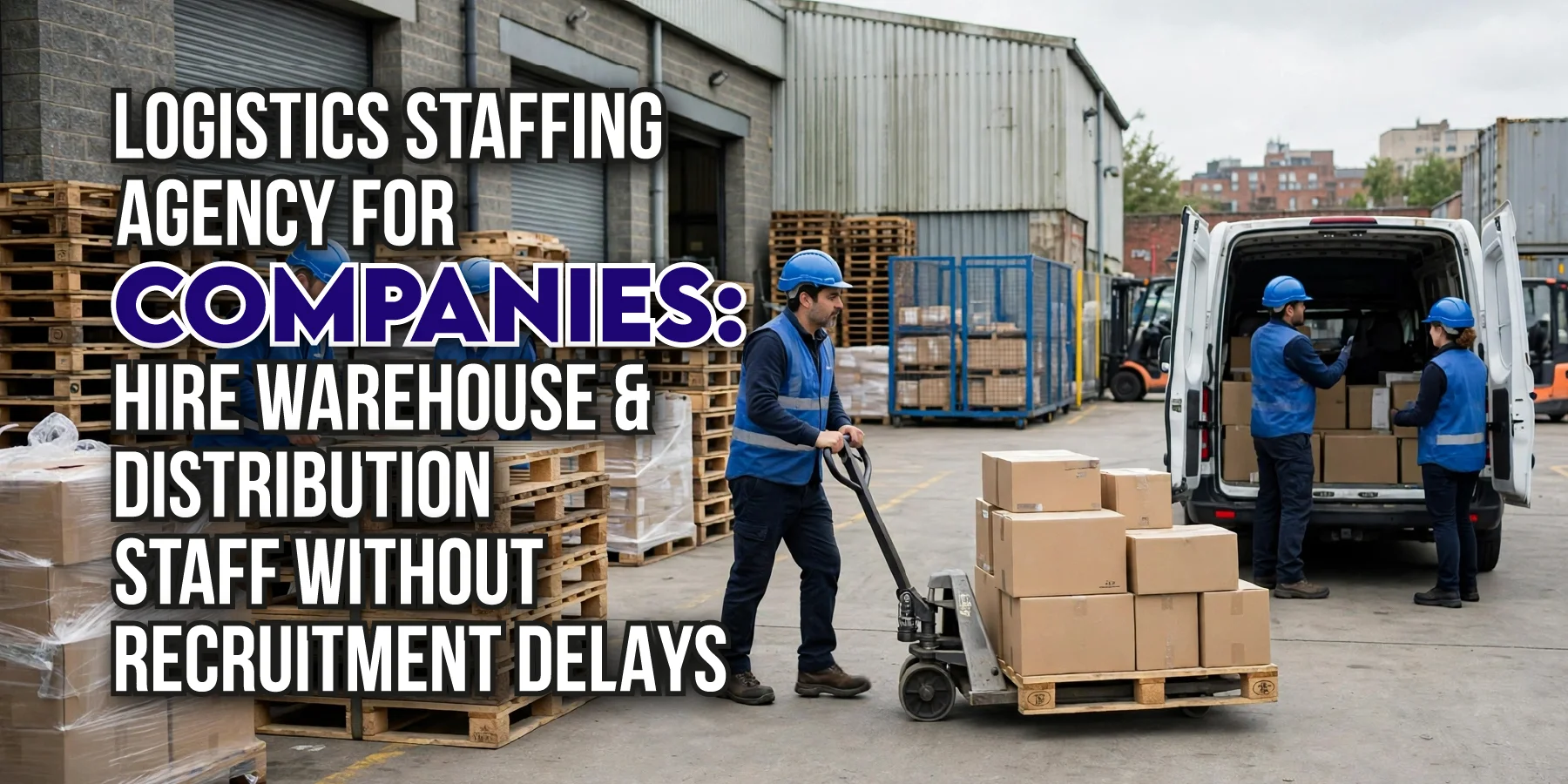
A distribution centre receives an unexpected increase in customer orders, but several packing and dispatch shifts remain understaffed. As order volumes grow, existing team members face greater pressure to maintain daily operations.
Working with a logistics staffing agency can help businesses identify suitable candidates and plan additional recruitment support before staffing gaps become more difficult to manage.
However, successful recruitment starts with defining the required roles, shift patterns, experience and operational responsibilities.
A warehouse needing order pickers may have different recruitment requirements from a distribution centre seeking forklift operators or permanent supervisors.
1st Workforce is a UK recruitment provider supporting companies across warehousing, logistics, distribution, manufacturing and fulfilment.
This guide explains how employers can reduce avoidable recruitment delays, identify suitable logistics personnel and prepare an effective staffing request.
How Can a Logistics Staffing Agency Help Companies Recruit Faster?
A logistics staffing agency helps companies define recruitment requirements, identify suitable candidates and explore temporary or permanent staffing arrangements. By establishing clear job duties, shift patterns, location requirements and essential skills early, businesses can reduce avoidable delays. However, actual recruitment timelines depend on candidate availability and the requirements of each assignment.
For example, a distribution centre requesting five packing operatives with clearly specified shifts gives a recruitment provider more useful information than a general request for warehouse personnel.
Therefore, employers should begin with an accurate operational brief.
Why Logistics Companies Experience Recruitment Delays
Recruitment delays do not always begin with a shortage of candidates. Sometimes, the problem is an incomplete or changing staffing requirement.
A logistics staffing agency may need additional information before identifying appropriate applicants.
Common causes of recruitment delays include:
Vague job descriptions
Incorrect staffing forecasts
Missing shift start and finish times
Unclear experience requirements
Short-notice requests
Specialist equipment needs
Difficult travel arrangements
Changes to assignment duration
Incomplete induction planning
For example, a warehouse advertising an ordinary operative position may later discover that the assignment requires specialist reach-truck experience.
Consequently, the original candidate criteria may no longer match the actual duties.
Accurate recruitment information can help prevent these avoidable problems.
Distribution Centre Staffing: Which Roles Should Companies Recruit?
Distribution centre staffing involves matching personnel to specific warehouse and logistics functions.
A logistics staffing agency can discuss relevant recruitment requirements, but employers must define the actual duties and site expectations.
Warehouse and Distribution Staffing Roles
Role | Typical Responsibilities | Recruitment Considerations | Relevant Experience or Checks |
|---|---|---|---|
Warehouse operative | Goods handling and general warehouse tasks | Physical duties and shift requirements | Relevant experience and induction |
Order picker | Selecting goods for customer orders | Picking methods and order accuracy | Picking-system familiarity |
Packing operative | Packing and labelling orders | Packaging procedures and accuracy | Relevant packing experience |
Goods-in operative | Receiving and checking deliveries | Delivery schedules and stock procedures | Goods-receiving experience |
Dispatch operative | Preparing orders for collection | Carrier deadlines and loading procedures | Dispatch-process knowledge |
Forklift operator | Operating specified lift-truck equipment | Training, competence and site authorisation | Relevant equipment training |
Stock-control assistant | Supporting inventory records and checks | System knowledge and attention to detail | Stock-control experience |
Warehouse supervisor | Coordinating operational personnel | Leadership, reporting and shift oversight | Relevant supervisory experience |
For example, a company experiencing delays at its dispatch stage may need dispatch personnel rather than additional order pickers.
Therefore, logistics staffing agency discussions should focus on the specific operational bottleneck.
Temporary Logistics Staff for Busy Warehouse Operations
Temporary logistics staff can support businesses experiencing changing operational demand.
For example, a fulfilment centre may require additional packing personnel during a promotional campaign.
Meanwhile, another warehouse may need temporary cover because several employees are on annual leave.
A logistics staffing agency can discuss temporary arrangements for:
Seasonal order increases
Staff absence
Holiday cover
Short-term projects
Additional shifts
Order backlogs
Temporary operational changes
However, temporary recruitment should not be treated as a guarantee of immediate candidate availability.
The suitability of the arrangement depends on the role, location, working hours and assignment requirements.
Staffing for Goods-In, Loading and Dispatch
Goods-in and dispatch departments often work around delivery schedules and carrier collection times.
For example, several inbound deliveries may arrive during the same period while dispatch personnel prepare outgoing orders.
A logistics staffing agency may help employers discuss suitable staffing for these separate functions.
Relevant tasks can include goods receiving, stock movement, loading support, labelling and dispatch preparation.
However, general warehouse personnel should not automatically undertake specialist machinery duties.
Employers must identify required equipment, training and authorisation before assigning those responsibilities.
Specialist Warehouse Roles and Forklift Recruitment
Forklift recruitment involves different suitability checks from general warehouse recruitment.
An employer may require experience with counterbalance trucks, reach trucks or other materials-handling equipment.
However, experience with one type of vehicle does not automatically establish competence with another.
A logistics staffing agency should receive accurate information about the required equipment and workplace duties.
What Employers Should Check
Before assigning an operator, employers should confirm:
Relevant basic training
Equipment-specific competence
Required conversion training where applicable
Workplace familiarisation
Site authorisation
Appropriate supervision
The Health and Safety Executive explains that lift-truck training includes basic training, specific job training and familiarisation.
Therefore, recruitment screening does not replace the employer's responsibility to ensure that personnel are competent and appropriately authorised for the machinery used.
How to Reduce Recruitment Delays Before They Affect Operations
Employers can reduce avoidable recruitment delays by preparing accurate information before approaching an agency.
The following process helps create a clearer recruitment brief:
Forecast demand. Review expected orders, deliveries and operational workload.
Identify bottlenecks. Determine which departments need personnel.
Calculate headcount. Estimate staffing needs for each shift.
Define job responsibilities. Separate picking, packing and specialist roles.
Confirm the site address. Include the postcode and relevant travel information.
Identify essential skills. Specify equipment knowledge and experience.
Plan induction. Prepare relevant site instructions and PPE arrangements.
Confirm the preferred start date. Explain any flexibility.
Agree communication arrangements. Identify the hiring manager and supervisor.
Review changing requirements. Update the recruitment provider when plans change.
A logistics staffing agency can work more effectively with a consistent brief.
However, these steps reduce uncertainty rather than guarantee a particular recruitment timeline.
Logistics Recruitment for Early, Late and Night Shifts
Shift timing affects recruitment suitability.
For example, a warehouse operating an early morning shift may need candidates who can reach the site before ordinary public transport services begin.
Similarly, late finishes can affect travel arrangements.
Therefore, a logistics staffing agency should receive exact shift start and finish times.
Relevant information includes break arrangements, site entry instructions, shift handovers and whether the assignment involves weekends.
Employers should also consider applicable working-time and night-work requirements.
How Many Warehouse Personnel Does a Distribution Centre Need?
There is no universal staffing ratio suitable for every distribution centre.
The appropriate headcount depends on actual workload, available equipment, shift duration and relevant productivity data.
Hypothetical Staffing Calculation
Imagine a warehouse expects to process 1,200 orders during a shift.
Its own operational records indicate that the packing department can complete an average of 100 orders per operative during the relevant working period.
Using those hypothetical assumptions:
1,200 orders ÷ 100 orders per operative = 12 packing operatives
If the department already has eight suitable packing operatives available:
12 required − 8 available = 4 additional packing operatives
Therefore, the business might initially enquire about four additional personnel.
However, this calculation is hypothetical and does not establish a general industry productivity standard.
Before approaching a logistics staffing agency, managers should adjust the estimate for order complexity, breaks, equipment and actual departmental performance.
Logistics Staffing Costs: What Should Employers Compare?
Logistics staffing costs depend on the requested roles, working hours and contractual arrangements.
A logistics staffing agency may quote differently for general packing assignments and specialist equipment positions.
However, employers should not assume one standard hourly charge applies to every warehouse.
Before comparing quotations, clarify:
Required role
Number of personnel
Hourly agency charge
Assignment duration
Shift length
Overtime arrangements
Specialist experience requirements
Minimum booking conditions
Cancellation terms
Invoice arrangements
VAT where applicable
Furthermore, the agency charge should not automatically be confused with the individual's gross pay.
Employers should compare quotations using equivalent roles and terms.
What Should Employers Check Before Choosing a Logistics Staffing Agency?
Choosing a recruitment provider involves more than comparing the first quotation.
A suitable logistics staffing agency should understand the requested roles and the employer's practical requirements.
Important questions include:
Does the provider recruit for relevant warehouse functions?
Can it discuss temporary and permanent options?
How does it establish candidate suitability?
What information does it require about shifts?
How are specialist equipment requirements addressed?
What are the contractual terms?
Who coordinates recruitment communications?
How are changes to assignments managed?
What responsibilities remain with the employer?
Additionally, review comparing local recruitment support when assessing geographic requirements.
No recruitment business should be selected solely on unsupported claims about speed or candidate numbers.
Common Warehouse Recruitment Mistakes
Avoidable mistakes can make warehouse recruitment more difficult than necessary.
Vague Job Descriptions
Specify the actual duties rather than requesting general warehouse personnel.
Missing Shift Information
Provide exact working hours, break arrangements and expected assignment dates.
Inaccurate Headcount
Calculate staffing needs according to department workload and existing personnel.
Confusing Different Roles
Do not assume picking, packing, dispatch and forklift positions require identical experience.
Overlooking Equipment Competence
Confirm relevant training and site authorisation for specialist machinery.
Insufficient Recruitment Notice
Where possible, plan ahead for predictable seasonal requirements.
For further guidance, review planning warehouse recruitment for busy periods.
Ignoring Candidate Travel
Consider whether the shift pattern is practical for the warehouse location.
Incomplete Induction Planning
Prepare PPE, manual-handling instructions and relevant workplace procedures before personnel arrive.
A logistics staffing agency can discuss suitable candidates, but operational supervision remains the responsibility of the employing or hiring arrangements and relevant site management.
Employer Checklist Before Requesting Warehouse and Distribution Staff
A complete staffing brief helps a logistics staffing agency understand the assignment.
Before requesting personnel, prepare:
Company name
Warehouse address and postcode
Required job roles
Number of personnel
Actual responsibilities
Preferred starting date
Shift start and finish times
Assignment duration
Relevant experience requirements
Specialist equipment competence
Site authorisation arrangements
PPE requirements
Induction procedures
Manual-handling requirements
Break arrangements
Reporting contact
Department supervisor
Expected changes in demand
Additionally, consider choosing recruitment providers for your site location when planning staffing across different warehouse locations.
UK Employer Responsibilities When Using Agency Personnel
Using temporary personnel does not remove a warehouse operator's responsibilities for workplace health and safety.
Employers and recruitment providers should establish who handles relevant employment checks, induction, training and assignment information.
Furthermore, the Agency Workers Regulations 2010 provide qualifying agency personnel with certain rights from the beginning of an assignment and additional equal-treatment rights after the applicable 12-week qualifying period.
A logistics staffing agency and hiring business should coordinate relevant information about working conditions.
Employers should also consider right-to-work requirements, working hours and appropriate workplace training.
For specialist equipment positions, the warehouse must ensure that personnel have suitable competence and authorisation.
Frequently Asked Questions
1. What does a logistics staffing agency do for UK companies?
A logistics staffing agency helps employers recruit suitable candidates for warehousing, distribution and related operational positions.
Services may include discussing job requirements, sourcing candidates and arranging temporary or permanent recruitment support.
However, the employer remains responsible for defining the actual duties, site procedures and operational supervision arrangements.
2. Can a logistics staffing agency help reduce recruitment delays?
A logistics staffing agency can help reduce avoidable delays when employers provide accurate staffing requirements early.
Clear job descriptions, shift times, site locations and experience expectations make recruitment discussions more focused.
However, actual recruitment times still depend on candidate availability, role requirements and relevant checks.
3. What types of warehouse and distribution staff can agencies provide?
Recruitment agencies may support relevant roles including warehouse operatives, order pickers, packing personnel, goods-in staff, dispatch personnel and supervisors.
Specialist positions may also involve forklift operators or quality-control candidates.
However, the available recruitment options depend on the provider's services and the specific assignment.
4. Can companies request temporary logistics staff for urgent shifts?
Employers can enquire about temporary logistics staff for unexpected absences, additional shifts and short-term operational requirements.
However, urgent requests do not guarantee immediate fulfilment.
Companies should provide the exact role, location, shift times and preferred start date so the provider can assess suitable recruitment arrangements.
5. What information should employers provide before requesting warehouse staff?
Employers should provide the required roles, headcount, site postcode, shift details, assignment duration and relevant experience.
Additionally, identify specialist equipment requirements, induction arrangements and the responsible supervisor.
For seasonal demand, review managing seasonal warehouse staffing requirements before finalising the recruitment brief.
6. Can a recruitment agency help with forklift and specialist warehouse roles?
A logistics staffing agency may support recruitment for suitable forklift and specialist warehouse positions.
However, employers must confirm the precise machinery, relevant training and individual competence.
An operator trained on one type of lift truck should not automatically undertake work with another machine without appropriate additional training and site familiarisation.
7. What is the difference between temporary and permanent logistics recruitment?
Temporary recruitment generally supports defined assignments, staffing gaps or changing operational demand.
Permanent recruitment focuses on continuing employment requirements.
However, the appropriate choice depends on the vacancy, workload forecast, commercial terms and recruitment priorities.
Some businesses use both arrangements to support their ongoing warehouse operations.
8. How can companies request warehouse and distribution personnel from 1st Workforce?
Employers can contact 1st Workforce with their warehouse location, required roles, number of personnel, shift times and preferred start date.
The company can then discuss relevant recruitment arrangements.
However, candidate suitability, availability and commercial terms depend on the specific assignment and business requirements.
Request Warehouse and Logistics Staff From 1st Workforce
Recruitment delays can create operational pressure across picking, packing, goods-in and dispatch departments.
A clear staffing brief gives employers a practical starting point when seeking additional personnel.
1st Workforce supports recruitment enquiries from warehouse managers, distribution centre operators, logistics businesses, e-commerce fulfilment companies and manufacturing employers.
Whether you require warehouse operatives, order pickers, packing personnel, dispatch staff, relevant forklift operators or permanent supervisors, a logistics staffing agency arrangement should reflect the actual site requirements.
Share your location, required roles, headcount, shift times and proposed start date to discuss suitable recruitment support.