
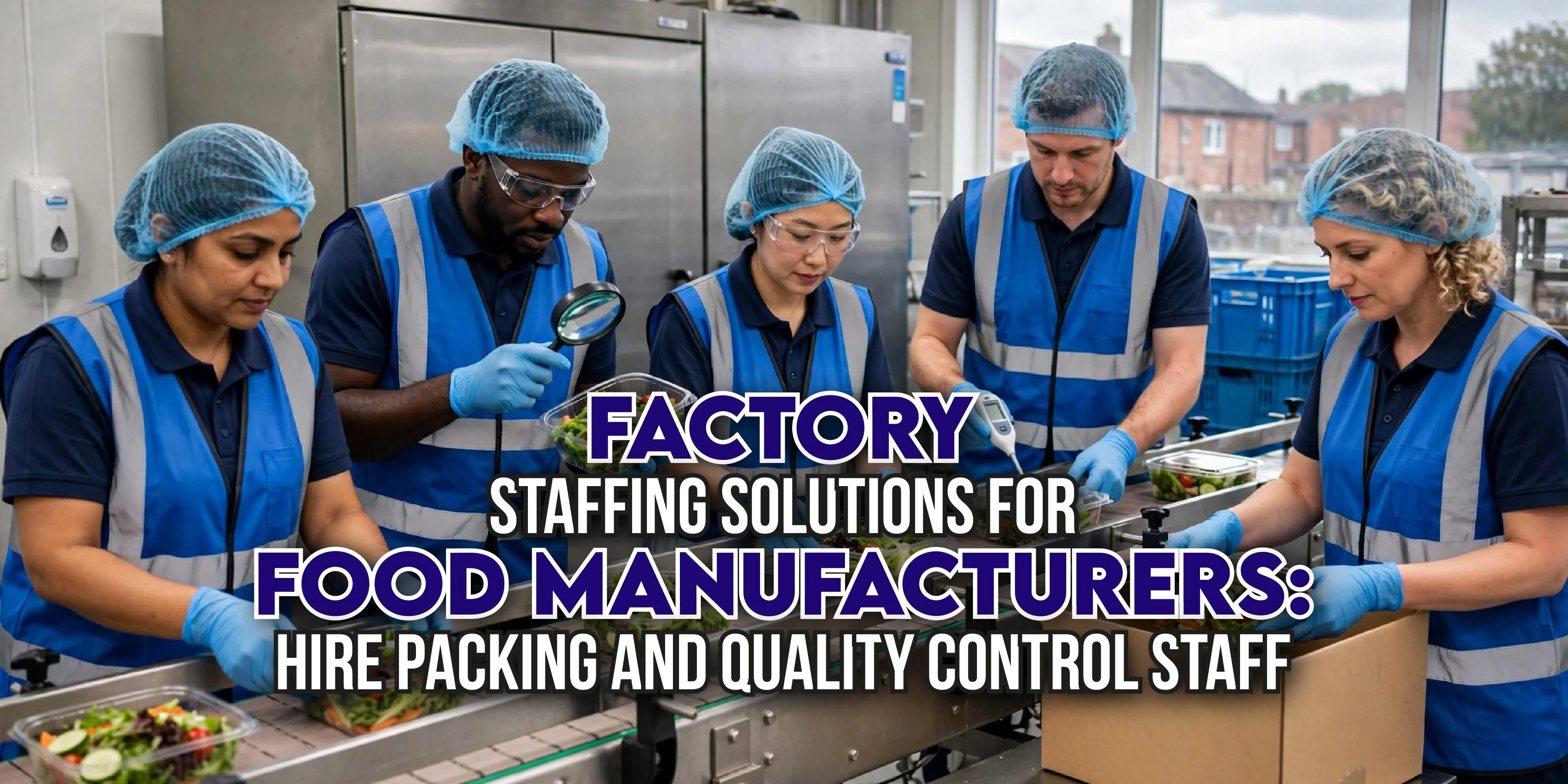
Factory staffing solutions for food manufacturers need to reflect the product, production environment and checks carried out at each stage. Packing operatives and quality control workers may work beside the same line, but their responsibilities are different. Defining those responsibilities before recruitment helps employers ask for suitable support.
1st Workforce offers food production staffing as part of its wider factory and operational recruitment services. We work from your role requirements, shift patterns and location rather than treating every production vacancy as interchangeable.
Identify where the production line needs support
A shortage at the packing stage can leave completed product waiting. A gap in inspection cover can delay checks or create extra work for supervisors. Before requesting staff, map where the line loses time and whether the issue is headcount, experience, training or task allocation.
For packing operative recruitment, describe the packaging format, pace of work, handling tasks and labelling responsibilities. For quality control workers, specify the checks they will perform, the records they must complete and the issues they must escalate.
Give packing and inspection separate role briefs
Packing support: preparing packaging, packing products and checking presentation against instructions.
Labelling support: following the site's approved label and batch procedures.
Inspection support: carrying out defined checks and recording findings.
Escalation: referring defects or uncertain results to the authorised person.
Do not assume temporary inspection staff can approve product release or make technical decisions. Assign those responsibilities explicitly to people with the required competence and authority.
Prepare induction before the first shift
Explain the working area, supervisor arrangements, hygiene procedures, protective clothing and task-specific training. Where the site separates products or production zones, tell workers which rules apply and who will explain them on arrival.
Practical details also matter: the correct entrance, changing arrangements, shift start time and break pattern. A worker arriving at the gate at the production start time may still need induction before joining the line.
Match cover to batches and changeovers
Food manufacturing workloads can vary with order volumes, product runs and packaging changes. Identify which positions require continuity and which tasks can be supported by additional operatives after induction.
Include time for handovers, line preparation and the site's cleaning arrangements. If production moves to a different product or packing format, review whether the role brief still matches the work.
Measure accuracy as well as output
Assess attendance, packing accuracy, completed check records and rework. Output alone can hide a presentation problem that later requires a batch to be checked again. Clear supervisor feedback helps distinguish a training need from an unsuitable assignment or unrealistic staffing plan.
Can a food factory staff agency provide short-term cover?
Temporary cover can be discussed for defined production periods, absence cover or changing order volumes. Available options depend on your location, working conditions and required experience.
Map the packing and inspection work separately
Begin with the product's journey through the relevant part of the factory. Identify the packing tasks, checks, records and handovers that take place before finished goods move on. A packing operative may follow a defined presentation standard, while a quality control worker may carry out specified checks and record results. The titles should reflect those differences rather than imply that either worker can substitute for the other without assessment.
Ask the production and quality leads to agree the brief before it reaches the agency. If they have different expectations, a candidate may arrive with experience that satisfies one team but not the other. Explain which decisions remain with authorised factory staff, including the handling of an exception or a product that does not meet the stated requirement. Recruitment support can help identify suitable people, but the manufacturer's procedures determine how the work is performed and who can approve the next step.
Describe the food-production environment honestly
Tell candidates about the conditions relevant to the assignment, including the working area, shift pattern and clothing arrangements. Explain whether the work involves chilled conditions, repetitive packing or other characteristics that affect the practical role. Avoid describing every vacancy as a standard factory job when the environment and procedures differ substantially between sites. Accurate information helps both the agency and the worker assess whether the assignment is suitable.
Identify the training and supervision the site will provide. Food-production procedures should be explained by the responsible business and matched to the worker's duties. Previous experience is useful, but it does not replace a briefing on the current product, area and process. Confirm how staff ask questions or report that they do not understand an instruction. The first shift should provide a clear introduction to the actual work, not rely on the assumption that a person who has worked in another factory already knows this site's arrangements.
Set out hygiene and task-specific instruction
The manufacturer should define the hygiene procedures relevant to the role and ensure workers receive suitable instruction and supervision. Explain what must happen before entering the production area, how concerns are reported and which activities require additional training. Keep the briefing connected to the site's food-safety management arrangements rather than relying on a generic certificate as proof that every task is understood.
For recruitment purposes, distinguish an essential prior qualification from training the business can provide. Do not create a requirement simply because it appears in another employer's vacancy. The government food-handler training guidance emphasise training and supervision appropriate to the work; the factory should confirm its specific needs with the responsible food-safety lead. Share those requirements clearly with the agency and allow time for the induction. A worker should not be put into independent production duties while the site is still deciding which instructions apply.
Make packing standards visible and usable
Packing accuracy depends on clear instructions about the product, packaging and required presentation. Explain how workers identify the correct materials and what they should do when something does not match the instruction. The site may use samples, approved visual aids or another controlled method. Whatever the format, workers need to know which version is current and who can clarify a discrepancy.
Avoid asking operatives to resolve product or labelling uncertainty through guesswork. A defined stop-and-refer process is more useful than a general instruction to keep the line moving. Supervisors should make it clear that raising a genuine query is part of doing the job correctly. When a product run or packing format changes, review whether the team needs a fresh briefing. An operative who performed well on one format may still need instruction on another, particularly where the visible differences are small but operationally important.
Define quality-control authority and record keeping
Quality control workers need to understand the checks they are assigned, the method to follow and the record to complete. State the experience or skills required to carry out those activities. Distinguish collecting information from deciding whether a product or batch can be released. The latter may remain with an authorised quality manager under the manufacturer's procedures, even where temporary staff support the checking process.
Explain how results and exceptions are communicated. Records should reflect the work actually completed, with uncertainties raised promptly rather than filled in later from memory. Confirm who reviews the record and what happens when the usual reviewer is unavailable. Recruitment discussions should include these responsibilities so that the agency can assess relevant experience. A broad request for “quality staff” gives little indication of whether the role involves visual checks, measurement, documentation or a specialist process requiring a different level of competence and supervision.
Match staffing to product runs and changeovers
The production schedule can create different demands across the same shift. A long run of one product may require a stable packing team, while several shorter runs introduce preparation and changeover work. Review the actual tasks and the people qualified or authorised to perform them. Do not assume that adding packing operatives will increase output if the bottleneck sits elsewhere in the process.
Build the staffing request around the periods when support is needed. Include the time for briefing, handover and the site's preparation arrangements. If a changeover requires specialist work, identify it separately rather than incorporating it silently into a general operative vacancy. Share schedule changes with the agency when they affect the assignment's skills or hours. A useful staffing plan allows the production manager to see which positions are covered and which responsibilities remain with experienced site personnel throughout the run.
Give supervisors capacity to introduce new workers
An experienced employee helping several new starters may temporarily contribute less direct output. Account for that training and supervision time when planning the first shifts. Introducing a large group at the busiest point of a production run can create pressure if the supervisor is also responsible for resolving equipment or quality issues. Consider a phased start where the operation and availability allow it.
Identify the person who confirms when each worker can perform an assigned task independently. Keep that decision linked to observed understanding and the site's procedures, not simply to the number of hours spent on the line. Workers should know whom to approach if an instruction changes or a problem appears. If the nominated supervisor is absent, provide an alternative. Clear supervision supports both the worker and the factory by preventing small uncertainties from turning into repeated errors across a full run.
Use a balanced review of the first production period
Review attendance, completed work, accuracy and the way exceptions were raised. Output figures alone may not show whether packing standards were met or whether records were completed correctly. Use measures that reflect the role and explain them to workers. A quality-control assistant should not be assessed as if speed were the only objective, while a packing operative needs a fair view of both pace and accuracy.
Discuss recurring problems with the agency using specific, factual examples. Determine whether the cause is a training gap, an unclear instruction, a change in the product or an unsuitable match. The appropriate response may be additional briefing rather than immediate replacement. Where a replacement is needed, update the role requirements so that the next candidate is assessed against the actual issue. Feedback is most useful when it helps the provider understand the work, rather than merely reporting that a person did not meet an undefined expectation.
Plan handovers between production and quality teams
A handover should identify unfinished work, outstanding checks and matters requiring an authorised decision. Give the incoming shift a clear account of what has been completed and what remains open. Avoid relying on a verbal message passed through several people, especially where the next team needs to distinguish an ordinary work queue from an item awaiting review under the site's procedures.
Use the manufacturer's approved records and information-sharing arrangements. Temporary staff should know how their work contributes to the handover without creating separate unofficial records. If a check or packing task could not be completed, record that fact and the reason through the proper process. Supervisors can then allocate work using accurate information. A consistent handover also helps the agency understand whether assignment changes are needed, such as different shift coverage or a role requiring more experience than the original vacancy description suggested.
Compare food factory staffing proposals by scope
Provide the same brief to any agency you are comparing. Include the duties, working conditions, shift times, essential experience and proposed duration. Ask how suitability will be assessed and how the agency will communicate attendance or replacement issues. Confirm the responsibilities for induction, supervision and feedback so that neither party assumes the other has completed a step that remains outstanding.
Discuss the full commercial arrangement and the process for changes rather than comparing an isolated headline rate. Explain whether production plans may change and how much notice can normally be provided. Availability will depend on the location, duties and timing, so avoid planning around an unsupported promise of immediate cover. A clear enquiry to 1st Workforce gives the provider a practical basis for discussing packing and quality control support while keeping the manufacturer's own standards, authorisations and day-to-day management central to the assignment.
Discuss your food production staffing requirement
Share your product type, line duties, shift times, headcount and assignment duration. Review our factory and quality control staffing services, then request a quote for packing and inspection support suited to your operation.