
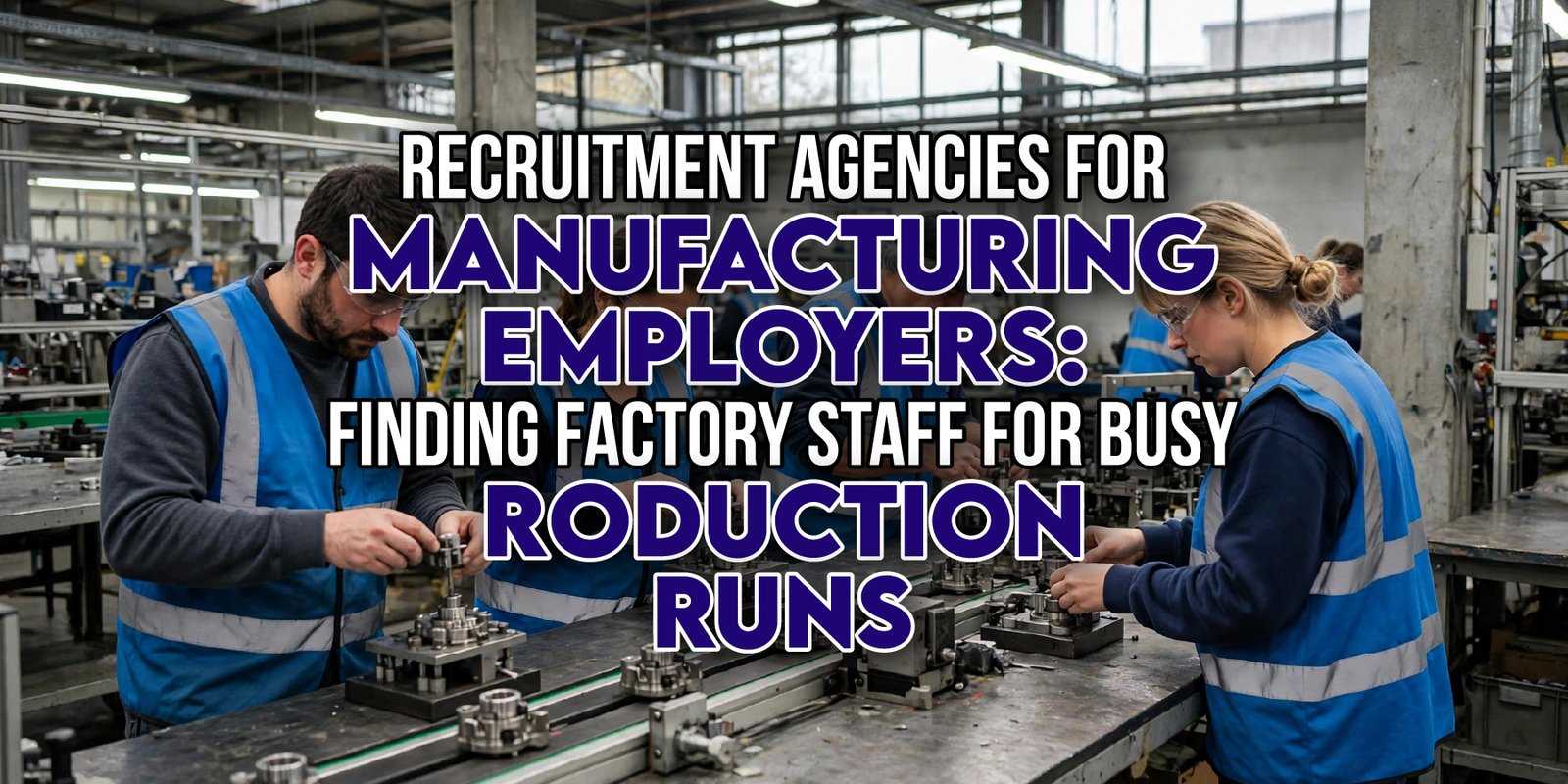
Recruitment Agencies for Manufacturing Employers: Finding Factory Staff for Busy Production Runs
A packaging line reaches its daily target, but a late customer order adds another run. Meanwhile, two experienced operatives are absent and the next shift has limited cover. For manufacturing managers, recruitment agencies can offer a way to discuss extra factory workers without assuming that every increase in output requires permanent headcount.
However, successful workforce planning begins on the production floor, not with a generic request for labour. Assembly, packing, materials movement and machine operation demand different skills, working arrangements and safety controls. Employers need to identify the actual constraint, calculate available hours and decide which roles are suitable for temporary support. This guide explains how to prepare that brief, compare recruitment agencies and protect production standards while staffing demand changes.
Quick Answer: How Can Recruitment Agencies Support Manufacturing Employers?
Recruitment agencies help manufacturers discuss temporary factory workers for production peaks, assembly, packing and absence cover, alongside permanent recruitment for ongoing roles. Employers should forecast labour requirements, define shift patterns, assess candidate suitability and prepare safe site inductions. Clear duties, equipment restrictions and supervisor arrangements allow recruitment agencies to review realistic staffing options without guaranteeing worker availability.
Why Do Manufacturing Employers Use Recruitment Agencies?
New contracts, seasonal orders and unexpected absences can change a factory’s labour requirements faster than its permanent recruitment plans. Recruitment agencies may help employers cover clearly defined gaps across shifts without disrupting the established core team.
What Makes Manufacturing Recruitment Different From General Hiring?
Manufacturing recruitment depends on the production process, shift pattern, hygiene requirements and the worker’s competence. Two vacancies described as production operative roles may involve very different materials, instructions and hazards.
Which Factory Roles Can Recruitment Agencies Help Fill?
The following table helps employers separate operational requirements before speaking with recruitment agencies. Actual role coverage depends on each provider and candidate suitability.
| Factory role | Typical duties | Experience or training considerations | Employer requirements |
|---|---|---|---|
| Production operatives | Support defined production activities | Process instruction and safe work methods | Clear tasks and supervision |
| Assembly workers | Assemble components to instructions | Product familiarity and inspection steps | Workstation training and tools |
| Packing operatives | Pack, label and prepare finished goods | Packing standards and handling procedures | Materials, quality checks and space |
| Materials assistants | Move approved inputs and finished stock | Handling methods and equipment restrictions | Safe routes and stock controls |
| Quality control support | Perform authorised checks and record findings | Written criteria and escalation training | Defined authority and review process |
| Machine operatives | Operate specified machinery when competent | Verified training and authorisation | Guarding, instruction and competent oversight |
No general factory placement establishes competence to operate specialist machinery. Verify permissions before allocating equipment work.
Production Operatives: When Should Factories Increase Headcount?
Additional production operatives may be useful when confirmed orders require more labour hours than the existing roster can provide. However, increasing numbers only helps if the line has sufficient materials, safe workstations and supervision.
Temporary Factory Workers vs Permanent Recruitment
Manufacturers should distinguish demand peaks from lasting vacancies. Recruitment agencies can discuss both models, although terms and sourcing arrangements vary.
| Recruitment model | Appropriate need | Employer planning consideration |
|---|---|---|
| Temporary assignment | Short run, absence or seasonal peak | Assignment length, shifts and induction |
| Permanent recruitment | Ongoing skilled or core position | Duties, long-term supervision and continuity |
| Mixed workforce | Predictable base plus fluctuating output | Task boundaries, experienced team leaders and training |
For stable output requirements, permanent hiring may offer greater continuity. Meanwhile, temporary factory workers can support defined activities during a short increase in demand.
How Can Industrial Staffing Help With Short Production Runs?
Industrial staffing plans should reflect the actual production timetable. A manufacturer may require assembly assistance for one week, followed by additional packaging shifts after units are completed.
How Should Employers Plan Workers Across Production Shifts?
Production demand is not necessarily spread equally across day, evening and night shifts. Therefore, recruitment agencies need specific start and finish times, expected breaks, shift rotations and any weekend requirements.
How Can Manufacturers Estimate Additional Labour Requirements?
Calculate labour requirements by production stage, using your own work measurements rather than invented industry productivity figures.
Additional production labour hours = forecast labour requirement − existing available productive labour hours.
For example, a hypothetical factory requires 420 productive labour hours for an upcoming packaging run and has 300 available from its established team. The initial gap is 120 worker-hours. These illustrative figures are not sector benchmarks.
What Should a Factory Staffing Brief Include?
Before approaching recruitment agencies, create a clear employer brief containing:
- Company name, factory location and manufacturing category.
- Production line or department, role titles and precise duties.
- Worker numbers by role and by shift.
- Temporary or permanent need, start date and assignment duration.
- Working hours, break arrangements and any night or weekend work.
- Essential experience, machine qualifications and authorisation needs.
- Manual handling, noise, hygiene and other relevant hazards.
- PPE, factory access, induction and supervision arrangements.
- Quality standards, escalation procedures and reporting contacts.
Separate essential competence requirements from preferences. This allows recruitment agencies to assess the scope without relying on assumptions about factory experience or worker availability.
Request Manufacturing Staffing Support From 1st Workforce
1st Workforce supports UK employers seeking temporary and permanent recruitment across factory, production, packing, warehouse and related roles. Once your role brief is ready, request factory staffing quotes with the factory location, headcount, dates and shift arrangements.
The team can discuss suitable staffing options. However, recruitment agencies do not automatically operate your production line or guarantee output, placement times or specialist qualifications.
How Do Factory Recruitment and Warehouse Staffing Work Together?
Manufacturing output also relies on materials arriving and finished products leaving the site. If a packing line finishes goods faster than warehouse workers can move them, extra factory labour may not resolve the bottleneck.
Employers coordinating these departments can read about recruitment support for warehouse and factory employers.
How Should Manufacturers Prepare Temporary Workers for Production Work?
Factories should explain safe access, emergency procedures, relevant hazards, PPE and task boundaries before an assignment begins. Then demonstrate the actual workstation process, quality checks, reporting route and conditions for stopping unsafe work.
Recruitment agencies and employers should exchange safety and competency information beforehand. Site supervisors remain responsible for appropriate instruction, oversight and checking that temporary workers understand the task.
What Skills and Training Might Production Workers Need?
An operative assisting with routine packaging may need documented handling and quality instructions. By comparison, a worker operating guarded machinery requires verified competence, suitable training and permission for that specific equipment.
What Happens After Production: Stock Handling, Repacking and Returns?
Some manufacturers need separate workers to manage finished stock, packaging and approved rework. Depending on the business, returned items may also require sorting and repacking under documented procedures.
For that separate workload, see temporary warehouse support for returns and repacking. It addresses returns operations rather than the manufacturing line itself.
How Should Manufacturing Employers Compare Recruitment Agencies?
Compare recruitment agencies against the same manufacturing brief. Ask whether the supplier understands the tasks, how candidate suitability is discussed, which shifts are covered and how information about factory hazards reaches workers.
Furthermore, examine contract terms, communication arrangements, induction responsibilities and changes to assignments. A lower headline charge does not necessarily represent the same scope of support.
What Should a Manufacturing Recruitment Quote Include?
| Staffing requirement | What employers should check | Why it matters |
|---|---|---|
| Roles and headcount | Duties and worker numbers for each shift | Defines the requested labour |
| Experience and competence | Essential skills and verification arrangements | Protects role suitability |
| Assignment dates | Hours, start date and expected duration | Aligns cover with the run |
| Induction and supervision | Who provides instructions and PPE? | Clarifies site responsibilities |
| Charges | Rate basis, VAT and relevant additions | Enables fair cost comparisons |
| Changes and cancellations | Notice, absence reporting and exclusions | Reduces commercial ambiguity |
Employers can discuss temporary manufacturing recruitment using the same written specifications shared with other recruitment agencies.
What UK Factory Safety and Agency Worker Rules Matter?
HSE guidance explains that businesses directing the daily work of temporary workers have significant workplace safety responsibilities. Manufacturers must assess relevant hazards, provide appropriate instruction and supervision, and coordinate with staffing suppliers.
In production areas, consider machinery guarding, conveyors, lifting, repetitive tasks, slips, workplace transport, noise and any hazardous substances. Recruitment agencies do not remove the factory operator’s safety duties.
Agency workers have applicable rights from the start of assignments. After a qualifying 12 weeks in the same role with the same hirer, they generally receive additional equal-treatment rights for specified working conditions, not automatic permanent employment.
For some food processing and packaging activities, labour suppliers require a Fair Work Agency gangmaster’s licence. Check the precise regulated activity and provider status; the requirement does not automatically cover every manufacturing assignment.
Common Factory Recruitment Mistakes
- Asking recruitment agencies for generic labour without describing production tasks.
- Overestimating labour needs while ignoring machine or material constraints.
- Failing to identify essential hygiene or specialist competence.
- Leaving night shifts, breaks or assignment dates uncertain.
- Assuming temporary workers can operate machinery without verification.
- Omitting safe induction, appropriate PPE or supervisor cover.
- Comparing recruitment charges without checking exclusions.
- Expecting guaranteed availability or uninterrupted production.
Manufacturing Staffing Checklist for Employers
- Forecast work separately for assembly, packing and materials handling.
- Calculate available productive hours and identify shift gaps.
- Choose temporary, permanent or mixed recruitment arrangements.
- Document required experience, licences and machine restrictions.
- Prepare PPE, task instruction, induction and safety information.
- Check supervisory capacity and quality-control procedures.
- Confirm whether sector-specific labour-provider licensing applies.
- Compare written terms, charges and communication arrangements.
- Give recruitment agencies realistic start dates and requirements.
Frequently Asked Questions
How do recruitment agencies support manufacturing businesses?
Recruitment agencies help manufacturers discuss temporary cover for busy lines, seasonal orders and staff absences, alongside permanent hiring for ongoing roles. Employers should identify duties, shifts, required competence and site hazards before requesting workers. The actual service, candidate availability and commercial arrangements depend on the provider and assignment.
What roles can manufacturing recruitment agencies help fill?
Depending on the supplier’s services, recruitment agencies may assist with production operatives, assembly workers, packers, stock-handling personnel and suitable quality support. Employers must distinguish routine roles from duties involving specialist machinery, technical certification or regulated activities. Candidate suitability and site-specific authorisation should be confirmed before work starts.
Can a factory staff agency provide temporary production operatives?
A factory staff agency may discuss temporary production operatives for planned production runs or shift gaps. However, employers should describe the product, task, working hours and required experience rather than assuming every candidate can perform any production duty. Availability depends on the assignment, and appropriate induction remains necessary.
When should a manufacturer request extra factory workers?
Begin planning when forecast work exceeds the hours and skills available from your current team. Additional recruitment agencies discussions may be useful before seasonal peaks, short contracts or anticipated absence cover. Include induction time, supervisor availability and production constraints when calculating demand rather than requesting workers from output targets alone.
What is the difference between temporary and permanent industrial staffing?
Temporary industrial staffing supports defined peaks, special projects or absence cover; permanent recruitment addresses sustained operational positions. Recruitment agencies may discuss both, but agreements and worker arrangements vary. Manufacturers should consider the stability of demand, the role’s competence requirements and whether a permanent core team is needed for continuity.
What information should a factory include in a staffing brief?
Provide the factory location, manufacturing activity, job duties, headcount, shifts, start date and assignment duration. Add necessary experience, equipment restrictions, PPE, hygiene rules, safety hazards and supervision details. Recruitment agencies can then discuss suitable recruitment approaches, although a detailed brief does not guarantee immediate placements.
What safety checks should employers make before assigning machine work?
Confirm the worker has suitable training, competence and authorisation for the particular equipment and task. The factory should provide relevant risk information, safe operating instructions and competent supervision. Recruitment agencies may help communicate candidate experience, but the hirer must not treat a general operative placement as permission to operate specialist machinery.
How should manufacturing employers compare recruitment agencies?
Compare recruitment agencies on role relevance, candidate suitability, shifts, communication, safety coordination and written commercial conditions. Clarify who provides induction, PPE and task-specific instruction. Review VAT, cancellation arrangements and exclusions, then judge the entire proposal instead of only an advertised charge or presumed placement speed.
How can a factory request staffing support from 1st Workforce?
Send 1st Workforce the site location, factory roles, numbers required, shifts, expected start dates and assignment length. Explain essential experience, machinery restrictions, hygiene requirements and induction plans. The agency can review your staffing enquiry and discuss relevant recruitment options, subject to available candidates and agreed terms.
Building a Reliable Workforce for Busy Production Runs
Manufacturing employers benefit from matching labour plans to real assembly, packing and shift requirements. Recruitment agencies can help discuss temporary or permanent staffing, while factories retain control over safety, supervision and production decisions. Clear role briefs and realistic workforce calculations make the recruitment discussion more useful.
Request Factory and Production Workers From 1st Workforce
If your factory needs additional operatives, share your site location, production tasks, headcount, shifts, required experience and preferred start date. Include assignment duration, PPE and site-induction arrangements so 1st Workforce can review the request.
Get a quote for factory and production staffing and discuss suitable temporary or permanent recruitment options.
Leave a Reply