
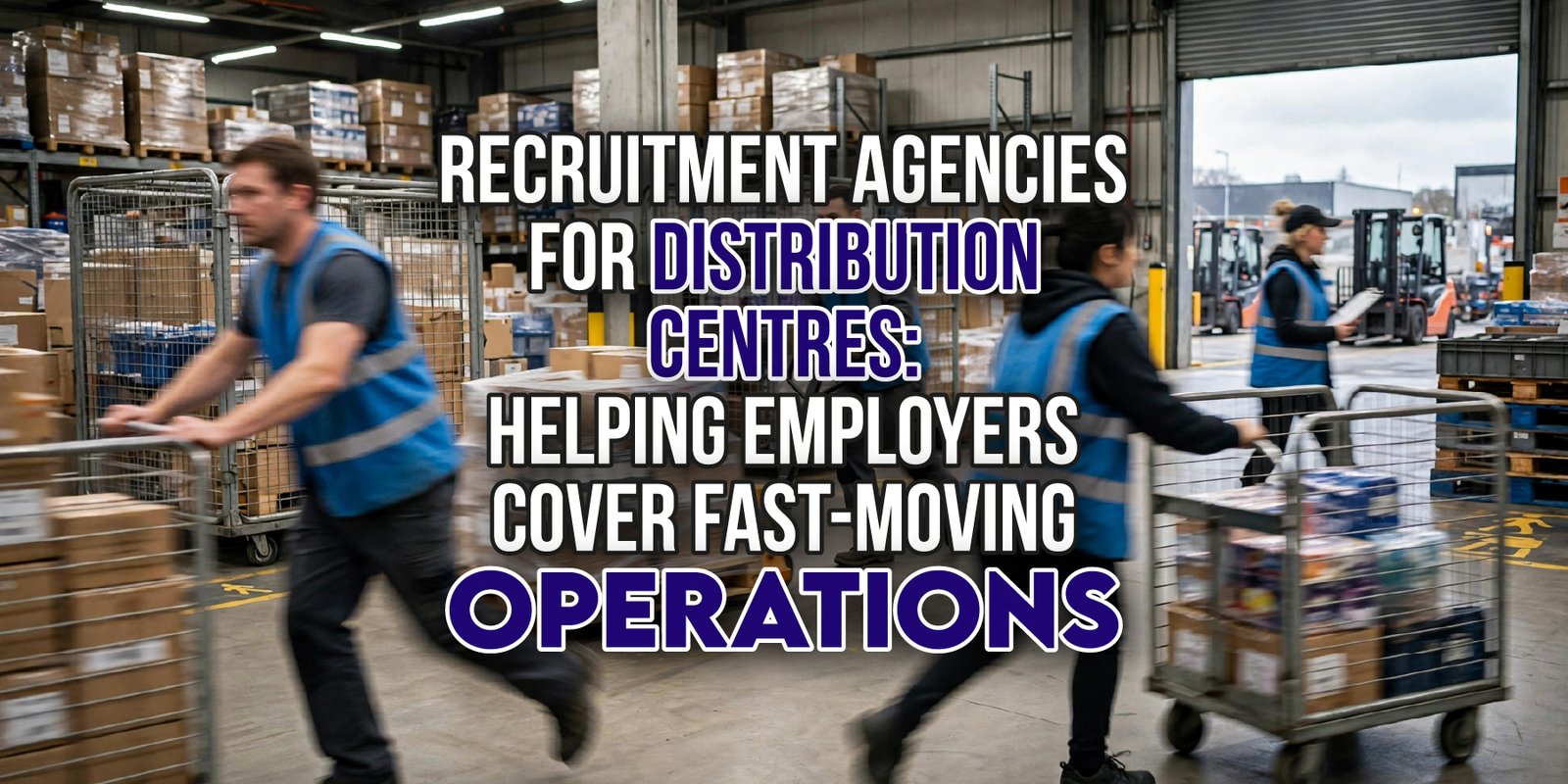
Recruitment Agencies for Distribution Centres: Helping Employers Cover Fast-Moving Operations
A delivery arrives late, the afternoon picking queue grows, and the final despatch window is approaching. Distribution centre managers must balance inbound goods, stock movement and outbound orders, often across several shifts. Recruitment agencies can help employers discuss additional workers for specific tasks, but a request for “warehouse staff” rarely explains enough about the real requirement.
Identify workload bottlenecks, skills and existing capacity before seeking temporary or permanent cover.
Quick Answer: How Can Recruitment Agencies Help Distribution Centres?
Recruitment agencies help distribution centre employers source temporary warehouse workers for goods-in, picking, packing, stock handling, dispatch and shift cover, as well as candidates for permanent positions. Employers should forecast workload, describe each role, specify shifts and workplace requirements, and allow for induction. Compare agencies on suitability, terms and communication rather than price alone.
Why Do Distribution Centres Use Recruitment Agencies?
Distribution workflows depend on several connected activities. A shortage of receiving workers can delay put-away; insufficient pickers may then affect outgoing orders. Consequently, recruitment agencies can be relevant when managers need additional labour in a particular part of the operation.
Other pressures include absence, delivery changes and seasonal demand. However, agencies cannot fix stock shortages or insufficient supervision.
What Makes Distribution Recruitment Different From General Hiring?
Distribution recruitment involves matching workers to physical processes, shift arrangements and specific site conditions. The same job title can cover quite different duties at two warehouses.
Therefore, recruitment agencies need details about goods, handling, access and essential experience, not just headcount.
Which Distribution Centre Roles Can Recruitment Agencies Support?
Different activities call for distinct worker instructions. The following roles may be discussed with recruitment agencies, subject to the provider’s services and candidate suitability.
| Operational role | Typical duties | Staffing considerations | Required checks |
|---|---|---|---|
| Goods-in operative | Receive and record incoming deliveries | Delivery times, unloading areas | Manual handling and site procedures |
| Order picker | Locate and assemble orders | Scanner systems, pick accuracy | System induction and safe access |
| Packing operative | Check, pack and label orders | Bench capacity, packaging standards | Quality and task instructions |
| Replenishment worker | Move stock to picking locations | Stock availability, movement routes | Equipment restrictions and competence |
| Dispatch assistant | Stage and prepare outgoing goods | Carrier cut-offs, loading sequence | Traffic segregation and safe handling |
| Stock-control support | Assist with counts and location checks | Inventory accuracy, system access | Approved checking procedures |
| Shift supervisor | Coordinate assigned tasks and workers | Oversight and escalation | Relevant supervisory experience |
Specialist equipment operation requires verified training, competence and site authorisation. General warehouse agency staff should never be assumed competent to drive forklifts or use powered machinery.
Warehouse Agency Staff for Goods-In Operations
Incoming deliveries may create short bursts of receiving, checking and put-away work.
Ask recruitment agencies about unloading, scanning and stock movement; establish who controls vehicles and equipment.
How Can Temporary Staffing Help With Picking and Packing Demand?
Picking and packing may peak at different times.
Temporary staffing can support additional picking, packing or labelling shifts when managers identify a genuine workload gap. However, adding pickers to a warehouse with fully occupied packing benches might simply move the queue downstream. Ask recruitment agencies for roles that address the actual bottleneck.
Logistics Recruitment for Dispatch and Stock Movement
Logistics recruitment for distribution centres often concerns goods-out preparation, replenishment, internal stock handling and loading support. These functions influence whether finished orders are ready for planned collection.
Define manual tasks and equipment restrictions. Do not assume the agency supplies licensed drivers or specialist credentials.
Temporary vs Permanent Recruitment in Distribution Centres
Recruitment agencies can discuss permanent core roles alongside temporary peak cover.
| Staffing model | Suitable requirement | Employer consideration |
|---|---|---|
| Temporary shifts | Absences or short demand increases | Assignment length and induction capacity |
| Seasonal cover | Known promotional or retail peaks | Variable headcount and shift planning |
| Permanent recruitment | Ongoing vacancies or sustained expansion | Long-term duties and supervisory continuity |
| Mixed workforce | Core roles plus fluctuating workloads | Clear task allocation and team coordination |
Permanent recruitment also matters in other shift-based industries. For a cross-sector example, see permanent staffing services in hospitality. Hospitality and distribution roles differ, so the linked service should not be treated as a warehouse recruitment specialism.
How Should Distribution Centres Plan Staffing Across Shifts?
Start with inbound deliveries, expected orders and dispatch deadlines. Then map existing employees’ productive hours by task, accounting for breaks, absence, training and supervisor availability.
When speaking to recruitment agencies, describe early, late, night and weekend requirements separately. Also consider local transport, working-time rules and how new workers will receive site instruction. A staffing request should reflect the actual hours and duties rather than an undifferentiated weekly total.
How Can Employers Estimate Additional Warehouse Labour?
Use a simple starting formula:
Additional labour hours = forecast operational labour hours − available existing labour hours.
For a hypothetical example, a distribution centre forecasts 320 productive hours of picking and packing, but its existing roster can provide 260 hours. The initial gap is 60 worker-hours. These figures illustrate the method; they are not industry productivity benchmarks.
Next, convert that gap into realistic shifts. Check equipment, workstations, induction time and the number of supervisors before requesting recruitment agencies to source additional people. Calculate goods-in and dispatch requirements separately because skills and deadlines may differ.
What Should a Distribution Centre Staffing Brief Include?
A clear written brief makes conversations with recruitment agencies more precise. Include:
- Company name, site address, access arrangements and reporting contact.
- Required roles, duties and worker numbers for each shift.
- Temporary or permanent need, start date and expected duration.
- Shift times, breaks, weekend requirements and planned variations.
- Essential experience, scanner systems and task-specific skills.
- Machinery restrictions, qualifications and authorisations where applicable.
- PPE, manual handling, relevant hazards and site induction arrangements.
- Supervision, equipment availability and escalation procedures.
- Forecast operational workload and likely changes in demand.
Employers should clarify which requirements are essential and which are preferred. Recruitment agencies can then discuss suitability against the specific assignment without promising a particular placement time.
Request Distribution Centre Staffing Support From 1st Workforce
1st Workforce supports UK employers with temporary and permanent recruitment for warehousing, distribution, logistics, picking, packing and other operational roles. You can request distribution centre staffing quotes using your completed staffing brief.
Share the location, roles, headcount, shifts and start date so the agency can review suitable options. Recruitment support does not mean 1st Workforce directly operates or supervises your distribution centre.
How Important Is Agency Location When Hiring Warehouse Staff?
Early starts, late finishes and site transport affect practical shift arrangements.
Employers comparing recruitment agencies can consider finding a recruitment agency near your distribution centre. Confirm coverage for the actual site.
What Should Employers Compare Between Recruitment Agencies?
Compare recruitment agencies using the same role brief. Review their understanding of goods-in, packing and dispatch, how they discuss candidate suitability, and the arrangements for shifts, absence reporting, induction and communication.
A written comparison is more meaningful than the lowest quoted figure. Consequently, recruitment agencies should be asked to clarify what the charge covers, who handles changes and which duties remain with the hiring business.
Distribution Centre Recruitment Agency Comparison Table
| Selection factor | What employers should ask | Why it matters |
|---|---|---|
| Distribution experience | Do you understand our tasks and workflow? | Helps define relevant roles |
| Worker suitability | How are skills and experience assessed? | Clarifies matching expectations |
| Shifts and site access | Can our working pattern be discussed? | Identifies practical constraints |
| Induction coordination | How are site risks and training needs shared? | Supports safe deployment |
| Communication | Who handles attendance queries and changes? | Establishes reporting routes |
| Commercial terms | What charges, minimums and cancellation terms apply? | Enables like-for-like comparisons |
| Recruitment model | Is this temporary supply or permanent placement? | Clarifies contracting and responsibilities |
After defining the scope, employers can discuss warehouse staffing requirements and request written terms.
What Factors Affect Distribution Centre Staffing Costs?
Costs depend on role duties, shifts, location, headcount and recruitment model.
Ask recruitment agencies about VAT, overtime, minimums and cancellations. Compare total terms.
What UK Agency Worker and Warehouse Safety Rules Matter?
Agency workers have relevant rights from the first day of an assignment, including access to shared facilities and vacancy information. Under the applicable qualifying rules, additional equal-treatment rights for basic working conditions generally arise after 12 weeks in the same role with the same hirer. This does not automatically create permanent employment.
Furthermore, HSE guidance explains that the business directing day-to-day work has significant safety responsibilities. Employers using recruitment agencies should provide risk information, appropriate induction, traffic segregation, manual handling controls and competent supervision. Verify training and authorisation before allocating forklift or other specialist machinery tasks.
Common Distribution Centre Recruitment Mistakes
- Requesting generic workers without describing goods-in or dispatch duties.
- Asking recruitment agencies for headcount without checking the true labour-hour gap.
- Overlooking packing capacity when expanding picking shifts.
- Omitting night shifts, access information or travel considerations.
- Treating temporary operatives as automatically qualified equipment users.
- Failing to prepare induction, PPE and supervisor arrangements.
- Comparing headline agency prices without written terms.
- Assuming candidate availability or shift attendance is guaranteed.
How 1st Workforce Supports Distribution and Logistics Recruitment
1st Workforce discusses temporary and permanent warehouse and logistics recruitment, while employers manage the workplace.
For distribution employers, recruitment agencies are most useful when supplied with a practical brief and realistic expectations about worker suitability and timing.
Distribution Centre Staffing Checklist for Employers
- Forecast inbound deliveries, picks, packing and dispatch separately.
- Identify workload gaps by role and shift.
- Calculate productive labour hours, allowing for absences and breaks.
- Choose temporary, permanent or mixed recruitment arrangements.
- Check workstations, equipment, induction and supervision capacity.
- Specify skills, PPE and machinery authorisation requirements.
- Confirm site address, access instructions and shift times.
- Compare agency quotations, responsibilities and cancellation terms.
- Agree reporting processes for attendance and operational changes.
Frequently Asked Questions
How do recruitment agencies help distribution centres?
Recruitment agencies help employers discuss temporary workers for inbound goods, picking, packing and dispatch, alongside permanent vacancies. The hirer should specify duties, shifts, headcount, training and location. The agency’s role depends on the agreed service; it does not automatically take responsibility for operating the warehouse or guaranteeing productivity.
Which distribution centre roles can recruitment agencies fill?
Depending on candidate suitability and the provider’s services, recruitment agencies may discuss goods-in operatives, order pickers, packing workers, replenishment assistants, dispatch personnel and relevant supervisors. Employers must identify equipment requirements, physical tasks and site procedures, and verify any specialist competence before assigning machinery work.
Can agencies supply temporary warehouse workers?
Some recruitment agencies and employment businesses provide temporary warehouse workers for defined shifts or assignments. Availability depends on the site, role, dates and other requirements. Employers should confirm who handles induction, working arrangements and supervision rather than assuming every supplier follows identical processes.
When should distribution centres use temporary staffing?
Temporary staffing can suit short-lived order surges, employee absences, seasonal peaks and additional dispatch shifts. Permanent recruitment is generally more appropriate for ongoing core roles. Managers should compare forecast labour with existing capacity and account for training before requesting extra workers through an agency.
How can warehouse managers plan extra shift cover?
Forecast work separately for receiving, picking, packing and goods-out. Subtract productive hours available from the current team, then consider breaks, absences, specialist competence and workstation limits. Share the resulting role-specific shifts with recruitment agencies; do not assume one additional worker can cover every task.
What should employers include in a recruitment brief?
Include site location, specific duties, headcount, required shifts, start date, assignment length and temporary or permanent status. Provide essential experience, equipment restrictions, PPE, access details, supervision and induction requirements. Clear information helps recruitment agencies assess suitability but cannot guarantee available workers or immediate placement.
How should businesses compare logistics recruitment agencies?
Ask recruitment agencies about relevant distribution roles, candidate assessments, shift arrangements, communication and commercial terms. Compare proposals against the same written scope and clarify VAT, exclusions and cancellation conditions. Make sure the supplier understands goods-in, picking, packing and dispatch rather than relying on generic warehouse descriptions.
What safety responsibilities apply to warehouse agency staff?
The site directing daily work retains significant health and safety responsibilities for warehouse agency staff. Appropriate inductions, warehouse traffic controls, manual handling guidance, supervision and task-specific instruction are essential. Staffing suppliers and hirers should coordinate risk information, and equipment operators must have relevant competence and authorisation.
How can employers request distribution staffing from 1st Workforce?
Prepare a brief showing your site, roles, number of workers, shift patterns, preferred start date and assignment duration. Add necessary experience, access restrictions, PPE and induction requirements. 1st Workforce can review the enquiry and discuss suitable recruitment options, subject to available candidates and agreed commercial terms.
Building a More Flexible Distribution Workforce
Effective distribution recruitment starts with clear workload forecasts, realistic labour requirements and role-specific safety preparations. Recruitment agencies can support temporary and permanent staffing discussions, but operational results still depend on the site’s processes, equipment and supervision.
Request Warehouse and Logistics Staff for Your Distribution Centre
If your operation needs goods-in, order picking, packing, stock movement or dispatch workers, send 1st Workforce your site location, roles, headcount, shifts and expected start date. Include training and induction details so the agency can assess the request.
Get a quote for warehouse and logistics staffing and discuss temporary or permanent recruitment options for your distribution centre.
Leave a Reply